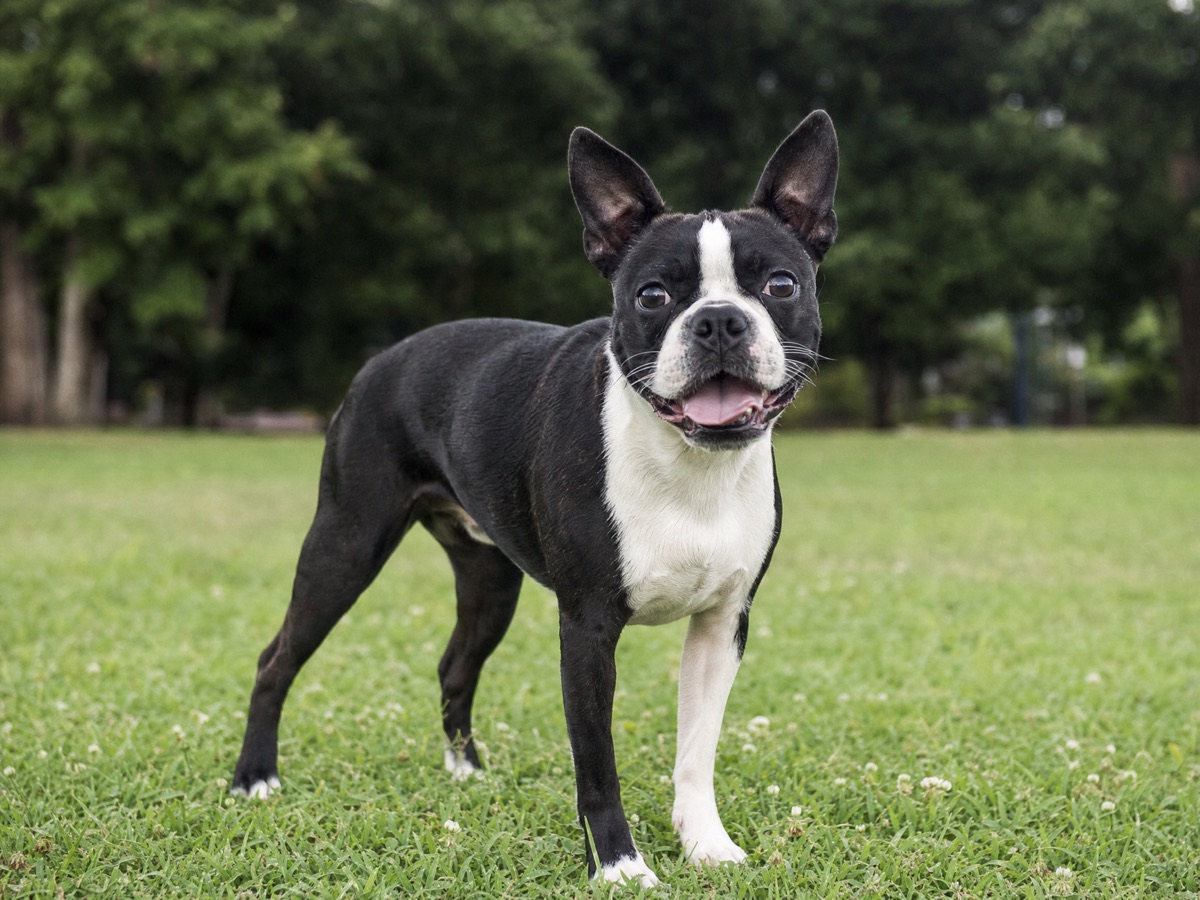
Boston Terrier
The 'American Gentleman' — a dapper, bat-eared charmer in a tuxedo coat.
On these lists: Dogs for first-time owners · Small dogs · Dogs for anxiety
Vital stats
| Size | Small · 38–43 cm |
| Weight | 5–11 kg |
| Life expectancy | 11–13 years |
| Energy | Moderate — 30–60 min/day |
| Shedding | Low, year-round |
| Coat | Short fine coat · brindle, seal or black, with white |
| Group | Non-sporting · FCI №140 / AKC |
| Origin | Boston, United States |
| FCI group | 9 — Companion and Toy Dogs · FCI 140 |
Breed traits
Friendliness
Care
Mind
The Boston Terrier by the numbers
The Boston Terrier facts owners search for most — price, lifespan, weight, shedding and colours, in one place.
Widely bred, so you can usually find a litter from a registered breeder without a long wait. Ongoing costs stay modest — it eats little and routine vet care sits at the lower end.
We don't quote a single figure: the real price swings with breeder, region, bloodline and health testing — and a rescue costs a fraction of a breeder's litter. Adopting is almost always the cheapest route.
Temperament
Created in Boston in the 1870s from bulldog and terrier stock, the Boston kept the muscle but traded the fire for charm. It's an alert, merry companion that studies faces, learns quickly and wants in on everything — equally happy performing tricks for an audience or snoring beside you on the sofa.
Habits & quirks
The head tilt
Few breeds work the quizzical tilt harder — big ears, bigger expression.
Snorts and snuffles
The short muzzle comes with a soundtrack: snoring, snuffling and the occasional reverse sneeze.
Velcro in a tuxedo
It follows you from room to room; closed doors are taken personally.
Zoomie o'clock
Long, elegant naps punctuated by sudden joyful laps of the living room.
Health
The Boston's flat face means it cools itself poorly, a set of breathing problems called BOAS, so it overheats faster than a long-nosed dog. The knees can slip (patellar luxation), and the breed's big, prominent eyes are easily scratched and prone to eye disease, including PRA. Buy from a breeder who selects for open airways and healthy eyes, keep your Boston out of the heat, and check those eyes often.
Nutrition
| Heat | The flat face makes cooling inefficient — walk early or late in summer and never leave it in a warm car. |
| Eyes | Those prominent eyes scratch easily; check them daily and see a vet promptly for squinting or redness. |
| Exercise | Thirty to sixty minutes of walks and play keeps it fit — it happily matches your pace, up or down. |
| Grooming | The fine coat needs only a weekly rub-down; nails and ears want regular checks. |
A flat-faced dog breathes harder when it's carrying extra weight, so keep a Boston lean and measure the meals rather than topping up the bowl. Count treats into the day's total and aim for ribs you can feel. It's a small dog with a small appetite to match, so it's easy to overfeed without noticing — weigh the food and watch the waistline.
Puppy guide
A Boston puppy is playful and people-focused, and it's happiest kept cool and handled gently. Mind the heat from day one, since a flat face cools badly, and get the puppy used to having its eyes and ears checked early so those checks stay easy. Keep play short and off hard jumps that jar the knees, and socialise often — a well-met Boston stays friendly for life.
Training
Bostons are bright, friendly and keen to please, which makes them a pleasure to train in short, upbeat, reward-based sessions. Start early, keep it light and food-motivated, and don't work the dog hard in the heat. They read the household well and adapt to its pace, so consistent, gentle house rules from the start give you the easy companion the breed is known for.
Known health issues
No breed is problem-free. These are the conditions most worth knowing about for this breed — with what a good breeder screens for and what an owner watches. General guidance, not a substitute for your vet.
Breathing trouble (BOAS)
Flat-faced breeds are prone to obstructed airways — the full story is here. Good breeders screen: Airway-graded parents (RFG 0–3); open nostrils. Watch for: Snoring, easy tiring, and overheating in warm weather.
Slipping kneecap
A kneecap that slips out of place, common in small breeds and usually manageable. Good breeders screen: Vet-checked knees on the parents. Watch for: An occasional skip or hop on a back leg.
Inherited eye disease
Progressive retinal atrophy and cataracts run in several breeds and can dim or take sight over time. Good breeders screen: Eye-tested parents and, where available, a DNA test for PRA. Watch for: Night-time bumping, cloudy eyes, or hesitation in dim light.
Worried about a symptom right now? Flat faces, hard breathing: the truth about brachycephalic dogs
Life expectancy
Boston Terriers live 11–13 years. Boston Terriers are fairly long-lived little dogs, and steady care keeps them at the better end. Keep the dog lean and out of the heat, stay on top of the eyes, and buy from a breeder who selects for open airways — the flat-faced problems are the ones most likely to shorten a Boston's life, and the ones you can most head off.
Popular Boston mixes
Boglen Terrier
A lively, friendly, scent-driven cross with a stubborn streak and a good appetite. Fun and affectionate; keep it lean and give it plenty of walks.
Frenchton
A playful, affectionate companion cross — but two flat-faced parents mean breathing and heat need real care. Buy from lines selected for open airways.
Bugg
A small, comical, people-loving cross. Both parents are flat-faced, so it overheats easily and needs its weight and breathing watched.
Boston Boxer
A muscular, playful, energetic mix with more drive than a Boston. It needs real exercise and early training, and can still feel the heat.
Bostonian
A clever, often lower-shedding cross with a curly coat and a friendly streak. Coat and size vary from pup to pup; bright and easy to train.
Similar breeds
Breeds with a similar build and background — worth a look if this one isn't quite the fit.
Compare this breed
Breeds that look like this
Common questions
Are Boston Terriers good for first-time owners?
Yes — they're friendly, adaptable, moderate-energy and eager to please, making them one of the easier small breeds for new owners and flats.
Do Boston Terriers have health problems?
The flat face can cause breathing issues and heat sensitivity, and the prominent eyes are injury-prone. Buy from breeders selecting for open airways.
Do Boston Terriers shed?
Very little — the fine coat drops only light hair year-round. A weekly once-over with a grooming mitt handles it.
Is the Boston Terrier hypoallergenic?
No dog is truly hypoallergenic, but the Boston Terrier comes closer than most: its low-shedding coat releases less of the dander that triggers allergies. Many allergy sufferers manage well with this breed, but spend time around one before committing.
Is the Boston Terrier good with children?
Generally yes. The Boston Terrier is a friendly, people-loving breed that usually does well with children when raised and socialised well. As with any dog, teach children to be gentle and supervise around toddlers.
Is the Boston Terrier easy to train?
Reasonably. The Boston Terrier is trainable with consistency and rewards, though it isn't the quickest study. Keep sessions short and positive, and be patient with the basics like recall.