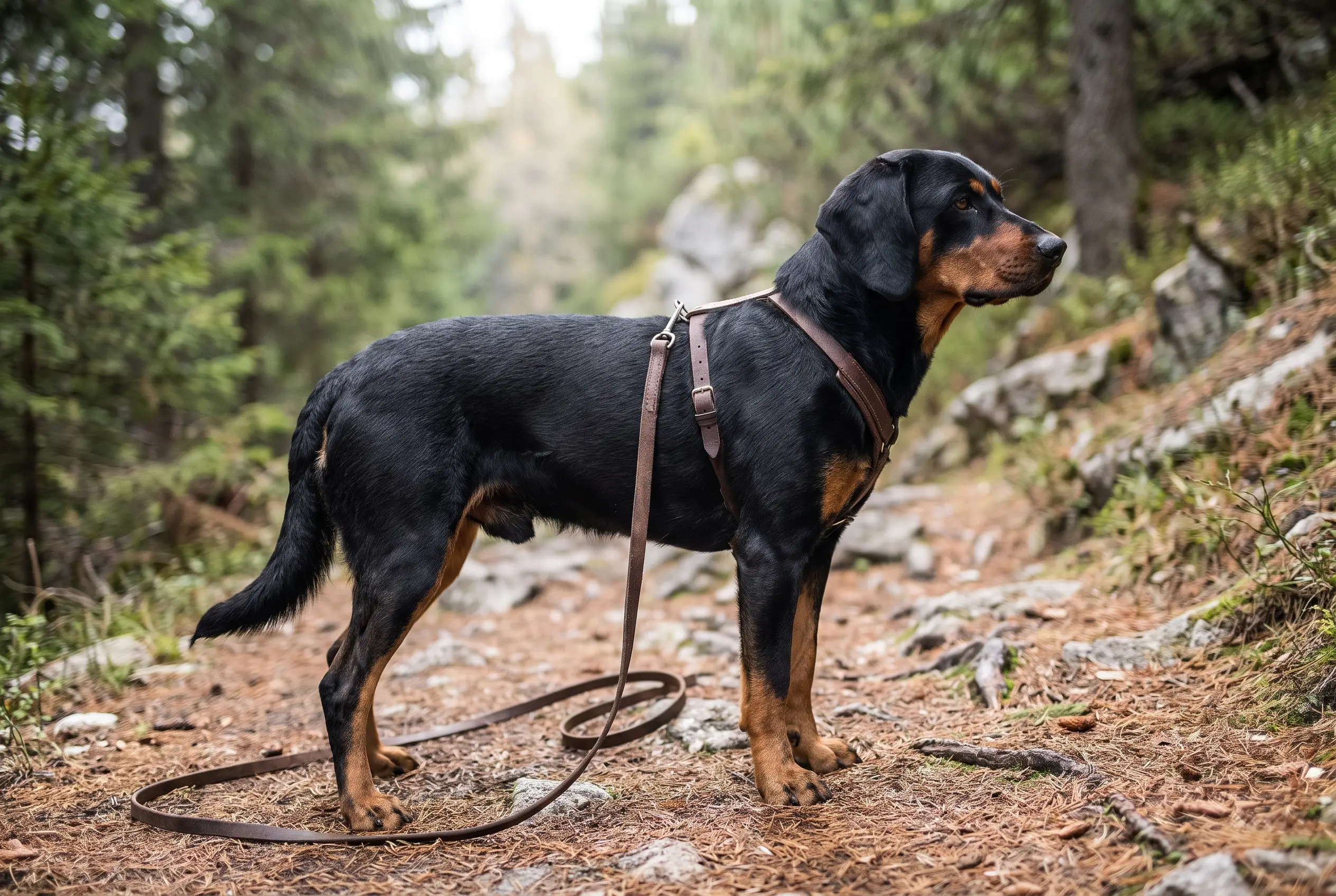
Tatranský Durič
Slovakia's newest hound, bred down from Kopov runts to trail wounded game on a leash rather than run it down in the open.
Vital stats
| Size | Small · 38–42 cm (dogs), 36–40 cm (bitches) |
| Weight | 10–15 kg — breed literature; the standard sets no weight |
| Life expectancy | Not established — the breed is too new for any published figure; comparably sized hounds typically run 12–14 years |
| Energy | High — a working leash hound bred for hours of methodical scent tracking |
| Shedding | Low to moderate — short coarse coat; not detailed in the standard |
| Coat | Short, coarse, close-fitting · black and tan, or solid red running light tan to deer red |
| Group | Hound · Leash (Scent) Hound (FCI №377, Group 6) |
| Origin | Slovakia |
| FCI group | 6 — Scent hounds and related breeds · FCI 377 |
Breed traits
Friendliness
Care
Mind
The Tatranský Durič by the numbers
The Tatranský Durič facts owners search for most — price, lifespan, weight, shedding and colours, in one place.
Less common, so expect a waitlist and some travel to a reputable breeder — which pushes the price up. Plan for steady ongoing costs — mid-range food, routine vet care and insurance.
We don't quote a single figure: the real price swings with breeder, region, bloodline and health testing — and a rescue costs a fraction of a breeder's litter. Adopting is almost always the cheapest route.
Temperament
The standard's behaviour clause reads almost like an answer to the Kopov's: "Intelligent, full of temperament, easy to handle. Balanced in character, no signs of aggressiveness or fear of his surroundings. Friendly with people." Where the Kopov's own clause says nothing about strangers or family life, the durič's spells it out twice — because easy handling and friendliness toward people were the actual goals of the breeding programme, aimed at hunters working small, often fenced grounds rather than open forest. The standard still wants a working hound underneath the manners: "despite his friendly character, he is eager to work and brave in contact with game," with "a great sense of smell and orientation in the field." What's missing, next to the Kopov's clause, is any mention of giving tongue. That's not an omission — a leash hound tracks a wounded animal to where it fell, working close to its handler and largely quiet, rather than baying across the countryside to say which way the chase is running.
Habits & quirks
Bred from the breed it's leaving behind
The standard's own history section is candid about where the founding stock came from: puppies too small or the wrong colour for the Slovenský kopov standard, crossed with other hunting breeds to sharpen scent work. The breed club's own literature adds that the Kopov's genetic contribution is meant to stay dominant even after those outcrosses — a breeding-programme goal, not a line in the FCI standard.
Two coats, no ranking
Black-and-tan or solid red are both fully standard, with no preference stated between them. In the red variety, the standard tolerates "some mixture of black" and even a black mask on the face; in the black-and-tan variety, a strip of tan is expected exactly where the white and black coat meet on the legs — the standard calls it a heritage mark from the old-type hounds behind the breed.
Provisional means still on trial
The FCI's own nomenclature listing is explicit: "Recognized on a provisional basis," dated 11 February 2026. Provisional status is a working period, not a formality — it's the FCI watching whether the breed holds a stable type and population before any move toward definitive recognition, and there's no fixed date by which that happens.
Named for a mountain range, not yet found beyond it
Nearly every dog and every breeder associated with the Tatranský durič is Slovak, and the breed club that runs its studbook is based in Michalovce, in eastern Slovakia — a long way from the High Tatras the name points to, and a reminder that breed names travel further than the dogs usually do.
Care
| Exercise | A small dog with a real hunting job: daily scent work, tracking games, or long walks with something to follow suit it better than a short lead-walk loop. It's built for a methodical trot over ground, not for sprinting. |
| Grooming | The short, coarse, close-fitting coat needs only a weekly brush — there's no heavy undercoat to plan a shedding season around, at least none the standard describes. |
| Training | The standard's own word for it is "easy to handle," and breed-club literature backs that up with a temperament chosen specifically to suit less experienced or first-time hunting-dog owners. That doesn't remove the nose from the equation — start scent games and recall early, the way you would with any hound. |
| Health | The breed club describes it as robust and free of significant hereditary problems, but that claim comes from the club, not from any independent survey, and the breed is barely old enough to have one. With a founding population this recent and this small, ask any breeder directly about the outcross lines behind a litter and how they're managing inbreeding. |
Life expectancy
This breed has a typical life expectancy of Not established — the breed is too new for any published figure; comparably sized hounds typically run 12–14 years.
Similar breeds
Breeds with a similar build and background — worth a look if this one isn't quite the fit.
Breeds that look like this
Common questions
Is the Tatranský durič actually recognised by the FCI?
Yes, but only provisionally, and only since 11 February 2026 — a matter of months before this was written. Provisional recognition is a real status, not a rumour, but it sits a step below the definitive recognition older FCI breeds hold, and it comes with an open-ended trial period. The Slovak Kennel Club recognised the breed nationally back in 2016; the FCI took until 2026 to follow. If you're told this breed has been internationally recognised for years, that's not accurate yet.
How is it different from the Slovenský Kopov?
Size, colour options and job all differ. The durič is the smaller of the two at 36–42 cm against the Kopov's 40–50 cm, comes in black-and-tan or solid red where the Kopov is always black-and-tan, and the FCI classifies it as a leash hound worked on lead to track wounded game to the kill — the Kopov (FCI №244) is a free-running scenthound that trails and bays over open, often mountainous ground. The durič was bred from undersized Kopov stock in the first place, so the resemblance is real; it's a deliberately smaller, quieter, more biddable version built for a different kind of hunting ground.
Can I get a Tatranský durič outside Slovakia?
Realistically, no, not yet. This is a breed that only reached FCI provisional status in 2026, its studbook is run by a single Slovak club, and the population is tiny even inside the country it was bred in. Anyone outside Slovakia looking for one today is looking for a breed that, for practical purposes, doesn't yet exist outside its home country.
Does the Tatranský Durič shed a lot?
Moderately. The Tatranský Durič sheds a fair amount, steadily through the year with heavier seasonal patches. A weekly brush keeps most of the loose hair off your floors and clothes.
Is the Tatranský Durič hypoallergenic?
Not really. No dog is truly hypoallergenic, and the Tatranský Durič's shedding coat releases plenty of the dander that sets off allergies. If someone at home is allergic, this isn't the easiest breed to live with — spend time around one first.
Is the Tatranský Durič good with children?
Generally yes. The Tatranský Durič is a friendly, people-loving breed that usually does well with children when raised and socialised well. As with any dog, teach children to be gentle and supervise around toddlers.
Is the Tatranský Durič easy to train?
Reasonably. The Tatranský Durič is trainable with consistency and rewards, though it isn't the quickest study. Keep sessions short and positive, and be patient with the basics like recall.