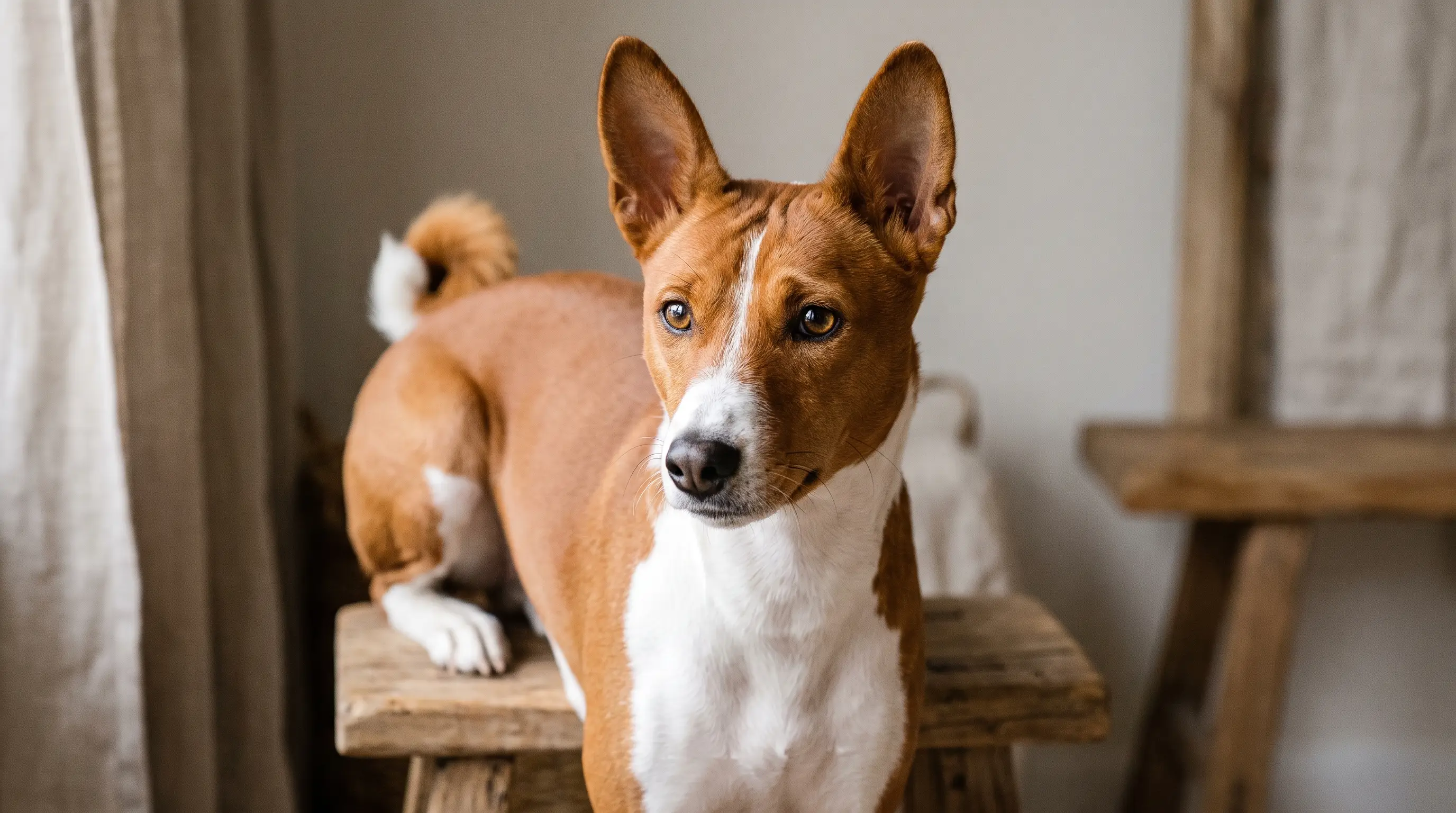
Basenji
The barkless hunter of the Congo — cat-clean, fox-quick, entirely its own dog.
On these lists: Dogs for hot weather
Vital stats
| Size | Small · 40–43 cm |
| Weight | 9–11 kg |
| Life expectancy | 13–14 years |
| Energy | Moderate-high — 60 min/day |
| Shedding | Low |
| Coat | Short, fine · red, black, tricolour, brindle — all with white |
| Group | Hound · FCI №43 / AKC |
| Origin | Central Africa, DR Congo |
| FCI group | 5 — Spitz and primitive types · FCI 43 |
Breed traits
Friendliness
Care
Mind
The Basenji by the numbers
The Basenji facts owners search for most — price, lifespan, weight, shedding and colours, in one place.
Widely bred, so you can usually find a litter from a registered breeder without a long wait. Ongoing costs stay modest — it eats little and routine vet care sits at the lower end.
We don't quote a single figure: the real price swings with breeder, region, bloodline and health testing — and a rescue costs a fraction of a breeder's litter. Adopting is almost always the cheapest route.
Temperament
For thousands of years the Basenji flushed game into nets for Central African hunters, working far ahead of humans and thinking for itself. That wiring survives intact: this is a clever, watchful, self-possessed dog that solves problems — including the problem of your fence — and offers affection on its own terms.
Habits & quirks
The yodel
Its flat larynx can't produce a bark — happiness arrives as a rolling 'barroo' instead.
Cat-wash
It grooms itself fastidiously with its tongue, which is why Basenjis barely smell of dog.
Rain refusal
A desert-adjacent heritage shows: many Basenjis flatly decline to go out in wet weather.
The vertical survey
Expect it up on hind legs — or the sofa back — scanning the horizon like a little sentry.
Health
The Basenji is a small, hardy primitive breed with two health matters worth raising with any breeder: Fanconi syndrome, a kidney condition the breed is known for, and progressive retinal atrophy (PRA), an inherited eye disease. Both can be screened for, and buying from lines that test has genuinely transformed the breed's outlook — so ask to see the results. Beyond that it is refreshingly low-maintenance: it grooms itself like a cat, carries a short, fine coat, and barely smells of dog, so the health work is mostly choosing well at the start.
Nutrition
| Exercise | An hour a day of walks and sprints in safe, enclosed spaces — a bored Basenji redecorates. |
| Containment | Fences must be tall, dig-proof and climb-proof; this breed treats escape as a hobby. |
| Training | Short, rewarding sessions work; repetition and raised voices simply switch it off. |
| Health | Ask breeders for Fanconi syndrome and PRA test results — screened lines have transformed the breed's outlook. |
A Basenji is a small, athletic dog that stays trim on modest meals, so measure the food and keep it lean — a light Basenji moves and jumps the way the breed is meant to. Feed good, measured portions rather than leaving food down, and treat with an eye on the total, since a small dog reaches its limit on very little. There is no special trick here beyond honest weight management; the Basenji's clean, near-odourless self-care does the rest.
Puppy guide
A Basenji puppy is bright, busy and already working out how the world comes apart, so channel that early. Socialise him widely while he is young, since the breed is naturally reserved with strangers, and make the fences tall, dig-proof and climb-proof before he teaches himself to escape — this is a breed that treats a boundary as a puzzle. Start short, rewarding training from day one, keep recall realistic against that strong prey drive, and give him proper daily exercise, because a bored Basenji redecorates.
Training
The Basenji hunted far ahead of its people for thousands of years, thinking for itself, and it trains exactly like a dog that still does. Short, rewarding sessions work; repetition and a raised voice just switch it off. It will negotiate everything, so pick the battles that matter — recall and a solid boundary — and make cooperating clearly worth its while. Keep expectations honest about the prey drive: a Basenji in pursuit has stopped listening, which is why the fence, not the command, is what keeps it safe.
Life expectancy
Basenjis live 13–14 years. Basenjis are long-lived little dogs, and the surest lever on those years is at the very start: buy from a breeder who screens for Fanconi syndrome and PRA, because healthy lines make all the difference. After that it is simple — keep him lean, give him the daily exercise and secure space an active hound needs, and let his cat-like self-care handle the grooming. Choose well and a Basenji stays busy, clean and full of opinions deep into old age.
Similar breeds
Breeds with a similar build and background — worth a look if this one isn't quite the fit.
Breeds that look like this
Common questions
Do Basenjis really never bark?
Correct — the shape of the larynx makes a true bark near-impossible. They yodel, chortle and, when properly outraged, scream instead.
Are Basenjis good for first-time owners?
Usually not. They're clean, quiet and small, but their independence and escape skills frustrate owners expecting a biddable companion.
Do Basenjis smell?
Barely at all. They self-groom like cats and have a short, fine coat — one of the least doggy-smelling breeds there is.
Does the Basenji shed a lot?
Not much. The Basenji is a low-shedding breed, so loose hair around the home stays minimal. It still needs regular grooming, but you won't be fighting drifts of fur.
Is the Basenji hypoallergenic?
No dog is truly hypoallergenic, but the Basenji comes closer than most: its low-shedding coat releases less of the dander that triggers allergies. Many allergy sufferers manage well with this breed, but spend time around one before committing.
Is the Basenji good with children?
They can be. The Basenji is reasonably sociable and can be good with children in the right home, especially when socialised early. Supervise around young kids and teach dog and child to respect each other.
Is the Basenji easy to train?
They can be a challenge. The Basenji is intelligent but independent, and would rather make its own decisions than take orders. Reward-based training and patience work best; expect recall in particular to take time.
Stories featuring this breed
All stories →
How we know: reading the ancient DNA of dogs and cats
The story of pet origins was rewritten in the last fifteen years — not by new bones, but by pulling readable DNA out of old ones. Here is how that actually works.
How to stop a dog barking too much
Barking is communication, not defiance, and the fix depends entirely on which of four reasons is driving it. The reward-based method for each, and why shouting or a bark collar usually makes it worse.
Low-shedding dog breeds, ranked from our own data
We scored every breed for shedding, 1 to 5. Here are the ones that scored lowest — the curly coats worth the grooming bill, the genuinely low-maintenance short-hairs, and why none of them are hypoallergenic.