Are my cats playing or fighting? The five reads
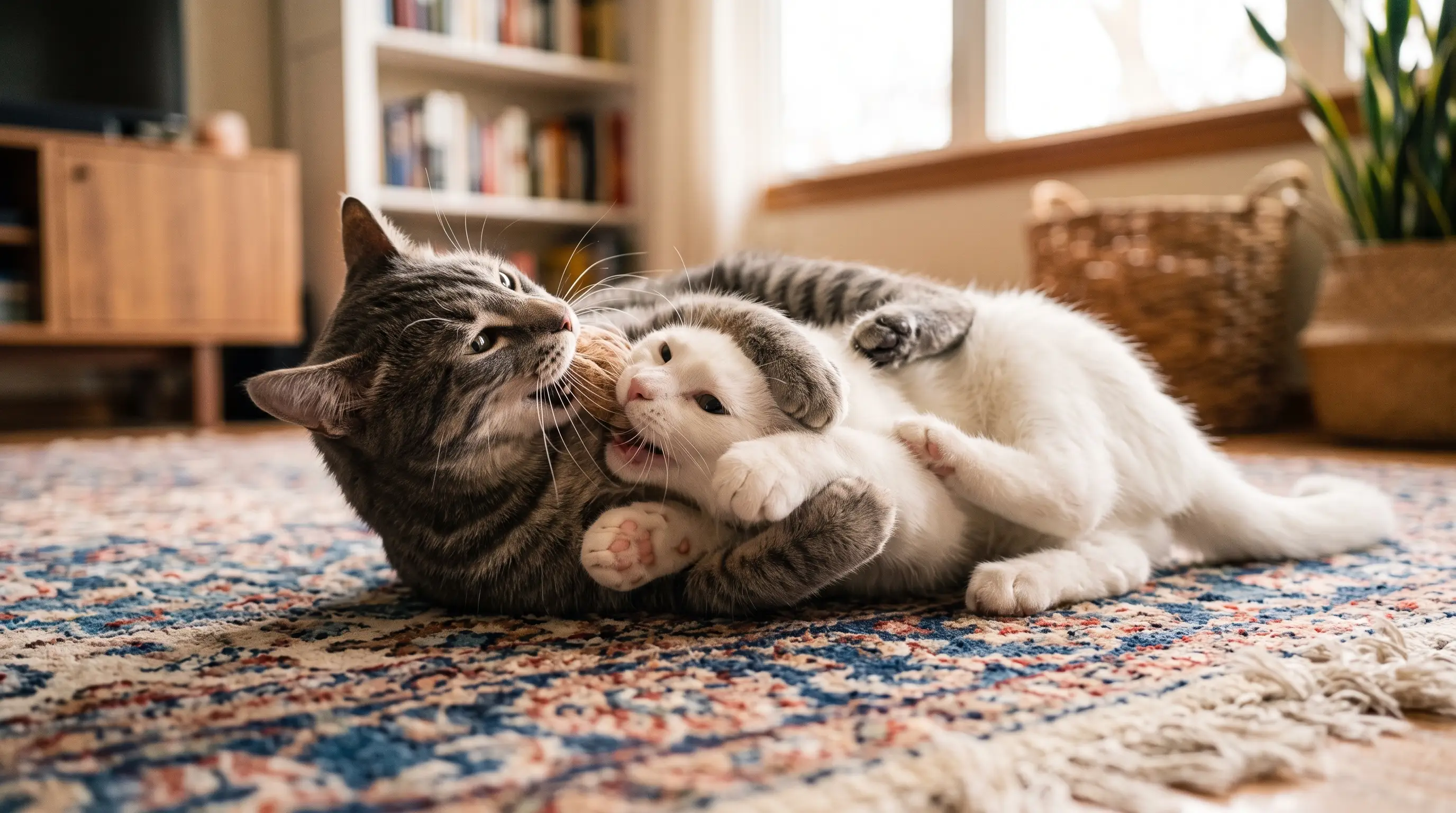
Two cats locked together, rolling across the floor, one biting the other's neck while the hind legs pummel like a drum roll: it looks like a fight to the death and is, most of the time, a perfectly friendly Tuesday. Cat play is built out of hunting and fighting moves, run with the safety on — which is why it fools owners constantly. The good news is that cats themselves are never confused, and they show the difference in five readable places. Learn the five, and you'll know within seconds whether to reach for popcorn or a cushion.
Why play looks so violent
Play in young mammals is rehearsal, and what cats rehearse is their profession: stalking, ambushing, grappling, killing. Kitten play-fighting is where bite inhibition is learned — each kitten calibrating how hard is too hard against a sibling who squeals and quits when the line is crossed. Adult cats that live together keep a version of it running for life: the wrestling bout, the corridor chase, the ambush from behind the sofa. Every move in the repertoire is borrowed from combat; what makes it play is the volume knob.
Even the alarming bits are standard equipment. The neck bite is a hunting hold, run gently. The bunny kick — clutching with the front legs while the hind legs rake — is the disembowelling move of a real cat fight, and in play it lands with claws in and pads out. Which is exactly why the moves themselves tell you nothing. The information is in how they're exchanged.
The five reads
One: reciprocity. Play swaps roles — the chaser becomes the chased, the cat on top ends up on the bottom, in cycles of seconds to minutes. A fight has a fixed direction: one cat always pressing, one always retreating. Two: claws and teeth. Play runs sheathed and inhibited — you'll see mouthing, not punctures, batting with soft paws. Extended claws, gripped bites and tufts of fur on the carpet are the real thing. Three: the soundtrack. Play is close to silent — some thumping, the odd squeak. Growling, yowling, hissing and that low rising moan are fight audio; screaming means it's already serious. Four: the bodies. Playing cats stay loose, ears mostly forward, fur flat, taking breaks mid-bout to sit and look elsewhere. Fighting cats are rigid, ears pinned, fur up, tails lashing, and nobody pauses. Five: the after. Play ends and the cats stay in the same room, groom, or nap within metres of each other. A fight ends in distance — one cat gone, hiding, watching doorways.
No single read settles it; the cluster does. Silent, role-swapping, pause-punctuated wrestling is play regardless of how it looks. One-directional pressure with sound effects is trouble regardless of how little contact there's been. The pauses are the most underrated tell — real fights don't have intermissions.
When play curdles
The two states aren't sealed off from each other. Play escalates: one cat crosses the other's threshold — too hard, too long, wrong spot, exactly the arithmetic from the mid-stroke bite — and the tone flips mid-bout. Watch for the hinge moments: a squeal followed by continued pressing instead of a break; one cat trying to leave while the other blocks; the soundtrack switching on. Mismatched pairs curdle most often — a two-year-old in full spate against a senior with arthritis, or a big adolescent against a small newcomer, is a game only one of them signed up for.
Chronic one-sided "play" is bullying with a family-friendly name, and its costs show up off-stage: the pressed cat starts eating at odd hours, using the tray furtively, living on top of the wardrobe. Those are the withdrawal patterns from the stress signs owners miss, and they mean the household needs restructuring — separate resources, more territory in parallel — not just refereeing. If the pair never learned each other in the first place, the staged protocol in introducing cats works as a reset, not just a first meeting.
Breaking it up without joining it
When it is a fight, the one rule is: never reach in. A cat in full arousal doesn't recognise your hand as furniture — the redirected bite that follows is one of the worst a household cat ever delivers, deep and infected-by-Thursday. Interrupt from a distance instead: a sharp clap, a cushion dropped between them, a blanket over one combatant, a door closed as one cat passes through. Then leave them separated until both have visibly deflated — fur down, pupils normal, eating — which can take hours, not minutes. Reintroducing two still-charged cats restarts the fight on sight.
Prevention is cheaper than refereeing. Most household fights are resource maths: one food station, one tray, one sunny windowsill and two cats is a queue, and queues breed ambushes. Run everything in parallel — bowls, trays, beds, perches, one per cat plus one spare, spread apart. Burn the surplus energy that funds rough play with the daily hunt-and-catch sessions from the zoomies guide, run separately for each cat if one monopolises the toy. And if the fights are new, sudden and out of character in a previously peaceful pair, book the vet before the behaviourist: pain is the classic hidden cause of a cat that has stopped tolerating its housemate.
Common questions
How can I tell if my cats are playing or fighting?
Check five things: reciprocity (play swaps chaser and chased; fights run one direction), claws and teeth (play is sheathed and inhibited), sound (play is nearly silent; growling, hissing and yowling mean trouble), body language (loose, ears forward, with pauses = play; rigid, ears pinned, fur up, no breaks = fight), and the aftermath (playmates stay near each other; fighters separate and hide). The cluster decides, not any single sign.
Why do cats bite each other's necks?
The neck bite is a hunting and mating hold that also appears, gently, in play-wrestling — one cat mouths the other's neck without gripping. With soft bodies, no vocalisation and role swaps around it, it's part of the game. Paired with pinned ears, growling and a rigid pinned-down victim, it's dominance or a real fight.
Why do cats bunny kick each other?
The bunny kick — gripping with the front legs while the hind legs rake — is a combat move from real cat fights, borrowed into play with the claws sheathed. In play it's brief and swapped between partners. Directed hard at one cat that's trying to escape, with claws out and fight audio, it's the real version.
When should I break up cats fighting?
When the fight signs cluster: one-directional pressure, screaming or sustained growling, claws out, fur flying, a cat trying to flee and being blocked. Interrupt from a distance — a clap, a cushion between them, a blanket, a closed door. Never reach in with your hands; redirected bites from a fully aroused cat are serious injuries.
Why is one of my cats suddenly attacking the other?
Sudden fighting in a previously peaceful pair has three usual causes: pain or illness in either cat (see a vet first), redirected arousal (something outside — often a strange cat through the window — discharged at the housemate), or a scent disruption such as one cat returning from the vet smelling wrong. Address the cause; a short separation-and-reintroduction often resets the relationship.
Do cats play fight with humans too?
Yes — especially cats that missed littermate play as kittens. Ankle ambushes and hand-wrestling are play-hunting aimed at you, and the fix is redirection, not punishment: hands are never toys, wand toys are, and a daily hunt-catch-eat session drains the energy that funds the ambushes.
More in Cats
Why does my cat meow at night? And how to make it stop
Night calling is a solvable problem with a short list of causes: a crepuscular body clock, a lesson you accidentally taught, an unneutered announcement, or — in older cats — a medical flag that comes first.
Why is my cat spraying? What it means and how to stop it
Spraying isn't a litter-box failure — it's a message about territory, written in urine. How to tell it from peeing, what's behind it, and the fixes that hold.
Why is my cat aggressive? Causes and how to calm it
Cat aggression isn't a personality — it's a diagnosis with about six usual suspects, and each one has a different fix. Work through them in order and the biting usually explains itself.
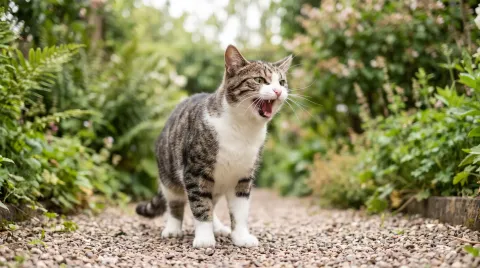
Why do cats hiss? What it means and what to do
A hiss is not an attack — it's the thing a cat does to avoid one. What the sound actually is, what triggers it, and why the polite answer is always to back off.
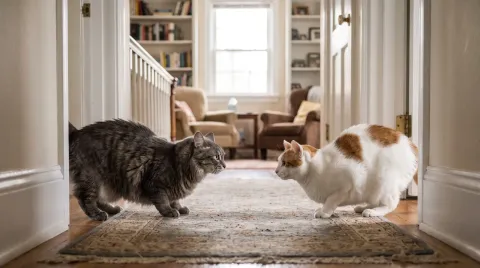
Why are my cats fighting? How to restore the peace
Two cats that shared a bed for years can turn into enemies in an afternoon. What breaks a feline relationship, why 'letting them fight it out' entrenches the war, and the reset that works.
How neutering changes cat behavior — and what it won't fix
Neutering deletes the hormone-driven behaviours — the roaming, the spraying, the 3am opera — and touches almost nothing else. What changes, what doesn't, and when.