Why do cats hiss? What it means and what to do
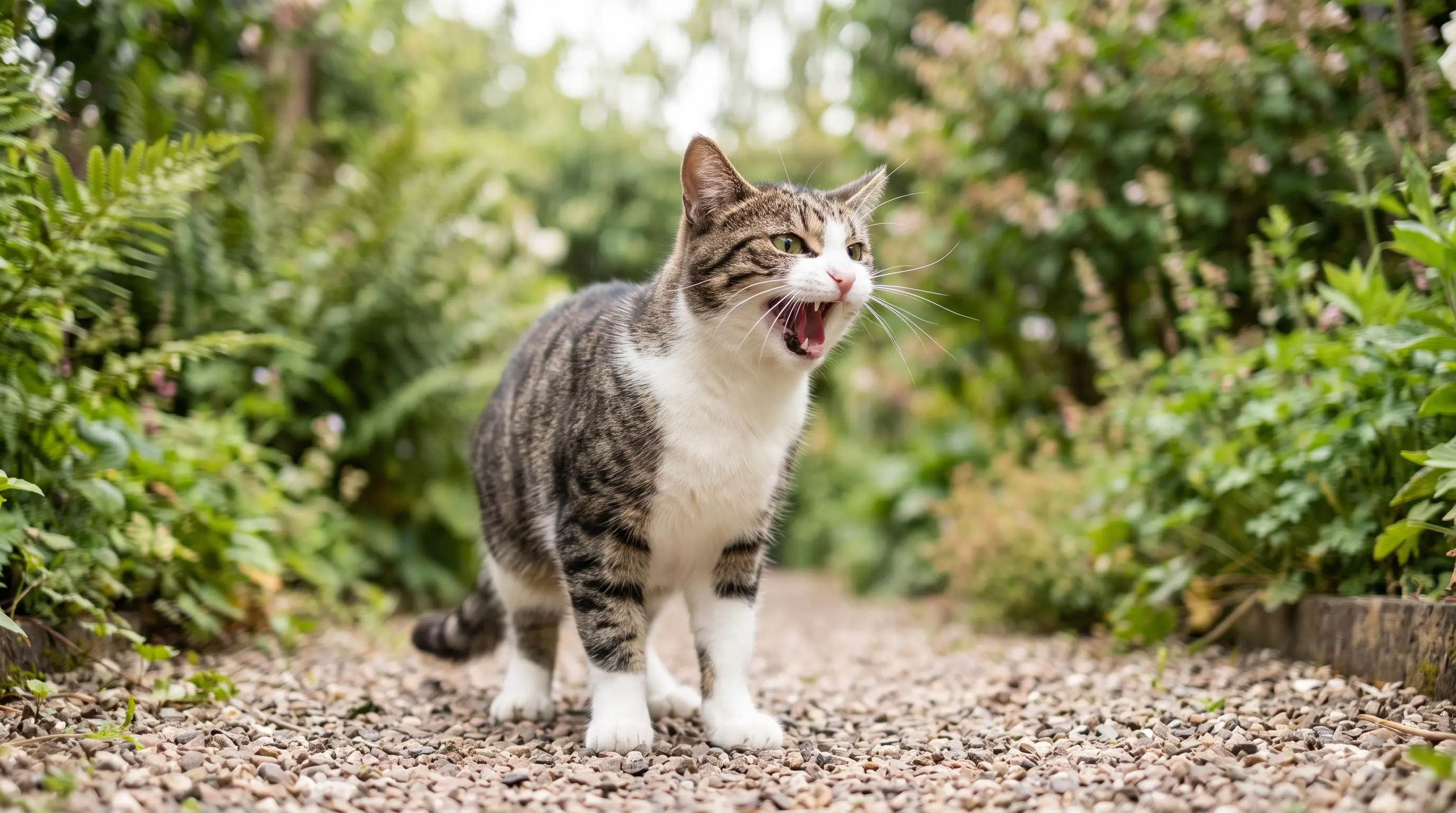
A hiss is a cat's clearest sentence, and it says one thing: stop, and give me space. It is a warning built specifically to prevent a fight, not to start one — which means a hissing cat is, in its own way, being polite. Read it right and most hissing resolves itself; read it as naughtiness or a challenge and you teach your cat that warnings don't work, which is how cats learn to skip the warning.
What a hiss actually is
Mechanically, a hiss is a burst of air forced through an arched tongue with the mouth held open, and the rest of the display comes as a package: ears flattened, whiskers forward, back sometimes arched, often a paw ready. Unlike a meow, it isn't a sound cats learned for our benefit — cats hiss at each other, and kittens can produce a creditable hiss within their first weeks of life, before they can do much else. One long-standing hypothesis holds that the display mimics a snake, borrowing the alarm that sound triggers in other animals; it's unproven, but the resemblance is doing real work either way, because practically every species that hears a hiss understands it. As feline signals go it is short-range, honest and cheap: the cat is advertising that it will defend itself precisely so that it won't have to.
What cats hiss at
The triggers all reduce to one calculation — something is too close, too fast, or too unknown. Fear and startle top the list: a stranger reaching down, a dog's nose, a vacuum rounding the corner. Pain is next, and easy to miss: a cat that hisses when touched, lifted, or approached near one part of its body is guarding something that hurts. Mothers hiss for their kittens, cats hiss over contested resources, and nearly every cat hisses at an unfamiliar cat on its territory. The strangest common case is the housemate who comes home from the vet smelling of clinic and gets hissed at like a burglar — scent is identity to a cat, and a wrong-smelling friend briefly isn't one. And some cats hiss during play that tipped over the line, which is a useful signal too: the game got too real, as our guide to cat body language helps you spot before the soundtrack starts.
What to do when your cat hisses at you
Believe it, immediately. Stop what you were doing, back away, and let the cat keep its exit — the hiss asked for distance, and giving it is how the encounter de-escalates. Don't punish it in any form, and don't hiss back, however popular the internet finds the idea: both answer a request for space with a threat, which raises the temperature the hiss was trying to lower. A cat whose warnings reliably work becomes a cat that can afford to warn; a cat whose warnings are ignored or punished learns to go straight to teeth. That's the practical reason the hiss deserves respect, quite apart from the courtesy of it. Once the moment has passed, work out what triggered it and change that — the fix lives with the trigger, never with the sound.
When hissing means a vet visit
A cat that starts hissing more than its own normal has changed, and cats don't change without reasons. When the hissing clusters around touch — being picked up, brushed, stroked over the hips or near the mouth — pain leads the differential: arthritis and dental disease are both common, both underdiagnosed, and both exactly the kind of problem a cat hides until handling forces the issue. A senior that newly hisses at housemates or people may also be losing sight or hearing and getting startled at closer range. Sudden, generalised irritability belongs at the vet's before any behavioural read; the full decision tree is in why is my cat aggressive, and the rule from that guide holds here: you can't train away a hiss that hurts.
Hissing between your own cats
Between resident cats, dose and direction matter more than the sound itself. During a new introduction, hissing is expected traffic — it's the residents setting terms, and the staged process in introducing cats is designed to keep it at the grumbling level while scent does the real negotiating. After a vet visit, give the returning cat a few hours apart and swap bedding between them so everyone smells like the household again before they share a room. And watch the trend line: occasional hissing over a sunbeam is feline small talk, but hissing that escalates week on week, pairs with staring, blocking and ambushes, or replaces contact entirely means the relationship needs the full reset — separation and a from-scratch reintroduction. If you're not sure how serious the scuffles are, playing or fighting gives you the tells.
Common questions
Why does my cat hiss at me?
Because something you did — usually approaching too fast, touching a sore or off-limits spot, or cornering it — made it want distance, and the hiss is its way of asking for that without a fight. It's a warning, not an attack: stop, back off, and look for what triggered it.
Why does my cat hiss at me for no reason?
There's always a reason; it's just not always visible. The usual hidden ones are pain that handling disturbed, a startle you didn't register, redirected arousal from something like a cat outside the window, or a smell on you the cat didn't recognise. If unexplained hissing becomes a pattern, a vet check comes before any other theory.
Should I hiss back at my cat?
No. Hissing back answers a request for space with a threat — at best your cat reads it as noise, at worst as escalation from the person it wanted distance from. It doesn't teach anything except that warnings don't work on you. Back away and give space instead; that's the reply the hiss was asking for.
Why is my cat hissing at my other cat all of a sudden?
The classic cause is scent: a cat back from the vet smells wrong, and its housemate briefly treats it as a stranger — a few hours apart and swapped bedding usually fix it. Otherwise look for redirected arousal from an outside cat, or a territory renegotiation as one cat hits social maturity. If it escalates rather than fades, separate and reintroduce in stages.
Do cats hiss when they are in pain?
Yes, and it's one of the most missed pain signs in cats. A cat that hisses when touched, lifted or approached near one region of its body is often guarding something that hurts — arthritis and dental disease are the common culprits. New hissing tied to handling earns a vet visit, not a behaviour plan.
How do I get my cat to stop hissing?
By removing what it's hissing at, not by addressing the sound. Identify the trigger — pain, fear, a cornered position, a new animal, a wrong smell — and change that, while making sure the hiss always works: you back off, the pressure drops. Punishing or ignoring hissing teaches a cat to skip the warning and go straight to claws.
More in Cats
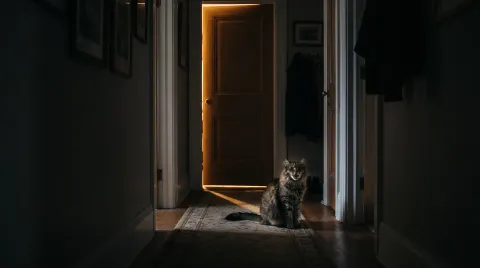
Why does my cat meow at night? And how to make it stop
Night calling is a solvable problem with a short list of causes: a crepuscular body clock, a lesson you accidentally taught, an unneutered announcement, or — in older cats — a medical flag that comes first.
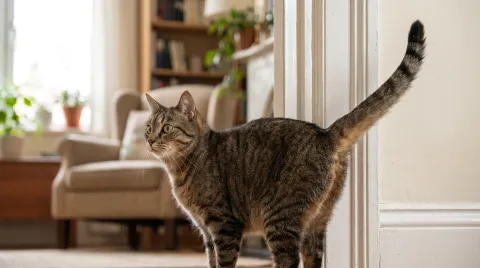
Why is my cat spraying? What it means and how to stop it
Spraying isn't a litter-box failure — it's a message about territory, written in urine. How to tell it from peeing, what's behind it, and the fixes that hold.
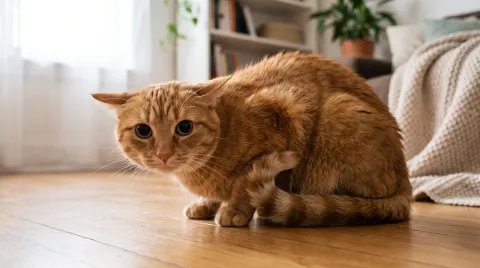
Why is my cat aggressive? Causes and how to calm it
Cat aggression isn't a personality — it's a diagnosis with about six usual suspects, and each one has a different fix. Work through them in order and the biting usually explains itself.
Why are my cats fighting? How to restore the peace
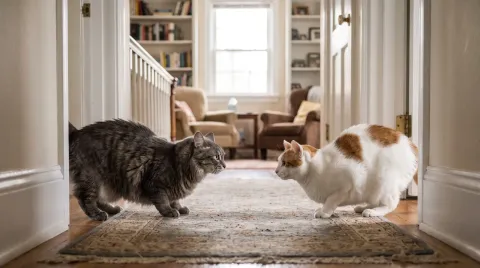
Two cats that shared a bed for years can turn into enemies in an afternoon. What breaks a feline relationship, why 'letting them fight it out' entrenches the war, and the reset that works.
How neutering changes cat behavior — and what it won't fix
Neutering deletes the hormone-driven behaviours — the roaming, the spraying, the 3am opera — and touches almost nothing else. What changes, what doesn't, and when.
Why your cat bites you mid-stroke
Purring one second, teeth the next — petting-induced aggression is the most misread move in cat ownership. The warnings arrive earlier than you think, and the fix is counting, not forgiveness.