How to read a pet food label
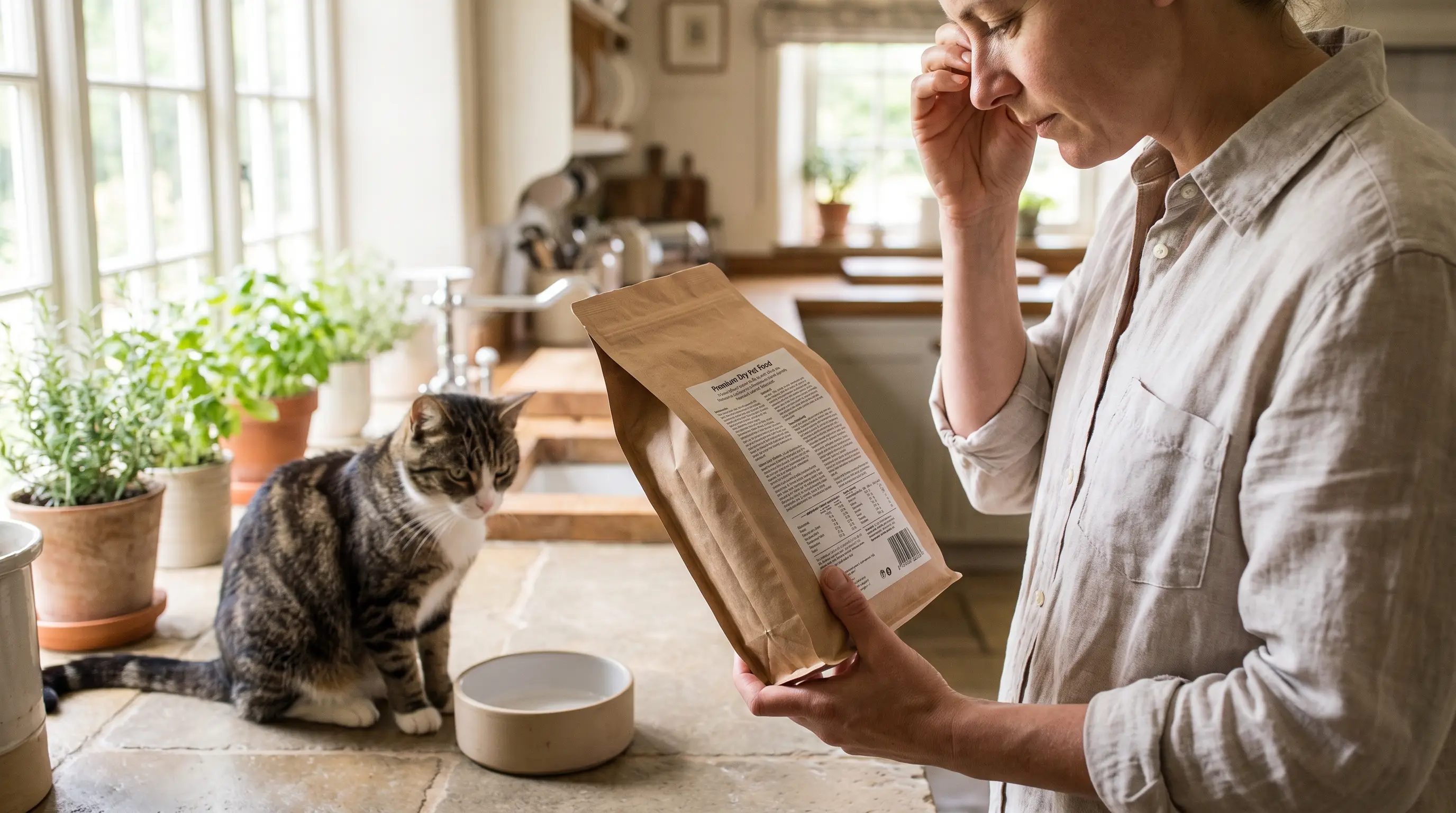
Read the back of the bag, not the front. The front is an advertisement; the legally controlled information lives on the back, and one line there tells you more than everything else combined: the nutritional adequacy statement. Learn to find that line, convert the guaranteed analysis to a fair comparison, and ignore the words with no legal meaning, and you can judge almost any cat or dog food in under a minute.
The nutritional adequacy statement

The nutritional adequacy statement is the most important line on the whole label, so find it before anything else. It is the small sentence, usually on the back, that says a food is "complete and balanced" for a named life stage. In the US that means it meets the AAFCO nutrient profiles; in the EU the equivalent standard is set by FEDIAF. The life stage matters: the recognised categories are growth (puppies and kittens, sometimes worded as growth and reproduction), adult maintenance, and all life stages, which is the strictest because it must satisfy the demands of growth. Feeding an adult-maintenance food to a kitten leaves out nutrients a growing animal needs.
The same line also tells you how the claim was proven, and the wording is different for each method. "Formulated to meet" the profiles means the recipe was checked on paper or by lab analysis against the nutrient minimums. "Animal feeding tests" means the food was actually fed to animals under AAFCO protocols, which for adult maintenance requires at least eight healthy dogs, each at least a year old, eating only that food for 26 weeks with vets checking their health. A feeding trial is stronger evidence than a formula that has never been tested in a live animal. If you cannot find any adequacy statement, the product is a treat or a supplement, not a meal, and it should say so.
The ingredient list
The ingredient list is ordered by weight, but it is wet weight before cooking, which is exactly why the first ingredient matters less than people think. Fresh chicken is roughly 70 to 80 percent water. Weighed with all that water still in it, it easily lands at the top of the list, then most of it evaporates during processing and the actual dry contribution shrinks. A "chicken meal" sounds worse and sits lower, yet it is chicken with the water already removed, around 90 percent dry matter, so it can deliver far more real protein than the fresh chicken listed above it.
This is where ingredient splitting hides in plain sight. A maker can list corn once as a single big entry, or split it into corn, corn gluten meal, and ground corn, three smaller entries that each fall below the meat. The total corn may outweigh the meat, but broken into pieces it looks minor. Read the first three to five ingredients together rather than fixating on the winner, and treat a named meat meal as a good sign, not a red flag.
The guaranteed analysis
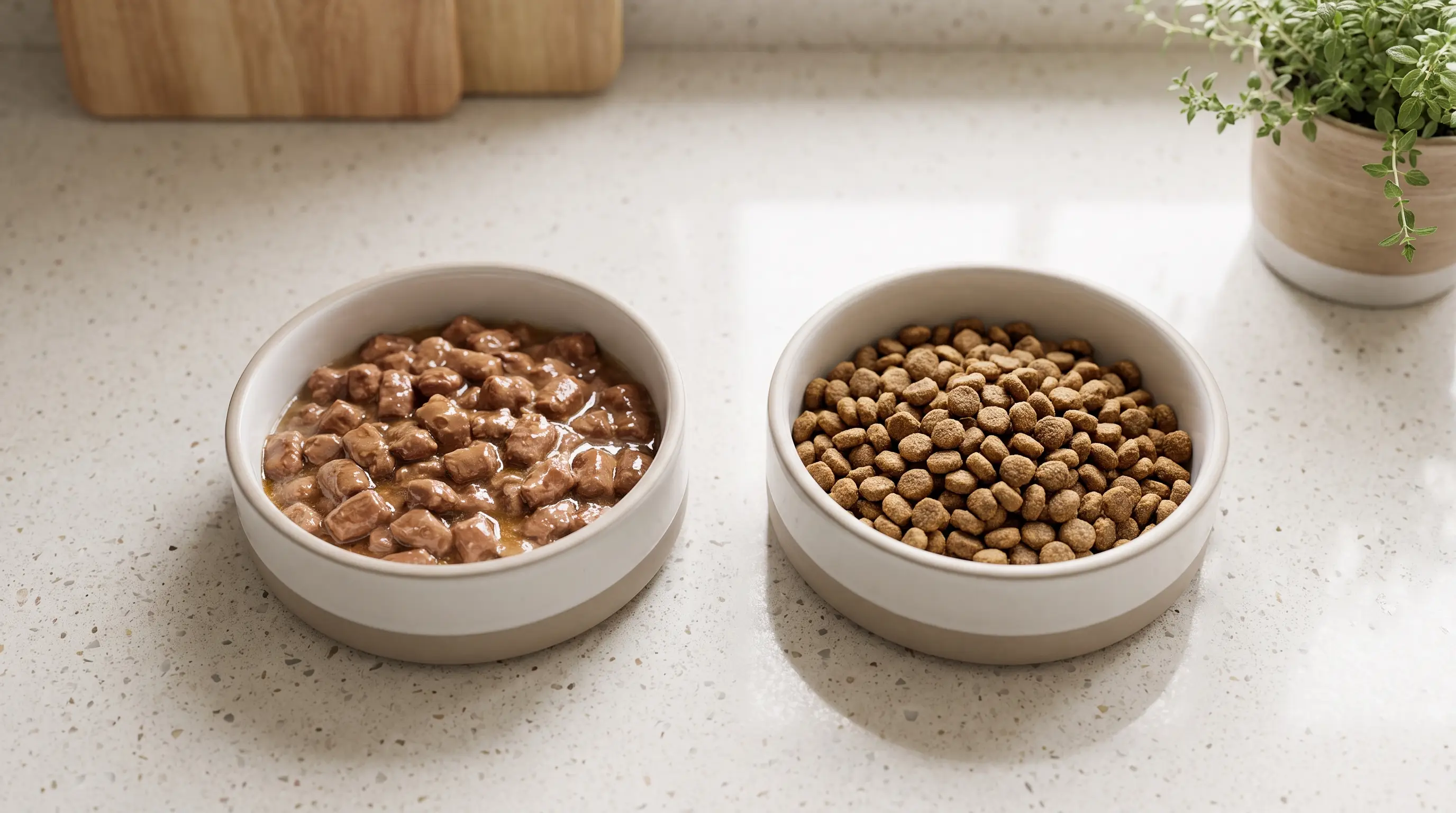
The guaranteed analysis lists four legal minimums and maximums: minimum crude protein, minimum crude fat, maximum crude fibre, and maximum moisture. "Crude" refers to the lab method, not the quality. These numbers look simple, but they trap people who compare a wet food to a dry food directly, because a can is mostly water and kibble is not. A tin at 10 percent protein and 78 percent moisture is not weaker than kibble at 25 percent protein and 10 percent moisture.
To compare fairly, convert to a dry-matter basis: take the nutrient percentage and divide it by the food's dry matter, which is 100 minus the moisture. The kibble becomes 25 divided by 90, about 28 percent protein. The wet food becomes 10 divided by 22, about 45 percent protein. On a like-for-like basis the can is actually the higher-protein food. Do this before you conclude anything from a guaranteed analysis, especially across formats or between brands.
Premium, natural, and by-product
Most of the appealing words on the front of the bag have little or no legal definition, so treat them as decoration. "Premium", "holistic", and "gourmet" are marketing terms with no regulatory meaning; a premium food is not held to any higher standard than a budget one. "Natural" is narrower under AAFCO, meaning nothing chemically synthetic, though foods still add synthetic vitamins and must disclose it. "Human-grade" is the one term with real weight, allowed only when every ingredient and the finished product are made and handled to human-food law, which is a high and documented bar.
"By-product" carries the worst reputation and deserves the least of it. By-products are the clean parts other than muscle meat, mostly organ tissue such as liver, kidney, and spleen, the same organs that are nutrient-dense and eaten by people in much of the world. A named by-product is not filler. The product name follows its own rules too: "chicken dog food" must be mostly chicken, while "chicken dinner", "entree", or "platter" only has to be a quarter chicken, and "with chicken" can be as little as three percent.
Grain-free and DCM
Grain-free is not automatically healthier, and there is an open safety question attached to it. Starting in 2018 the FDA investigated a possible link between certain grain-free diets, often those heavy in peas, lentils, and other legumes, and dilated cardiomyopathy, a serious heart-muscle disease. By late 2022 the agency had logged well over a thousand reports but concluded there was not enough data to establish that grain-free food causes the condition, and it stopped issuing routine updates. That is not the same as an all-clear. The link is unproven, not disproven.
For most pets, grains are a normal, digestible source of nutrients, and true grain allergies are uncommon compared with meat-protein sensitivities. Unless a vet has diagnosed a specific reason to avoid grain, going grain-free buys no known benefit and carries an unsettled question. Choose a food because its maker and its testing are sound, not because the front of the bag drops the word grain.
The maker and the feeding guide

Who makes the food matters as much as what is in it, so check whether a qualified nutritionist stands behind it. The strongest signal is a food formulated with input from a board-certified veterinary nutritionist, a company that runs feeding trials, and a maker that owns its plant and will answer questions about quality control. A pretty label from a company that cannot tell you who designed the recipe is a warning. The feeding guide on the side is only a starting point, printed as a broad range because it cannot know your individual animal. A lean, active adult and a neutered couch-dweller of the same weight need very different amounts, and a big cat like a Maine Coon eats on a different scale than a small one. Start near the middle of the range, weigh your pet every few weeks, and adjust to keep the body condition right rather than trusting the number on the bag.
Common questions
How do you read a dog food label?
Start on the back, not the front. Find the nutritional adequacy statement to confirm the food is complete and balanced for your dog's life stage, read the first few ingredients together while remembering the list is by wet weight, then convert the guaranteed analysis to a dry-matter basis before comparing brands or wet against dry.
What is the most important thing on a pet food label?
The nutritional adequacy statement is the single most important line. It tells you whether the food is complete and balanced to AAFCO or FEDIAF standards, which life stage it is for, and whether that was proven by a feeding trial or only by formulation. A food without this statement is a treat or supplement, not a meal.
What does complete and balanced mean on dog food?
Complete and balanced means the food contains every essential nutrient in the right proportions to be your pet's sole diet for a named life stage. In the US it is measured against AAFCO nutrient profiles; in the EU against FEDIAF. It can be substantiated by a live feeding trial or by a formula checked on paper, and a feeding trial is the stronger proof.
Is meat meal bad in dog food?
No, meat meal is usually a concentrated protein source, not a low-quality filler. Fresh meat is mostly water, so it loses most of its weight during cooking, while a named meat meal has the water already removed and delivers more actual protein per gram. The one to be cautious of is a vague, unnamed meal such as "meat and bone meal."
How do you calculate dry matter basis in pet food?
Divide the nutrient percentage by the food's dry matter, which is 100 minus the moisture percentage, then multiply by 100. For kibble with 25 percent protein and 10 percent moisture, that is 25 divided by 90, about 28 percent. This lets you compare wet and dry foods fairly, since a can is mostly water.
Are by-products bad in pet food?
Not usually. By-products are the clean, non-muscle parts of an animal, mostly organs such as liver, kidney, and spleen, which are nutrient-dense and eaten by people in many countries. A named by-product is a legitimate ingredient; be more wary of vague, unnamed sources than of the word by-product itself.
See also
More in Dogs

How much to feed a puppy, by age and size
The bag's chart is a starting point, not an answer. How much a puppy really needs, how meals drop from four a day to two, and the large-breed rule that matters more than the amount.

Feeding a senior dog: what actually changes after 7
Most older dogs need fewer calories, not a special 'senior diet' — and they should not have their protein cut. What changes, what doesn't, and when a change in appetite is a vet visit.
Reading the pet food ingredient list: meat, meal and by-product
'Chicken' first isn't the win it looks like, and 'by-product' isn't the villain. How to read an ingredient panel the way the people who write it do.
Human-grade vs feed-grade pet food, decoded
'Human-grade' is one of the few pet-food terms with a legal meaning — and one of the most stretched. Here's what it really requires, and whether it's worth paying for.

Pet food quality words, decoded: what the label really promises
Human-grade, holistic, natural, premium, single protein. Most of it is marketing, some of it is law. Here's what each word actually guarantees — and the one claim that really matters.
Organic, natural, holistic: which pet food claims are real
Only one of these words is backed by law. Here's what organic, natural, holistic, premium and gourmet actually guarantee on a bag of dog or cat food.