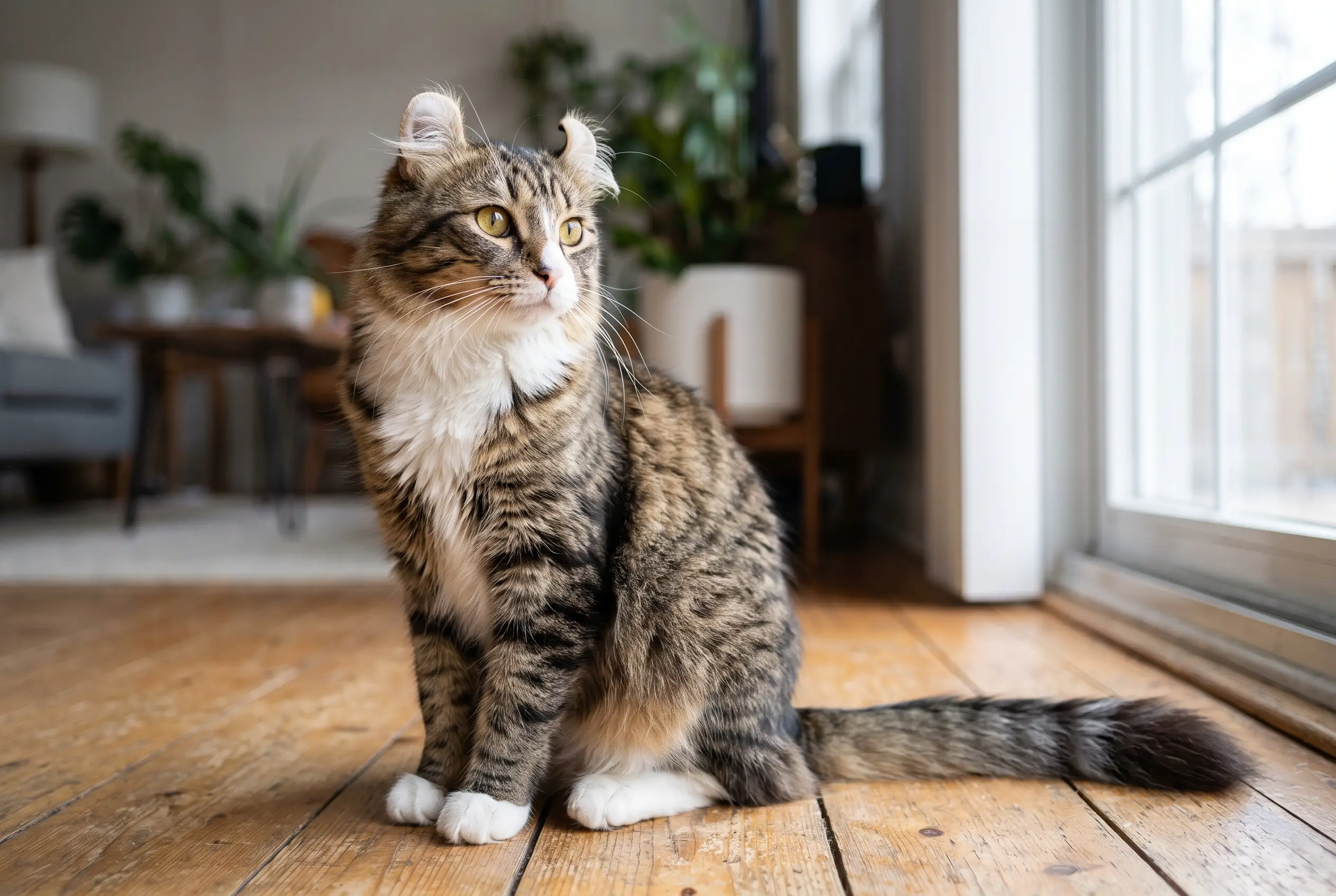
American Curl
A dominant mutation, one founding stray, and ears that finish curling on their own schedule.
Vital stats
| Size | Small to medium · svelte, semi-foreign build |
| Weight | 2.5–4.5 kg · males heavier |
| Life expectancy | 12–16 years — breed literature, not a registry figure |
| Energy | High — playful well past kittenhood |
| Shedding | Low — minimal undercoat |
| Coat | Short or semi-long, silky, almost no undercoat |
| Group | Shorthair |
| Origin | United States |
Breed traits
Friendliness
Care
Mind
The American Curl by the numbers
The American Curl facts owners search for most — price, lifespan, weight, shedding and colours, in one place.
Less common, so expect a waitlist and some travel to a reputable breeder — which pushes the price up. Ongoing costs stay modest — it eats little and routine vet care sits at the lower end.
We don't quote a single figure: the real price swings with breeder, region, bloodline and health testing — and a rescue costs a fraction of a breeder's litter. Adopting is almost always the cheapest route.
Temperament
American Curls stay kitten-like long after kittenhood ends — breeders call them 'Peter Pan' cats for it. They investigate anything new that enters the house, learn to play fetch with small balls and crumpled paper, and are unusually good at working a door or cupboard latch open. They vocalize in a soft coo rather than a yowl, and they'd rather be in the middle of whatever the household is doing than off on their own, which makes them easy with children, calm dogs and other cats once introductions go slowly. The one house rule: don't grab or tug the ears. The curl itself isn't painful, but the cartilage underneath is firm, and rough handling is uncomfortable for the cat.
Habits & quirks
Grading day is at four months
A kitten's ears are flat at birth, start curling within two to seven days, and keep shifting for weeks before locking into their final shape around 16 weeks. That's the earliest point a breeder can honestly grade a kitten as pet, breeder or show quality — which is why show-quality littermates cost more than the rest of the litter.
Every litter has straight-eared kittens too
The curl gene is dominant, not universal — a Curl-to-straight pairing typically produces a mix. Straight-eared kittens are still pedigreed American Curls, useful to a breeding programme, and routinely sold as pets rather than held back.
Plays fetch and never grows out of it
Small balls, bottle caps, balls of paper — a Curl will retrieve them repeatedly, which is part of why the breed is nicknamed 'Peter Pan': playful and curious well into old age.
Talks in coos, works the latches
Vocal but quiet, with a chirping coo instead of a yowl, and oddly capable at nosing open a cupboard or door it's decided to investigate.
Care
| The ears | The cartilage that holds the curl is firm, not floppy, so never force an ear straight or grab it by the tip. Because the ear curls backward and away from the head rather than folding forward and shut, the canal stays relatively open — check it during a regular ear clean the way you would any cat's, since curl direction doesn't grant immunity from wax buildup or infection. |
| Health screening | No inherited disease has been tied to the breed specifically. The mutation (gene Cu) has been studied in homozygous cats without turning up skeletal problems, which is the key difference from a fold-eared breed's cartilage mutation — more on that below. Ask a breeder for standard baseline screening (a heart check for HCM, routine bloodwork) the way you would for any pedigreed cat, since no breed-wide test exists to skip. |
| Coat | Both coat lengths carry little undercoat and rarely mat. A comb once a week keeps the semi-long variety tidy; the shorthair needs even less. |
| Enrichment | A Curl that plays fetch and opens cupboards needs a job. Rotate toys, keep a couple of retrievable balls in circulation, and expect this cat to want to be part of whatever room you're in rather than settled somewhere quiet. |
Life expectancy
This breed has a typical life expectancy of 12–16 years — breed literature, not a registry figure.
Similar breeds
Breeds with a similar build and background — worth a look if this one isn't quite the fit.
Common questions
Is the American Curl's ear mutation the same as the Scottish Fold's?
No, and the difference matters. The Curl's gene (Cu) folds only the ear's own cartilage backward; studies of homozygous Curls haven't found any effect on the rest of the skeleton. The Scottish Fold's gene affects cartilage throughout the body and causes osteochondrodysplasia, a painful, progressive joint disease with no cure. Both breeds have distinctive ears from a dominant mutation, but only one of those mutations carries a known welfare cost.
Do all American Curl kittens have curled ears?
No. The gene is dominant but doesn't reach every kitten in a litter — a typical litter includes straight-eared cats alongside curled ones. Straight-eared American Curls are still purebred, still useful to a breeding programme, and are commonly the ones sold as pets rather than show or breeding stock.
Why do some American Curl kittens cost more than their littermates?
Ear grading. A kitten's curl isn't final until around 16 weeks, and once it locks in, breeders sort litters into pet, breeder and show quality based on how tight and symmetrical the arc is. A full 90-to-180-degree crescent that meets the show standard is rarer than a partial curl, and the price follows the grade.
Does the American Curl shed a lot?
Not much. The American Curl is a low-shedding breed, so loose hair around the home stays minimal. It still needs regular grooming, but you won't be fighting drifts of fur.
Are American Curl cats hypoallergenic?
No cat breed is truly hypoallergenic. The trigger is Fel d 1, a protein in a cat's saliva and skin that transfers to the coat during grooming and then travels on loose hair and dander — so a cat that sheds less, like the American Curl, spreads less of it around the house, but still produces it. If someone at home reacts to cats, spend real time with this breed before deciding, and no breeder should promise you an allergy-free cat.
Are American Curl cats good with children?
Usually yes. The American Curl is a sociable cat that tends to tolerate the noise and handling of family life better than most, which is why it comes up so often for homes with kids. It still needs somewhere high and quiet to retreat to, and children need teaching that a cat walking away is allowed to.
How much grooming does a American Curl need?
A weekly comb is usually enough for the American Curl, with a second pass during a seasonal moult. That keeps loose hair off your furniture and cuts down on hairballs, since everything the cat doesn't shed onto the sofa it swallows while washing.