Cornish Rex
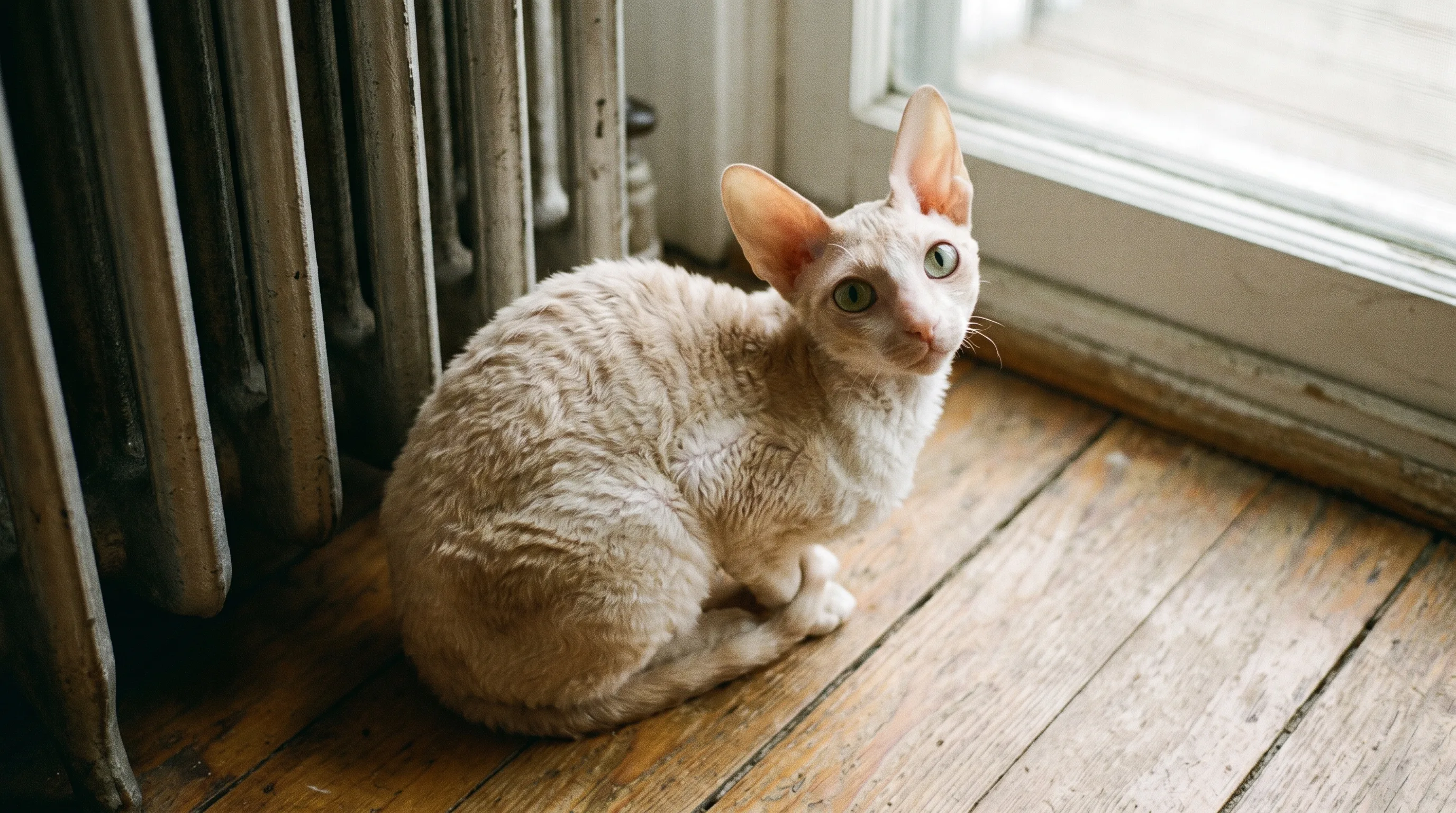
All undercoat and no overcoat, on a body built like a whippet.
On these lists: Hypoallergenic cats
Vital stats
| Size | Small · fine-boned, arched, long-legged |
| Weight | 2.5–4.5 kg · males heavier |
| Life expectancy | 11–15 years |
| Energy | Very high — sprints into old age |
| Shedding | Very low, but the coat is fragile |
| Coat | Very short, wavy, down hair only; no guard hairs |
| Group | Shorthair |
| Origin | England |
Breed traits
Friendliness
Care
Mind
The Cornish Rex by the numbers
The Cornish Rex facts owners search for most — price, lifespan, weight, shedding and colours, in one place.
Less common, so expect a waitlist and some travel to a reputable breeder — which pushes the price up. Ongoing costs stay modest — it eats little and routine vet care sits at the lower end.
We don't quote a single figure: the real price swings with breeder, region, bloodline and health testing — and a rescue costs a fraction of a breeder's litter. Adopting is almost always the cheapest route.
Temperament
Cornish Rex are relentless in a good-humoured way. They run, jump and skid around a room well past the age other cats stop, they use their front paws like hands to open and fetch things, and they will follow you from room to room narrating. Affection is physical and constant — under the duvet, inside a jumper, on the back of your neck — partly because they genuinely need the heat. They're bright enough for clicker training and harness walks, they greet strangers rather than hiding, and they are not remotely self-sufficient. A Cornish Rex left alone all day is a bored, noisy, destructive cat, and two is the usual answer.
Habits & quirks
Hunts the warm spot
Radiators, laptops, the underside of a duvet, the crook of your knees. With no guard hairs there is very little insulation, and a Cornish Rex organises its whole day around temperature.
Uses its paws
Doors, drawers, lids and light objects all get lifted, hooked and carried. The narrow front paws are unusually dextrous even by cat standards.
Never quite settles
The breed keeps a kitten's run-and-skid energy for a decade or more. Expect laps of the flat at eleven at night.
Breaks its own whiskers
Curled whiskers are fragile and often snap short. It looks alarming, it doesn't hurt, and they grow back curled again.
Care
| Grooming — don't | The coat is too delicate to brush. Combing or brushing snaps the hairs and leaves bald patches; a hand or a soft damp cloth once a week is the whole routine. Some Cornish Rex get greasy skin and need an occasional gentle bath, especially around the nail beds and the chin. |
| Keeping warm | This is a real care requirement, not a quirk. Keep the house comfortable, provide covered beds and a heat source, and don't let a Cornish Rex outside in cold or wet weather. In strong sun the thin coat also burns — shade matters both ways. |
| Health screening | Ask for a cardiologist's echo for hypertrophic cardiomyopathy, and about patellar luxation and umbilical hernia in the line. Progressive hair loss occurs in some cats and is cosmetic. Some vets also flag rex breeds as needing careful anaesthetic dosing because of low body fat. |
| Feeding | A fast metabolism plus poor insulation means a Cornish Rex often eats more for its size than you'd expect. Feed to condition rather than to a chart, and check the ribs — under that coat there is nowhere for weight to hide, which makes monitoring easy. |
Life expectancy
This breed has a typical life expectancy of 11–15 years.
Similar breeds
Breeds with a similar build and background — worth a look if this one isn't quite the fit.
Common questions
Is the Cornish Rex hypoallergenic?
No. It sheds very little, which helps some people, but the allergen is Fel d 1 in saliva and skin and a Cornish Rex produces it like any cat — arguably more accessibly, since there's less coat between you and the skin. Spend real time with one before deciding.
What's the difference between a Cornish and a Devon Rex?
Two different mutations that happen to look similar. The Cornish has no guard hairs at all and a tight, even marcel wave over a fine arched body; the Devon has a looser, more tousled coat that does include guard hairs, plus a broader pixie face and huge low-set ears. Cross them and you get straight-coated kittens, because the genes are not the same.
Do they need bathing?
Some do. With so little coat to absorb skin oils, a proportion of Cornish Rex get a greasy feel and dark residue in the nail beds and chin. A gentle bath every few weeks fixes it. Others never need one — it varies by individual, not by line.
Does the Cornish Rex shed a lot?
Not much. The Cornish Rex is a low-shedding breed, so loose hair around the home stays minimal. It still needs regular grooming, but you won't be fighting drifts of fur.
Are Cornish Rex cats good with children?
Usually yes. The Cornish Rex is a sociable cat that tends to tolerate the noise and handling of family life better than most, which is why it comes up so often for homes with kids. It still needs somewhere high and quiet to retreat to, and children need teaching that a cat walking away is allowed to.
How much grooming does a Cornish Rex need?
Very little. The Cornish Rex handles its own coat and a comb once a week or so is plenty — mostly to catch loose hair before the cat swallows it. Claws, teeth and ears still want the usual checks, which is the part people skip on an easy-coated cat.