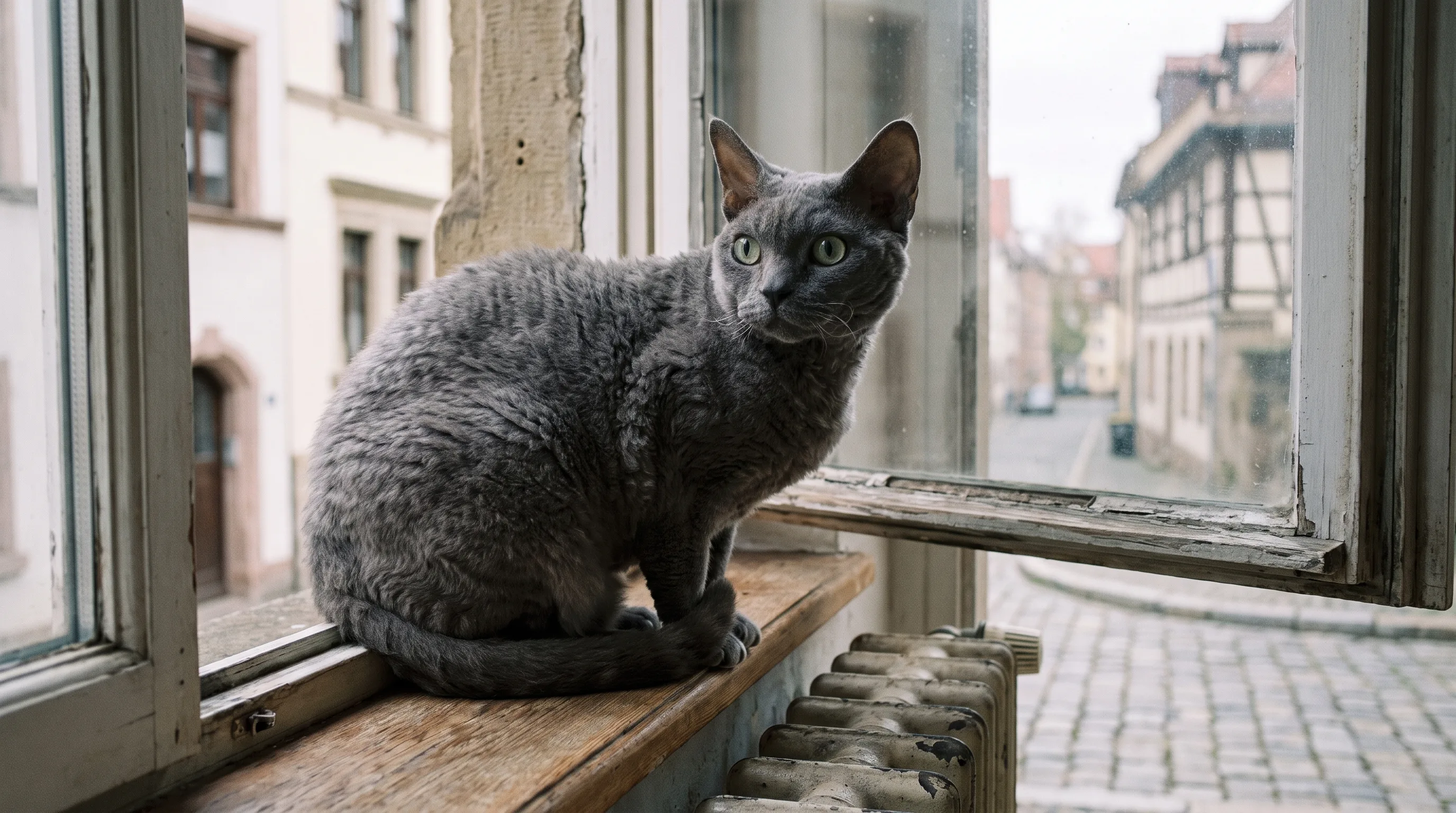
German Rex
Europe's first curly cat, from a Berlin hospital garden — and genetically the same as a Cornish Rex.
Vital stats
| Size | Small to medium · moderate, rounded build |
| Weight | 2.5–4.5 kg · males heavier |
| Life expectancy | 12–15 years |
| Energy | Moderate to high — active, then a lap |
| Shedding | Very low, but the coat is fragile |
| Coat | Short, woolly, loosely waved; no coarse guard hairs |
| Group | Shorthair |
| Origin | Germany |
Breed traits
Friendliness
Care
Mind
The German Rex by the numbers
The German Rex facts owners search for most — price, lifespan, weight, shedding and colours, in one place.
Less common, so expect a waitlist and some travel to a reputable breeder — which pushes the price up. Ongoing costs stay modest — it eats little and routine vet care sits at the lower end.
We don't quote a single figure: the real price swings with breeder, region, bloodline and health testing — and a rescue costs a fraction of a breeder's litter. Adopting is almost always the cheapest route.
Temperament
German Rex are friendly and even-tempered in a way the other rex breeds aren't quite — less frantic than a Cornish, less mischievous than a Devon. They're playful into adulthood, follow their people around, and settle readily on a lap, partly because the coat leaves them cold. Most are relaxed with visitors, other cats and dogs, and they're quiet, using a small voice sparingly. The breed's problem isn't temperament, it's numbers: there are very few German Rex anywhere, and finding a well-bred kitten usually means a waiting list and a long drive.
Habits & quirks
Sits on the warm thing
Almost no insulating coat means the German Rex is drawn to laps, radiators and laptops, and will burrow under a blanket rather than sleep on top of one.
Plays past kittenhood
The breed keeps chasing and pouncing well into middle age, but in bursts — it is not the perpetual motion of a Cornish Rex.
Coat changes with the season
The wave loosens and tightens through the year, and some cats moult to a thinner coat in summer. It fills back in.
Whiskers snap short
Curled whiskers are brittle across every rex breed. Broken ones are normal and regrow curled.
Care
| Grooming — hands, not brushes | The hairs are fine and break easily. A weekly stroke with a hand or a soft damp cloth is the whole routine; brushing or combing leaves thin patches. Ears usually need a gentle clean every couple of weeks. |
| Warmth | Treat it as a care requirement. Keep the house comfortable, offer covered beds, and don't put a German Rex outside in cold or wet weather. Thin-coated areas also sunburn, so shade matters in summer. |
| Health screening | There's no documented breed-specific inherited disease, which mostly reflects how few cats there are rather than a clean bill of health. Ask for a cardiologist's echo for hypertrophic cardiomyopathy and about how closely related the parents are — with a population this small, inbreeding coefficient is the number that matters. |
| Finding one | Expect a wait. Serious breeders are concentrated in Germany and a handful of other European countries, litters are infrequent, and cats offered without papers at short notice are usually something else with a wavy coat. |
Life expectancy
This breed has a typical life expectancy of 12–15 years.
Similar breeds
Breeds with a similar build and background — worth a look if this one isn't quite the fit.
Common questions
Is the German Rex the same as the Cornish Rex?
Genetically, effectively yes. Both carry the same recessive deletion in the LPAR6 gene, and crossing them produces curly kittens rather than straight ones — the test that proves two mutations are the same. They are kept apart as breeds because they look different: the Cornish is fine-boned and arched, the German is a rounder, more ordinary cat shape.
Why is it so rare?
It was never widely taken up. The Cornish Rex arrived in the same decade, was heavily promoted in Britain and the United States, and absorbed most of the interest in curly cats. The German Rex stayed a small European breed and remains one, with a correspondingly narrow gene pool.
Is it hypoallergenic?
No. Like every rex, it sheds very little, and some allergy sufferers find that easier — but the allergen is Fel d 1 in saliva and skin, and this cat produces it normally. Meet an adult before making a decision.
Does the German Rex shed a lot?
Not much. The German Rex is a low-shedding breed, so loose hair around the home stays minimal. It still needs regular grooming, but you won't be fighting drifts of fur.
Are German Rex cats good with children?
Usually yes. The German Rex is a sociable cat that tends to tolerate the noise and handling of family life better than most, which is why it comes up so often for homes with kids. It still needs somewhere high and quiet to retreat to, and children need teaching that a cat walking away is allowed to.
How much grooming does a German Rex need?
Very little. The German Rex handles its own coat and a comb once a week or so is plenty — mostly to catch loose hair before the cat swallows it. Claws, teeth and ears still want the usual checks, which is the part people skip on an easy-coated cat.