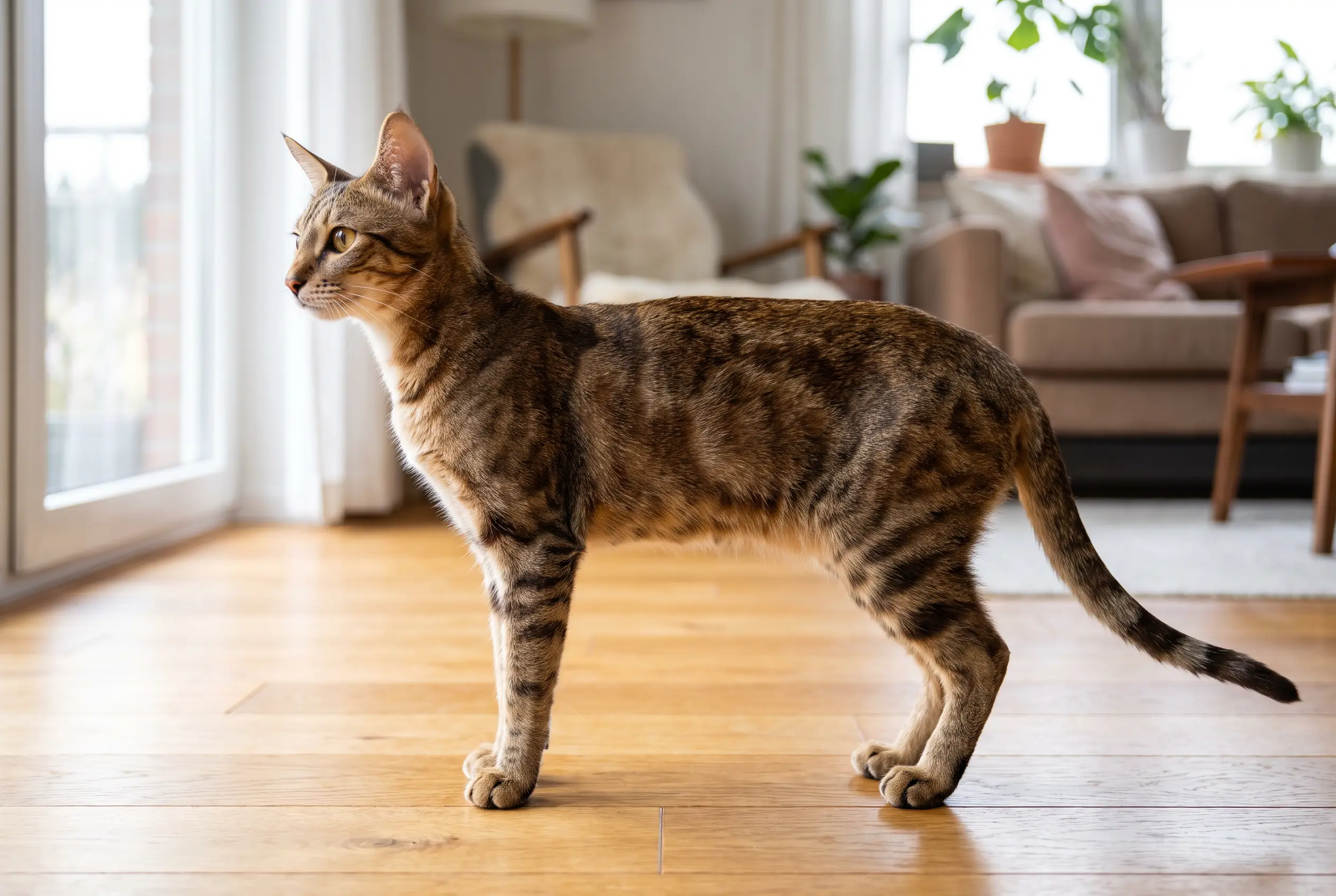
Sokoke
Patterned like the forest it's named for, built from nothing wilder than an ordinary Kenyan house cat.
Vital stats
| Size | Medium · long-legged, lean, whip-like tail |
| Weight | 2.5–4.5 kg · breed literature, no figure in the standard |
| Life expectancy | 15–20 years — breed literature, not survey data |
| Energy | Very high — an athletic, constant climber |
| Shedding | Low — short single coat, almost no undercoat |
| Coat | Short, close, slightly coarse but glossy; modified (ticked) blotched tabby |
| Group | Shorthair |
| Origin | Kenya |
Breed traits
Friendliness
Care
Mind
The Sokoke by the numbers
The Sokoke facts owners search for most — price, lifespan, weight, shedding and colours, in one place.
Less common, so expect a waitlist and some travel to a reputable breeder — which pushes the price up. Ongoing costs stay modest — it eats little and routine vet care sits at the lower end.
We don't quote a single figure: the real price swings with breeder, region, bloodline and health testing — and a rescue costs a fraction of a breeder's litter. Adopting is almost always the cheapest route.
Temperament
Sokoke owners reach for the word dog-like, and mean it: this is a cat that bonds hard, follows its people from room to room, and in many households walks on a harness without much fuss. It's genuinely vocal too — chirps, trills and a running commentary rather than silence — and it does not do well ignored or left alone for long stretches. Curiosity runs constant; a Sokoke investigates new objects, works open what it can open, and rarely sits still as long as a typical shorthair. With strangers it tends to hold back and take its own time, which reads as caution rather than unfriendliness once you know the cat. Because the coat carries almost no insulating undercoat, this isn't a cat built for an unheated house in a cold climate — it wants a warm indoor spot, not a draughty windowsill, whatever the weather outside is doing.
Habits & quirks
Walks on tip-toe
The hind legs run longer than the front, which gives the Sokoke a springy, high-stepping gait breeders call tip-toe walking — visible even crossing a room at a slow pace.
Talks all day
Chirps, trills and short conversational meows run through the day. A silent Sokoke usually means it's asleep, not content.
Takes to a harness
Many owners walk their Sokoke on lead with little training behind it; the dog-like attachment and the appetite for new ground make it one of the more willing shorthairs to leash-train.
Feels the cold
The single coat carries almost no undercoat, so a Sokoke through a Northern European winter wants a heated bed and a closed door, not a draughty hallway.
Care
| Grooming | Minimal. A weekly rub-down with a damp hand or a soft brush lifts the loose hair; the coat is too short and close-lying to need more. |
| Health | No breed-specific DNA test is published for the Sokoke yet. The concerns breeders flag instead are the small founding population, which limits genetic diversity, and reports that cats from the original Kenyan lines carry weaker natural resistance to viruses common in Europe and North America — ask a breeder about their kitten vaccination protocol and whatever inbreeding-coefficient records they keep. |
| Warmth | Because there's essentially no undercoat, a Sokoke in a cold climate needs indoor heating rather than an extra blanket alone; draughts and cold floors bother this breed more than most other shorthairs. |
| Enrichment | Tall climbing routes, daily interactive play and company all matter. A Sokoke left alone and bored finds its own, louder entertainment. |
Life expectancy
This breed has a typical life expectancy of 15–20 years — breed literature, not survey data.
Similar breeds
Breeds with a similar build and background — worth a look if this one isn't quite the fit.
Common questions
Is the Sokoke part wildcat?
No. It looks like a small forest predator, but genetic studies place it firmly within the domestic cat family, closely related to Asian and Arabian domestic lineages, not the African wildcat or any wild forest species. The breed's look came from selecting an existing feral domestic population for its natural markings, not from crossing in a wild animal — this is the single most common thing people get wrong about the Sokoke.
How is the Sokoke different from an Abyssinian or an Egyptian Mau?
All three get called natural or African breeds, but the coats are different traits entirely. The Abyssinian is ticked all over with no blotches or spots at all. The Egyptian Mau is genuinely spotted. The Sokoke carries a classic (blotched) tabby pattern with ticking inside the blotches, which is what gives it the marbled African tabby look unique to the breed — and unlike the Mau's ancient-Egypt story, the Sokoke's founding population was found on Kenya's coast as recently as 1978.
Can you actually get a Sokoke kitten?
Not easily. It remains one of the rarest breeds in any registry — FIFe recorded no newly registered kittens at all in a recent year — and most breeders are in Scandinavia, particularly Denmark, where the breeding programme was built. A realistic plan is a waiting list measured in years, not months, and a willingness to travel for the kitten.
Does the Sokoke shed a lot?
Not much. The Sokoke is a low-shedding breed, so loose hair around the home stays minimal. It still needs regular grooming, but you won't be fighting drifts of fur.
Are Sokoke cats hypoallergenic?
No cat breed is truly hypoallergenic. The trigger is Fel d 1, a protein in a cat's saliva and skin that transfers to the coat during grooming and then travels on loose hair and dander — so a cat that sheds less, like the Sokoke, spreads less of it around the house, but still produces it. If someone at home reacts to cats, spend real time with this breed before deciding, and no breeder should promise you an allergy-free cat.
Are Sokoke cats good with children?
Often, in the right home. The Sokoke is reasonably sociable and can settle well with children who already know how to handle a cat gently. Give it high perches and a room the kids don't own, and introductions go far better.
How much grooming does a Sokoke need?
Very little. The Sokoke handles its own coat and a comb once a week or so is plenty — mostly to catch loose hair before the cat swallows it. Claws, teeth and ears still want the usual checks, which is the part people skip on an easy-coated cat.