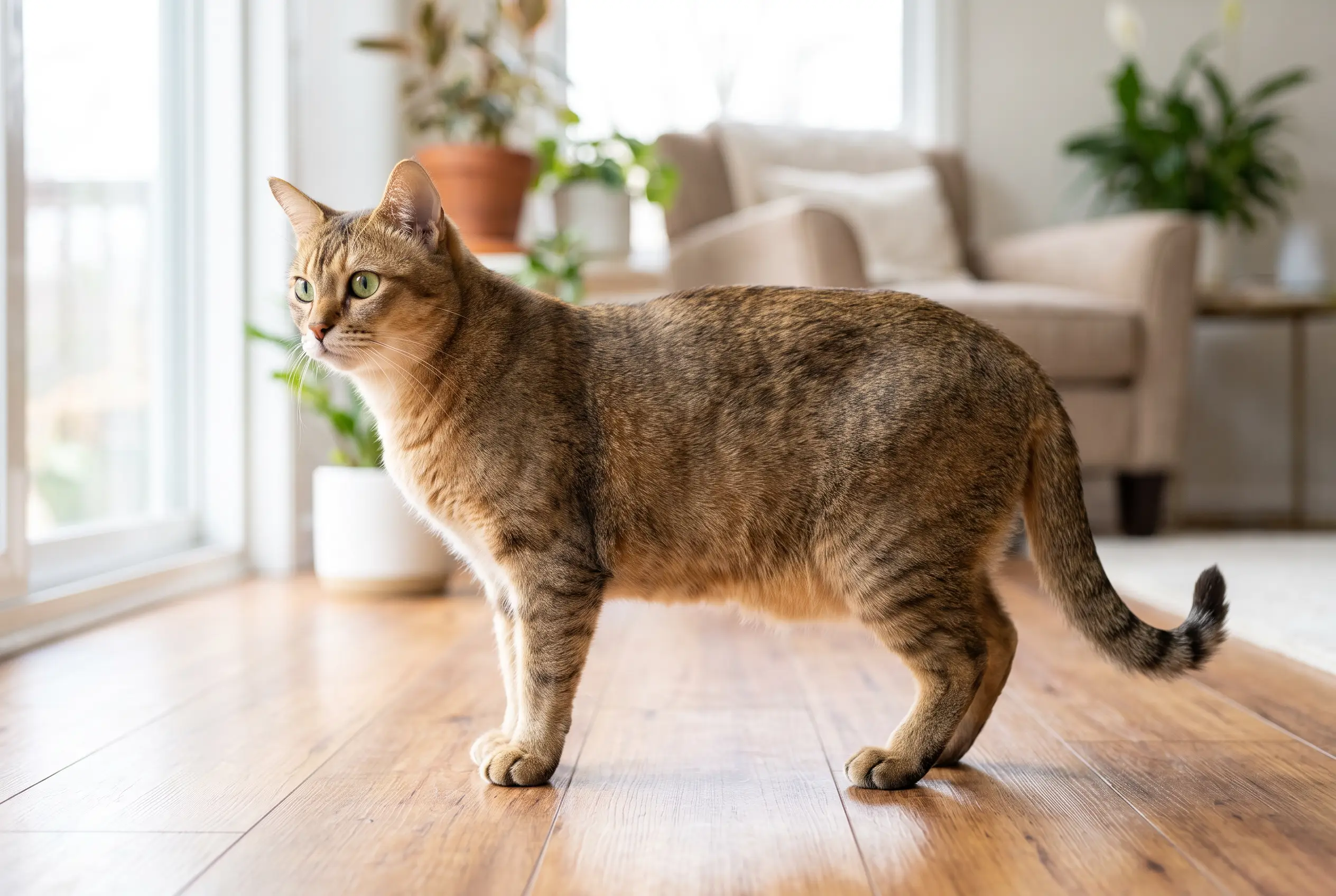
Australian Mist
Australia's own breed: a spotted or marbled coat softened by a misted veil of ticking, on a cat bred on purpose to prefer the indoors.
Vital stats
| Size | Medium · solid, rounded build |
| Weight | 3–6.5 kg · males heavier |
| Life expectancy | 12–16 years |
| Energy | Moderate — playful as a kitten, settles with age |
| Shedding | Very low, short coat with almost no undercoat |
| Coat | Short, dense; ticked, spotted or marbled tabby |
| Group | Shorthair |
| Origin | Australia |
Breed traits
Friendliness
Care
Mind
The Australian Mist by the numbers
The Australian Mist facts owners search for most — price, lifespan, weight, shedding and colours, in one place.
Less common, so expect a waitlist and some travel to a reputable breeder — which pushes the price up. Ongoing costs stay modest — it eats little and routine vet care sits at the lower end.
We don't quote a single figure: the real price swings with breeder, region, bloodline and health testing — and a rescue costs a fraction of a breeder's litter. Adopting is almost always the cheapest route.
Temperament
Australian Mists read as the calmer, more biddable relative of their two parent breeds. Kittens chase, fetch and work out cupboard latches with real energy, but most settle by two or three years old into an even-tempered adult that's happy to be picked up, carried through the house and handed to a stranger at the door. They tolerate handling well, get along with children and cat-friendly dogs, and don't need the constant company a Burmese does — a Mist left alone for an ordinary working day copes fine, though it still wants attention once someone's home. The voice stays quiet, chirps and soft trills rather than a yowl. The trait every breeder mentions first is how little interest they show in going outside: this is a cat that sits at a closed door without pushing at it.
Habits & quirks
Wears its pattern under a veil
The coat works in three layers at once: a pale ticked ground colour, a darker spotted or marbled tabby pattern underneath it, and fine dark lines tracing the face, legs and tail. Together they blur the markings instead of sharpening them, which is the 'mist' the name describes — look closely and the spots or marbling seem to be seen through gauze rather than drawn on.
Settles at a closed door
Straede selected for cats that tolerate — and usually prefer — staying inside, which matters in a country where many councils require cat containment, some of them around the clock, to protect native wildlife. Most Mists sit at a shut door rather than scratch at it, unusual enough among cats that owners bring it up unprompted.
Colour keeps arriving
Kittens are born pale, and the ticking and pattern both darken and sharpen for up to two years. A Mist bought as a kitten for its faint markings can end up a noticeably different-looking adult.
Plays first, calms later
The early years carry real Burmese and Abyssinian energy — fetch, fishing objects out of glasses, working a door handle — before most cats settle into the breed's reputation for an easy, undemanding adulthood.
Care
| Grooming | The short, dense coat has almost no undercoat and rarely mats. A rubber grooming mitt once a week lifts what's loose; there's little else to do outside the twice-yearly moult. |
| Health screening | Ask for four things in writing: DNA tests for pyruvate kinase deficiency and progressive retinal atrophy (rdAc), both inherited from the Abyssinian side, and for feline hypokalaemic polymyopathy, inherited from the Burmese side; and blood typing before any mating, since the breed's mixed ancestry carries both type A and type B cats, and a type A kitten born to a type B queen can die of neonatal isoerythrolysis in its first days. The domestic outcross in the foundation stock added real genetic diversity, but it didn't erase what came in with the two purebred parents — treat 'hybrid vigour' as partial protection here, not proof of a clean bill of health. |
| Built for containment, not confinement | A Mist tolerating life indoors isn't the same as a Mist with nothing to do. Climbing space, window perches, a scratching post and daily play keep the breed's famous calm from tipping into boredom — a risk that's easy to miss precisely because this cat complains about it less than an Abyssinian or Burmese would. |
| Outdoor access, done safely | If you want to give a Mist fresh air without breaking a containment ordinance or risking local wildlife, a secured outdoor run — a 'catio' — is the standard answer, and most cats take to one readily. |
Life expectancy
This breed has a typical life expectancy of 12–16 years.
Similar breeds
Breeds with a similar build and background — worth a look if this one isn't quite the fit.
Common questions
Is the Australian Mist just a mix of Burmese and Abyssinian?
Genetically, largely yes, with a quarter of ordinary Australian domestic cat added on purpose for genetic diversity — the foundation stock was roughly half Burmese, a quarter Abyssinian and a quarter domestic shorthair. It's bred to its own standard now, for a specific coat and a specific temperament, and hasn't been crossed back to either parent breed since the founding programme closed.
Is this a good cat for a fully indoor life?
It's one of the few breeds actually developed for that. Dr Truda Straede bred specifically for cats content to stay in, partly because Australian councils increasingly require it to protect native wildlife. Most Mists settle into an indoor life without the frustration you'd see in a more outdoor-driven breed, provided they still get climbing space and daily play.
Why haven't I heard of this breed, or why is it hard to find?
Recognition came late outside Australia — TICA accepted it for championship only in 2014, GCCF in 2017, and CFA hasn't recognised it at all. Most breeders are still in Australia, with small programmes in the UK, New Zealand and North America, so a Mist kitten outside Australia usually means a wait list and a long-distance breeder.
Does the Australian Mist shed a lot?
Not much. The Australian Mist is a low-shedding breed, so loose hair around the home stays minimal. It still needs regular grooming, but you won't be fighting drifts of fur.
Are Australian Mist cats hypoallergenic?
No cat breed is truly hypoallergenic. The trigger is Fel d 1, a protein in a cat's saliva and skin that transfers to the coat during grooming and then travels on loose hair and dander — so a cat that sheds less, like the Australian Mist, spreads less of it around the house, but still produces it. If someone at home reacts to cats, spend real time with this breed before deciding, and no breeder should promise you an allergy-free cat.
Are Australian Mist cats good with children?
Usually yes. The Australian Mist is a sociable cat that tends to tolerate the noise and handling of family life better than most, which is why it comes up so often for homes with kids. It still needs somewhere high and quiet to retreat to, and children need teaching that a cat walking away is allowed to.
How much grooming does a Australian Mist need?
Very little. The Australian Mist handles its own coat and a comb once a week or so is plenty — mostly to catch loose hair before the cat swallows it. Claws, teeth and ears still want the usual checks, which is the part people skip on an easy-coated cat.