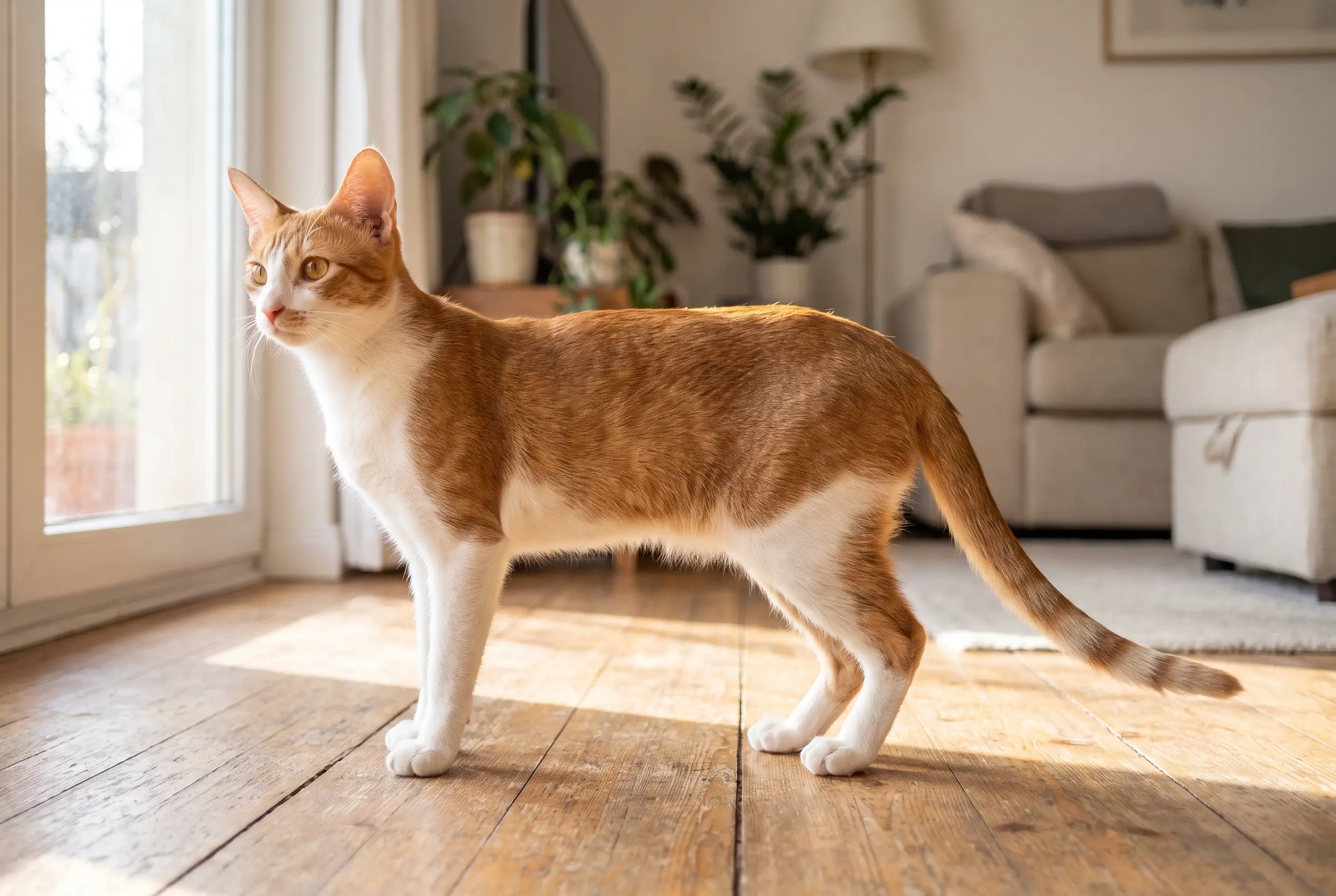
Brazilian Shorthair
Brazil's own street cat, written into a standard instead of crossed into a new one.
Vital stats
| Size | Medium · slender and muscular, not cobby |
| Weight | 3.5–6 kg — breed literature, not in the WCF standard |
| Life expectancy | 14–18 years — breed literature, not survey data |
| Energy | High — playful and active well into adulthood |
| Shedding | Low — short, glossy coat with no undercoat |
| Coat | Short, silky, close-lying; every colour and pattern except pointed |
| Group | Shorthair |
| Origin | Brazil |
Breed traits
Friendliness
Care
Mind
The Brazilian Shorthair by the numbers
The Brazilian Shorthair facts owners search for most — price, lifespan, weight, shedding and colours, in one place.
Less common, so expect a waitlist and some travel to a reputable breeder — which pushes the price up. Ongoing costs stay modest — it eats little and routine vet care sits at the lower end.
We don't quote a single figure: the real price swings with breeder, region, bloodline and health testing — and a rescue costs a fraction of a breeder's litter. Adopting is almost always the cheapest route.
Temperament
This is a cat that behaves like it grew up having to earn its keep, because it did. Brazilian Shorthairs stay playful long past kittenhood, learn a household's routine fast, and hunt with real competence if they get access to a garden or a bug. They're outgoing rather than reserved, approaching visitors instead of vanishing from them, and they attach hard to their people. A Brazilian Shorthair left alone for long stretches doesn't sulk quietly — it goes looking for attention somewhere else. Good with sensible children and other pets, but it wants to be part of the household's actual activity, not a spectator to it.
Habits & quirks
Built leaner than the other shorthairs
Next to a British Shorthair's roundness or an American Shorthair's square block, this one looks upright and elegant: a wedge head longer than broad, a slightly curved profile, and tall, tufted ears set high rather than wide.
Still hunts like it means it
Generations of feeding themselves left the instinct intact. Given a garden or even just a moving toy, this is a cat that stalks properly rather than batting half-heartedly.
Comes in nearly every colour
The standard recognises all colours and patterns except the pointed pattern, and any amount of white — a direct result of drawing from a wide, unplanned street-cat gene pool rather than a narrow founding line.
Trails its person around the house
It picks a person over a spot on the sofa, turning up wherever that person is working, cooking or sitting instead of staking out one favourite chair.
Care
| Grooming | About as low-maintenance as a coat gets: short, silky and close-lying with no undercoat. A weekly stroke with a rubber curry brush lifts loose hair, and there's no seasonal blowout to plan around. |
| Health | No signature inherited disease is documented for this breed. That's a genuine feature of a wide, naturally selected street-cat gene pool, not a gap in the research. Treat it like any healthy shorthair: annual vet checks, core vaccinations and parasite control, and a dental check every visit rather than waiting for bad breath to announce a problem. |
| Exercise | Energy stays high into adulthood. Two real play sessions a day with something that moves like prey — a wand toy, a thrown ball — keep the hunting drive satisfied indoors where outdoor access isn't safe. |
| Company | The attachment to people is genuine. Left alone all day, every day, a Brazilian Shorthair tends to seek attention elsewhere rather than settle into solitude, so a second pet or a household with someone home most days suits it better than a quiet, empty flat. |
Life expectancy
This breed has a typical life expectancy of 14–18 years — breed literature, not survey data.
Similar breeds
Breeds with a similar build and background — worth a look if this one isn't quite the fit.
Common questions
How is the Brazilian Shorthair different from the British, American or European Shorthair?
All four started as an ordinary local domestic cat that a registry standardised, but the standards themselves diverged. The British Shorthair is deliberately cobby with a round head and round copper eyes; the American Shorthair is square and hard-coated; the European (Celtic) Shorthair is broad-headed and lithe but still compact, with medium, wide-set, almost-upright ears. The Brazilian Shorthair is the leanest of the four: a wedge-shaped head longer than broad, a slightly curved profile, and large ears set high and tufted rather than wide-set, closer in silhouette to a slim domestic cat than to any of the others' rounder builds. Geography settles the rest — this is the one you'll struggle to find outside Brazil.
Can you actually get a Brazilian Shorthair outside Brazil?
Realistically, no. The World Cat Federation is the only major registry that recognises the breed, breeders are concentrated in Brazil, and the WCF standard itself limits novice-class showing to Brazil. Outside South America there is no meaningful supply of kittens — if you want this specific breed rather than a cat that resembles it, expect to be looking at Brazilian breeders and international shipping, not a local litter.
Isn't this just a Brazilian street cat?
Genetically, yes, and that's the breed's actual argument for existing. Rather than importing or crossing other pedigree cats, Paulo Samuel Ruschi picked a consistent type out of Brazil's own feral and domestic cat population and wrote it down as a standard. A pedigree here doesn't buy you a different animal — it buys a documented, judged type and a wide, healthy gene pool that a random street cat's parentage can't guarantee on paper.
Does the Brazilian Shorthair shed a lot?
Not much. The Brazilian Shorthair is a low-shedding breed, so loose hair around the home stays minimal. It still needs regular grooming, but you won't be fighting drifts of fur.
Are Brazilian Shorthair cats hypoallergenic?
No cat breed is truly hypoallergenic. The trigger is Fel d 1, a protein in a cat's saliva and skin that transfers to the coat during grooming and then travels on loose hair and dander — so a cat that sheds less, like the Brazilian Shorthair, spreads less of it around the house, but still produces it. If someone at home reacts to cats, spend real time with this breed before deciding, and no breeder should promise you an allergy-free cat.
Are Brazilian Shorthair cats good with children?
Usually yes. The Brazilian Shorthair is a sociable cat that tends to tolerate the noise and handling of family life better than most, which is why it comes up so often for homes with kids. It still needs somewhere high and quiet to retreat to, and children need teaching that a cat walking away is allowed to.
How much grooming does a Brazilian Shorthair need?
Very little. The Brazilian Shorthair handles its own coat and a comb once a week or so is plenty — mostly to catch loose hair before the cat swallows it. Claws, teeth and ears still want the usual checks, which is the part people skip on an easy-coated cat.