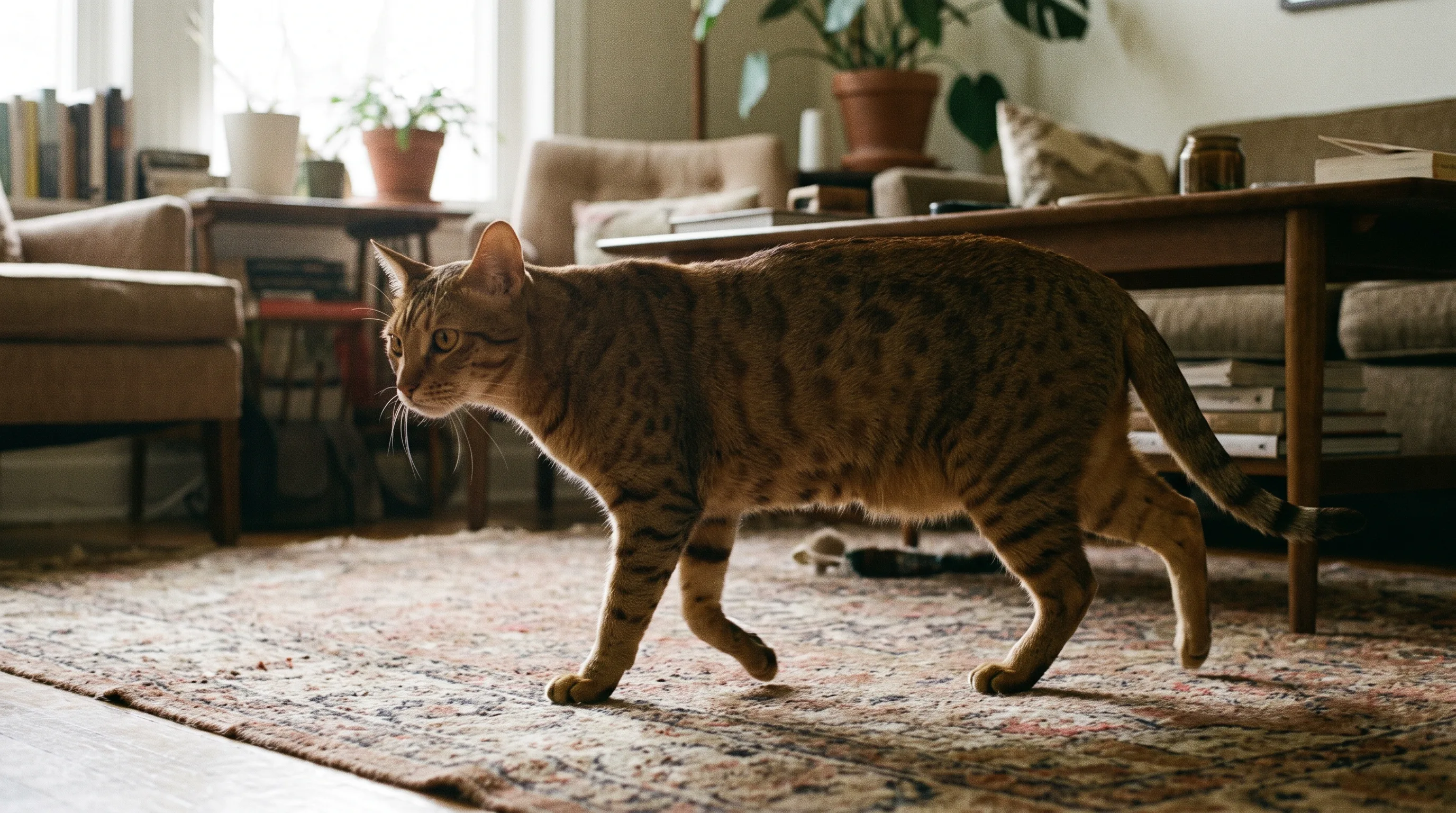
Ocicat
Looks like an ocelot, behaves like a labrador, and has no wild ancestry whatsoever.
Vital stats
| Size | Medium to large · long, powerful, heavy-boned |
| Weight | 2.7–5 kg females · up to 7 kg males |
| Life expectancy | 12–18 years |
| Energy | Very high — needs a job every day |
| Shedding | Low, short satiny coat |
| Coat | Short, satiny, close-lying; spotted agouti |
| Group | Shorthair |
| Origin | United States |
Breed traits
Friendliness
Care
Mind
The Ocicat by the numbers
The Ocicat facts owners search for most — price, lifespan, weight, shedding and colours, in one place.
Less common, so expect a waitlist and some travel to a reputable breeder — which pushes the price up. Ongoing costs stay modest — it eats little and routine vet care sits at the lower end.
We don't quote a single figure: the real price swings with breeder, region, bloodline and health testing — and a rescue costs a fraction of a breeder's litter. Adopting is almost always the cheapest route.
Temperament
Ocicats are dogs in spotted coats. They come when called, learn fetch, sit and high-five, walk on a harness, and take to a car better than most cats. They greet visitors rather than hiding, they follow their people from room to room, and they'd rather be carried than left behind. That sociability has a cost: an Ocicat that spends a working day alone becomes noisy and destructive, and this is a breed that genuinely does better in pairs. They're strong and confident with dogs and children, and they'll take charge of a household if nobody else does. Loud, but with a conversational Siamese-lite voice rather than a howl.
Habits & quirks
Learns commands
Sit, come, fetch, high-five. Ocicats work for food and attention the way a dog does, and a clicker plus five minutes a day gets further than most owners expect.
Runs the house
Confident to the point of bossy. An Ocicat will decide where it sleeps, who it greets and which door should be open, and it will lobby for all three.
Wants water
Taps, showers, the washing-up bowl. Not universal, but common enough that Ocicat owners learn to cover the glass.
Travels well
One of the few breeds that generally tolerates a carrier, a car and a new room without going to pieces. Harness training usually sticks.
Care
| Grooming | Almost nothing. A rubber mitt once a week lifts the little that sheds and brings up the satin. Never clip the coat — the ticking is what makes the spots visible, and a clipped Ocicat looks like a different cat until it grows back. |
| Health screening | Abyssinian ancestry brings pyruvate kinase deficiency and progressive retinal atrophy, both DNA-testable, plus renal amyloidosis, which has no test and shows up in middle age. Hypertrophic cardiomyopathy is screened by scan. Ask for all of it in writing. |
| Training and enrichment | Treat this like a working dog's requirement, not an extra. Clicker sessions, puzzle feeders, tall climbing routes and a harness walk if the cat takes to it. An unemployed Ocicat gets into cupboards and stays there. |
| Company | Two cats is the honest recommendation. Ocicats bond hard, hate an empty house, and pair well with each other or with another confident, active breed. |
Life expectancy
This breed has a typical life expectancy of 12–18 years.
Similar breeds
Breeds with a similar build and background — worth a look if this one isn't quite the fit.
Common questions
Does the Ocicat have any wild cat in it?
None. The name comes from the resemblance to an ocelot and nothing else. The breed is Abyssinian, Siamese and American Shorthair, and unlike the Bengal, the Savannah or the Chausie it has never used a wild species — which is also why it has no legal restrictions attached to it anywhere.
Is it the same as a Bengal?
No, and the difference matters if you're choosing. The Bengal descends from the Asian leopard cat, has rosettes and often a glittered coat, and is a busier, more intense animal. The Ocicat is fully domestic, has solid thumbprint spots on a ticked ground, and is easier to live with — more sociable, more trainable, less inclined to redesign your flat.
Are they good with children?
Very. They're sturdy, they don't startle, and they actively seek out company and games. The usual rule applies — a cat needs an escape route it can use — but an Ocicat is one of the easiest pedigree cats to bring into a busy family, provided somebody is home enough.
Does the Ocicat shed a lot?
Not much. The Ocicat is a low-shedding breed, so loose hair around the home stays minimal. It still needs regular grooming, but you won't be fighting drifts of fur.
Are Ocicat cats hypoallergenic?
No cat breed is truly hypoallergenic. The trigger is Fel d 1, a protein in a cat's saliva and skin that transfers to the coat during grooming and then travels on loose hair and dander — so a cat that sheds less, like the Ocicat, spreads less of it around the house, but still produces it. If someone at home reacts to cats, spend real time with this breed before deciding, and no breeder should promise you an allergy-free cat.
How much grooming does a Ocicat need?
Very little. The Ocicat handles its own coat and a comb once a week or so is plenty — mostly to catch loose hair before the cat swallows it. Claws, teeth and ears still want the usual checks, which is the part people skip on an easy-coated cat.