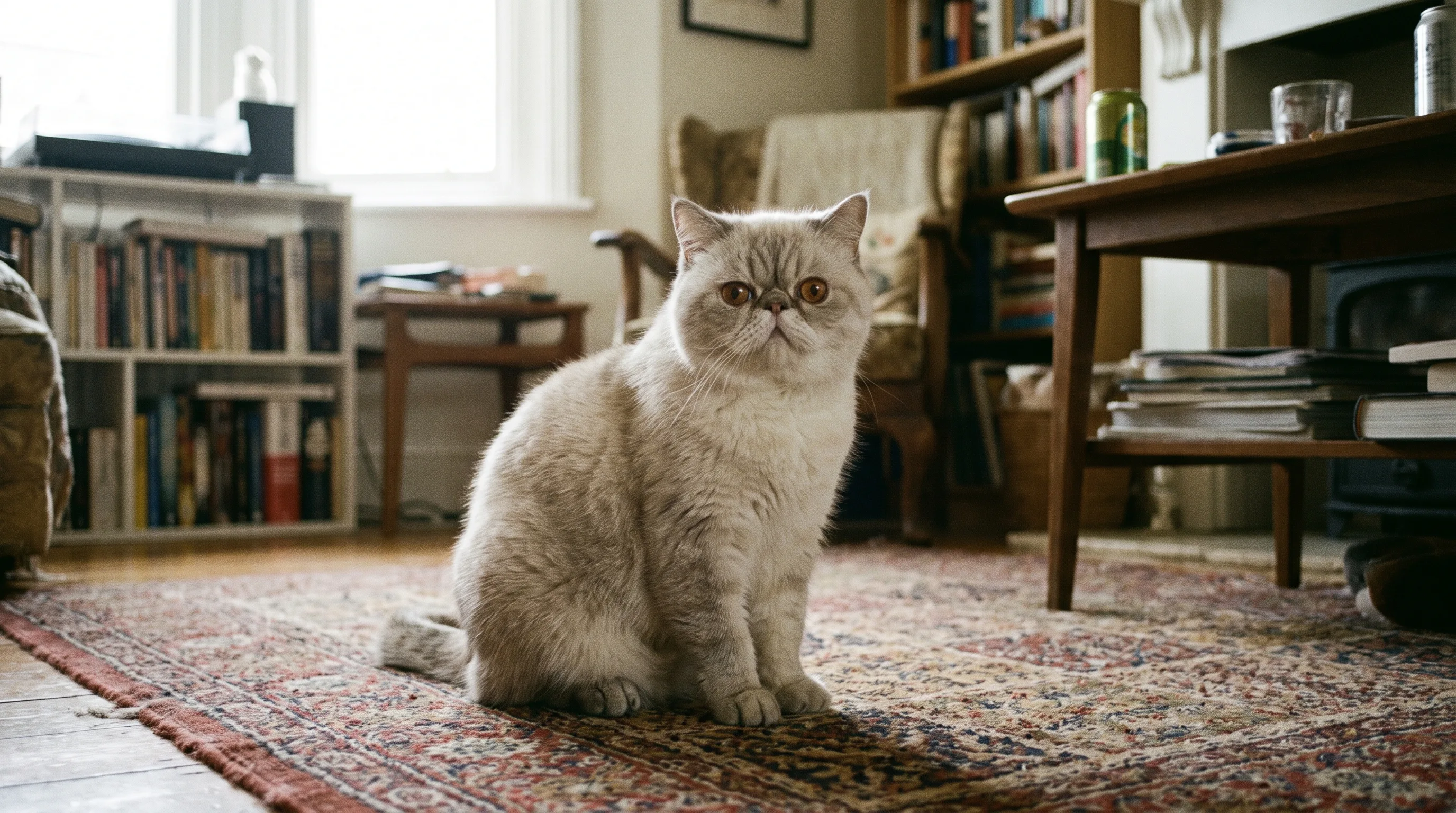
Exotic Shorthair
The Persian without the daily comb — and with the same flat face to think about.
On these lists: Cats for seniors
Vital stats
| Size | Medium · cobby, heavy-boned, short-legged |
| Weight | 3.5–6 kg · males heavier |
| Life expectancy | 12–16 years |
| Energy | Low to moderate — short bursts, long rests |
| Shedding | Moderate, dense double coat |
| Coat | Short, dense, plush; stands off the body |
| Group | Shorthair |
| Origin | United States |
Breed traits
Friendliness
Care
Mind
The Exotic Shorthair by the numbers
The Exotic Shorthair facts owners search for most — price, lifespan, weight, shedding and colours, in one place.
Widely bred, so you can usually find a litter from a registered breeder without a long wait. Ongoing costs stay modest — it eats little and routine vet care sits at the lower end.
We don't quote a single figure: the real price swings with breeder, region, bloodline and health testing — and a rescue costs a fraction of a breeder's litter. Adopting is almost always the cheapest route.
Temperament
Exotics are the calm option. They're affectionate without being insistent, they'd rather sit beside you than on you, and they take household noise, visitors and dogs in their stride. They play in short bursts, often with a favourite toy carried around, then sleep for hours. They're quiet — a soft, rarely-used voice — and they tolerate being alone for a working day better than most affectionate breeds, which is unusual. What they aren't is athletic: an Exotic isn't going to climb the curtains or patrol the top of the wardrobe, and a household that wants an active cat should look elsewhere.
Habits & quirks
Carries a toy
A common Exotic habit: one favoured object gets moved from room to room and slept next to. It is the most active thing many of them do all day.
Sits, and stays sat
Low energy is a breed feature, not a fault. An Exotic will occupy the same chair for hours and is entirely content doing it.
Snores
Short muzzles make for noisy sleepers. A soft snore or snuffle at rest is common; laboured breathing when awake or after mild activity is not, and is a vet visit.
Runs the tear ducts
The flat face crowds the tear ducts, so most Exotics have wet, staining eyes that need wiping daily. This is a routine, not an occasional job.
Care
| Grooming | Genuinely easy compared to a Persian — a comb twice a week keeps the dense plush coat clear, and it doesn't mat the way a long coat does. Longhaired kittens from Exotic litters need the full Persian routine instead. |
| The face | Daily. Wipe the eyes and the nose fold with a soft damp cloth to prevent staining and skin infection. Check the nostrils are open, and mention any noisy breathing to your vet rather than accepting it as a breed sound. |
| Health screening | Two are non-negotiable: a negative PKD1 DNA test on both parents for polycystic kidney disease, which came in from the Persian side and can still be found in unscreened lines, and a cardiologist's echo for hypertrophic cardiomyopathy. Ask also about brachycephalic airway problems and about difficult births, which are common in flat-faced breeds. |
| Heat | A short muzzle is a poor radiator. Exotics cope badly with hot weather, so keep them cool and indoors on hot days, and never leave one in a car or a conservatory. |
Life expectancy
This breed has a typical life expectancy of 12–16 years.
Similar breeds
Breeds with a similar build and background — worth a look if this one isn't quite the fit.
Common questions
Is an Exotic Shorthair just a short-haired Persian?
Effectively yes, and that's the point of it. Same standard, same body, same temperament, a shorter coat — hence the old nickname, the lazy man's Persian. Because Persian outcrossing is still permitted, Exotic litters regularly contain longhaired kittens, and the two breeds share the same health profile.
Does the flat face cause problems?
It can, and how much depends on how extreme the individual is. Crowded tear ducts are near-universal and need daily wiping. Narrowed nostrils and a shortened airway cause snoring in many and real breathing difficulty in some; heat tolerance is poor across the board. Cats with a more open muzzle generally breathe better, and asking to see the parents breathe at rest is a reasonable thing to do.
Are they good with children?
Yes, provided the children are calm. Exotics are patient, they don't scratch readily, and they enjoy company. They're also not fast enough to get out of the way of a toddler, so they need a raised retreat they can actually use, and children need to be taught to leave a sleeping cat alone.
Does the Exotic Shorthair shed a lot?
Moderately. The Exotic Shorthair sheds a fair amount, steadily through the year with heavier seasonal patches. A weekly brush keeps most of the loose hair off your floors and clothes.
Are Exotic Shorthair cats hypoallergenic?
No cat breed is truly hypoallergenic, and the Exotic Shorthair isn't one of the easier ones. The trigger is Fel d 1, a protein in a cat's saliva and skin that ends up on the coat during grooming and then spreads on loose hair and dander — and this breed sheds enough to move plenty of it around. If someone at home is allergic to cats, this is a hard breed to live with; spend real time around one first.
How much grooming does a Exotic Shorthair need?
A weekly comb is usually enough for the Exotic Shorthair, with a second pass during a seasonal moult. That keeps loose hair off your furniture and cuts down on hairballs, since everything the cat doesn't shed onto the sofa it swallows while washing.