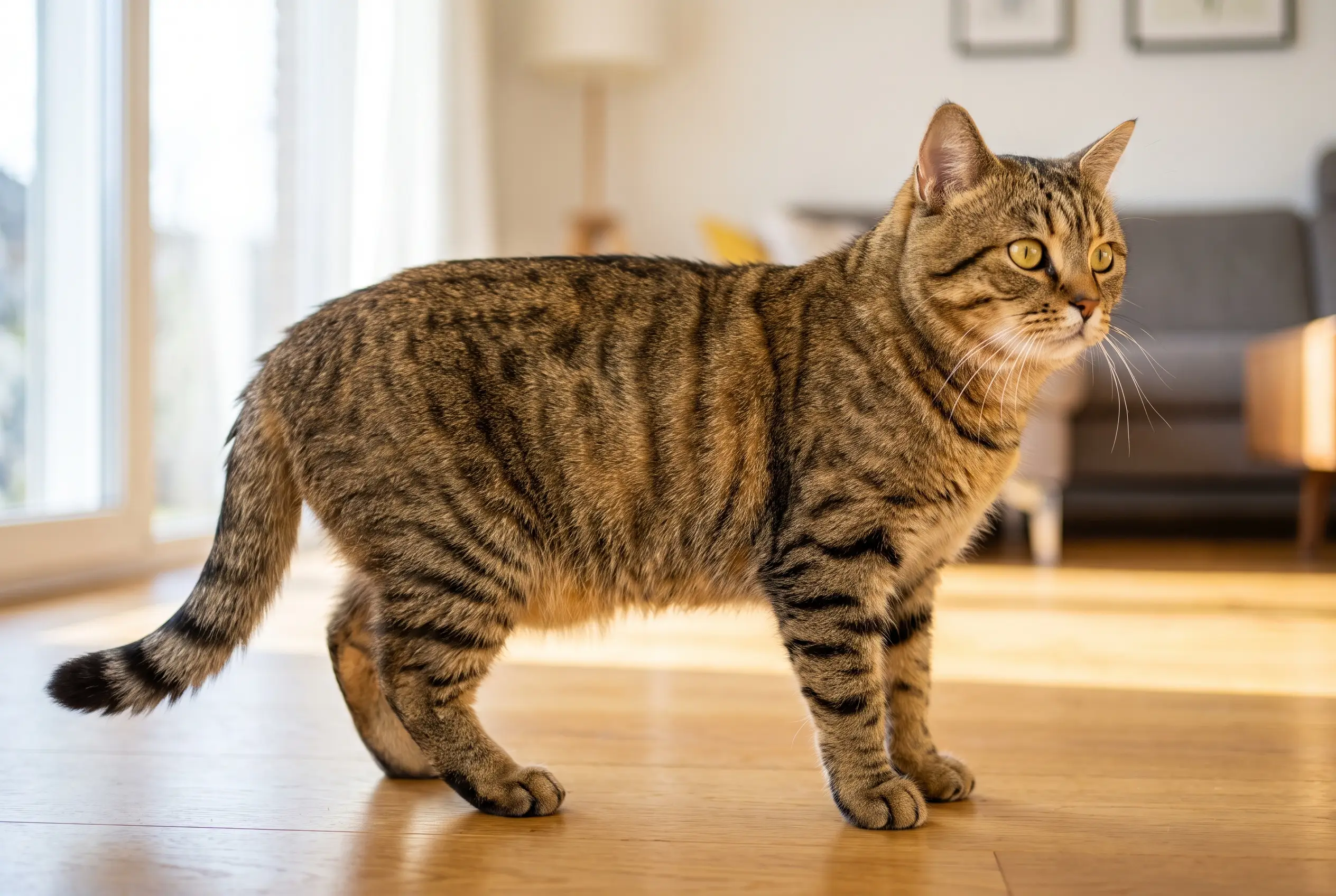
Dragon Li
China's native farm-and-street cat, given a written standard only in this century — and still, mostly, just a very good hunter.
Vital stats
| Size | Medium · compact, muscular, round head |
| Weight | 4–5.5 kg · breed literature, no standard figure |
| Life expectancy | 12–15 years · breed literature |
| Energy | High — active and half-hunting most of the day |
| Shedding | Moderate |
| Coat | Short, thick, ticked; golden-brown mackerel tabby, darkest at the tips |
| Group | Shorthair |
| Origin | China |
Breed traits
Friendliness
Care
Mind
The Dragon Li by the numbers
The Dragon Li facts owners search for most — price, lifespan, weight, shedding and colours, in one place.
Less common, so expect a waitlist and some travel to a reputable breeder — which pushes the price up. Ongoing costs stay modest — it eats little and routine vet care sits at the lower end.
We don't quote a single figure: the real price swings with breeder, region, bloodline and health testing — and a rescue costs a fraction of a breeder's litter. Adopting is almost always the cheapest route.
Temperament
Shaped by farm work rather than a breeding programme, the Dragon Li is clever, watchful and largely self-directed. It hunts for real — mice, insects, anything that moves in a yard — and that drive doesn't switch off indoors; toys get stalked and pounced on with actual intent rather than a half-hearted swat. Some owners describe a cat that will bring an object back on its own initiative, though that's an individual quirk that turns up often enough to mention, not a documented trait every Dragon Li shows. Underneath the independence, breed literature consistently calls the temperament gentle: this isn't a cat that ignores you, it's a cat that decides on its own schedule when affection happens. It's also slow to grow up — breeders report up to three years before an adult body, coat and temperament all settle, longer than almost any other shorthair. With its own household it warms up; with strangers, it tends to hold back and take its time.
Habits & quirks
Hunts like the job never ended
Generations as a farm and granary cat left a strong prey drive that doesn't switch off behind a door. Indoors, that means real stalking of a moving toy, not the half-hearted swat most shorthairs give a feather wand.
Takes its time growing up
Breeders report a Dragon Li isn't a finished adult — body, coat and temperament together — until close to three years old, well past the age most shorthairs settle.
Some will fetch
A number of owners describe a Dragon Li bringing back a thrown toy on its own initiative. It isn't a documented breed-wide trait the way it is in some other breeds, just a report that turns up often enough to be worth mentioning — don't buy one expecting a retriever.
Wears a very specific tabby
Look for the details the standard actually asks for: dark lines running back from the eyes ('tears of the dragon'), one unbroken necklace across the chest, a single stripe down the spine, and legs that close into full rings rather than broken bars. An ordinary brown tabby usually gets one or two of these right, rarely all four.
Care
| Grooming | The short, dense coat needs a weekly brush and nothing more — there's no undercoat to mat and no fringe to keep clean. |
| Health screening | No breed-specific DNA panel exists; the registered population has always been too small for the kind of study that identifies and names an inherited disease. That's an absence of data, not a clean bill of health. Ask for a basic wellness exam and current FeLV/FIV status, the same as for any cat with recent outdoor ancestry. |
| Exercise | This is a working cat without work to do. Give it something to chase every day — a wand toy, a puzzle feeder, rotated hunting-style games — or it invents its own targets, which around a house usually means houseplants and moths. |
| Sourcing | Be realistic about where one actually comes from. Outside China there is essentially no active breeding pipeline; CFA's brief support ended in 2015 and no other major registry picked the breed up afterward. Inside China, CAA-registered Dragon Li are a small, specific population — the great majority of golden-brown tabby street and farm cats that match the look are simply that: unregistered cats, not pedigreed Dragon Li. |
Life expectancy
This breed has a typical life expectancy of 12–15 years · breed literature.
Similar breeds
Breeds with a similar build and background — worth a look if this one isn't quite the fit.
Common questions
Is my brown tabby secretly a Dragon Li?
Almost certainly not. A brown mackerel tabby coat is common in random-bred cats worldwide and isn't, by itself, evidence of anything. A pedigree Dragon Li comes with CAA papers (or, historically, a CFA Miscellaneous-class registration, which CFA stopped issuing in 2015) tracing to the standardized Chinese population, plus the specific markings the standard asks for — the eye-line 'tears,' the unbroken chest necklace, the single dorsal stripe, fully closed leg rings. A moggie with a similar coat is just a moggie.
How is the Dragon Li different from a Bengal or an Egyptian Mau?
Mainly the pattern. The Dragon Li is a mackerel tabby — narrow parallel stripes running down the sides, not spots. The Egyptian Mau is naturally spotted, and the Bengal is spotted or marbled from deliberate breeding with the Asian leopard cat generations back. The ancestry differs just as much: the Mau's spotting is old and natural, the Bengal's comes from a wild cross, and the Dragon Li is a natural Chinese landrace with no wildcat blood in it at all.
Can you actually buy a Dragon Li outside China?
Realistically, no. CFA gave it five years of Miscellaneous-class showing and dropped the breed in 2015 when the population never grew past a handful of cats and one active US breeder; no other Western registry has taken it up since. A few may exist through direct import or dedicated hobbyist breeding, but there's no established pipeline the way there is for, say, the Egyptian Mau. Almost anything sold as a 'Dragon Li' in the West is a golden-brown tabby domestic shorthair, not a papered one.
Does the Dragon Li shed a lot?
Moderately. The Dragon Li sheds a fair amount, steadily through the year with heavier seasonal patches. A weekly brush keeps most of the loose hair off your floors and clothes.
Are Dragon Li cats hypoallergenic?
No cat breed is truly hypoallergenic, and the Dragon Li isn't one of the easier ones. The trigger is Fel d 1, a protein in a cat's saliva and skin that ends up on the coat during grooming and then spreads on loose hair and dander — and this breed sheds enough to move plenty of it around. If someone at home is allergic to cats, this is a hard breed to live with; spend real time around one first.
Are Dragon Li cats good with children?
Often, in the right home. The Dragon Li is reasonably sociable and can settle well with children who already know how to handle a cat gently. Give it high perches and a room the kids don't own, and introductions go far better.
How much grooming does a Dragon Li need?
Very little. The Dragon Li handles its own coat and a comb once a week or so is plenty — mostly to catch loose hair before the cat swallows it. Claws, teeth and ears still want the usual checks, which is the part people skip on an easy-coated cat.