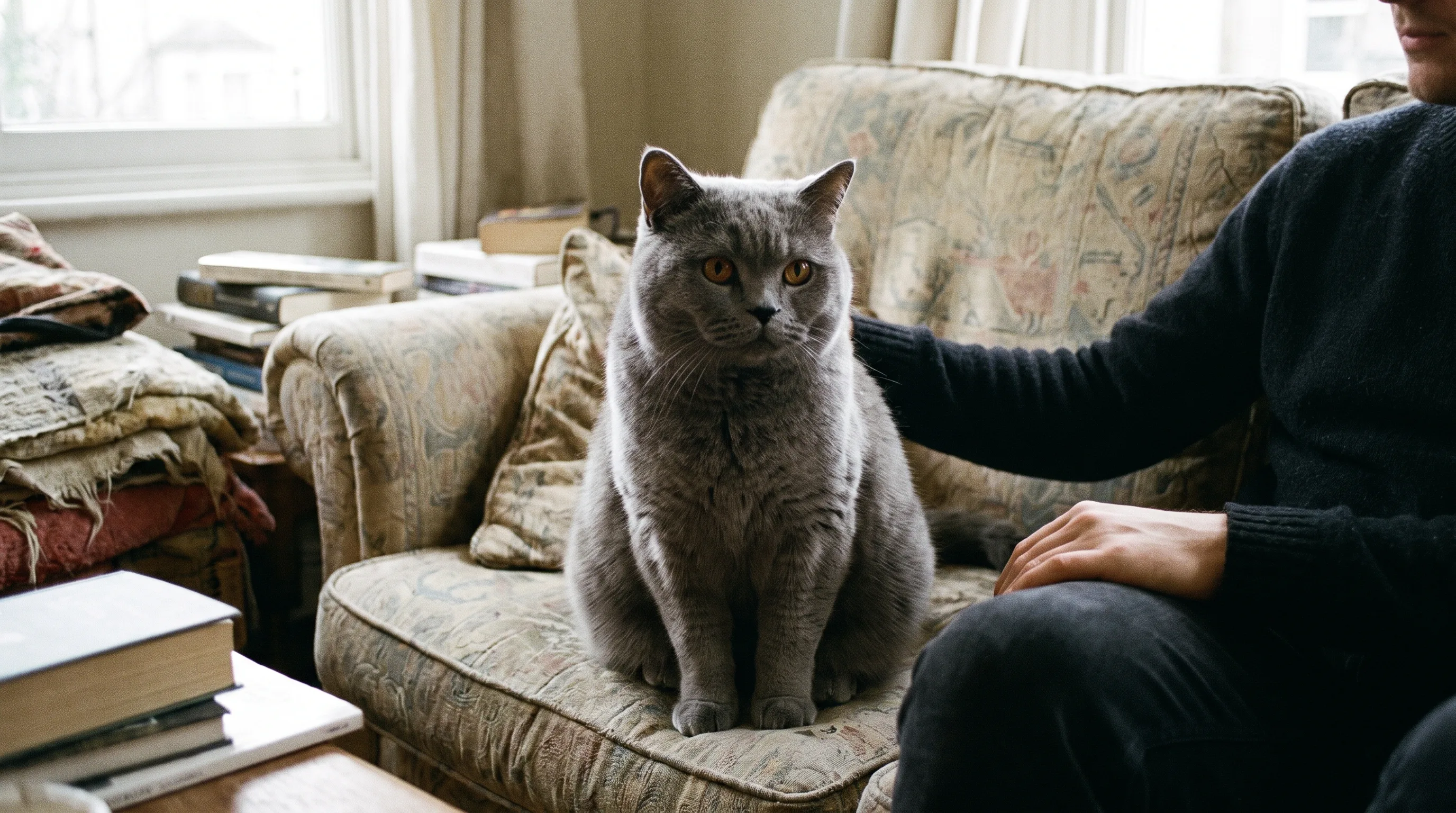
British Longhair
All the British Shorthair's dignity, wrapped in twice the coat.
On these lists: Cats for seniors
Vital stats
| Size | Medium to large · cobby, heavy-boned, powerful |
| Weight | 3.5–5.5 kg females · up to 8 kg males |
| Life expectancy | 12–16 years |
| Energy | Low to moderate — short games, long naps |
| Shedding | High, with a dense undercoat |
| Coat | Semi-long, thick plush double coat with a ruff |
| Group | Longhair |
| Origin | United Kingdom |
Breed traits
Friendliness
Care
Mind
The British Longhair by the numbers
The British Longhair facts owners search for most — price, lifespan, weight, shedding and colours, in one place.
Less common, so expect a waitlist and some travel to a reputable breeder — which pushes the price up. Ongoing costs stay modest — it eats little and routine vet care sits at the lower end.
We don't quote a single figure: the real price swings with breeder, region, bloodline and health testing — and a rescue costs a fraction of a breeder's litter. Adopting is almost always the cheapest route.
Temperament
British Longhairs are undemanding company with firm views on personal space. They're affectionate on their own terms — following you from room to room, settling on the sofa beside you, sleeping at the foot of the bed — and most of them dislike being lifted, held or carried, which surprises people who expect a big fluffy cat to be a cuddler. They're patient with children who don't grab, unbothered by dogs, and they tolerate a working day alone better than almost any other affectionate breed. Play is short and enthusiastic and then over. Slow to mature: three to five years to reach full size and full coat.
Habits & quirks
Sits beside you
The defining habit. A British Longhair wants company at arm's length and will move to the next cushion rather than onto your lap — and object, briefly and clearly, if you pick it up.
Grows for years
Full size, full jowls and full coat take three to five years. A yearling looks like a different, leggier cat.
Sheds in drifts
The dense undercoat comes out twice a year in quantity. During those weeks the coat needs daily attention and the house needs a lint roller.
Keeps its own hours
Independent enough to spend an afternoon somewhere else in the house without checking in, which is exactly what makes it workable for people who go out to work.
Care
| Grooming | Two or three combs a week through the ruff, the armpits and the trousers, and daily during the spring and autumn moults. A dense undercoat under a semi-long topcoat is the classic recipe for mats at the skin, so a comb that reaches the base of the coat matters more than a brush that skims the top. |
| Weight — the standing risk | Low energy plus a heavy frame plus a coat that hides the outline. British cats are among the most commonly overweight pedigrees. Feed measured meals, weigh the cat every couple of months rather than judging by eye, and keep daily play in the routine. |
| Health screening | Ask for a negative PKD1 DNA test on both parents — the post-war Persian outcrosses put polycystic kidney disease into the British lines, and it is still found in unscreened cats. Add a cardiologist's echo for hypertrophic cardiomyopathy, which is the other significant inherited risk. |
| Handling | Work with the breed rather than against it. Teach children to stroke rather than lift, do nail trims and vet handling in short sessions from kittenhood, and accept that this is a cat that shows affection by proximity. |
Life expectancy
This breed has a typical life expectancy of 12–16 years.
Similar breeds
Breeds with a similar build and background — worth a look if this one isn't quite the fit.
Common questions
Is the British Longhair a real breed or just a fluffy British Shorthair?
Both, depending on the registry. Genetically it is a British Shorthair carrying the recessive longhair gene, and the kittens have always turned up in British litters. TICA, WCF and LOOF give it its own standard and its own classes; CFA does not recognise it. If you're buying, the practical question is whether the breeder is registering and health-testing to a real standard, not which side of that argument they're on.
Do they need as much grooming as a Persian?
No, but more than people expect. A Persian needs daily combing to stay out of trouble; a British Longhair needs two or three times a week most of the year and daily through the moults. The coat is plush rather than silky, so it packs down against the skin if it's neglected.
Why doesn't mine like being picked up?
Because that's the breed. British cats — short and long — are affectionate but not handleable in the way a Ragdoll or a Birman is, and being lifted removes their control of the situation. It isn't a training failure and it usually doesn't change with age. Sit down and let the cat come to you instead.
Does the British Longhair shed a lot?
Moderately. The British Longhair sheds a fair amount, steadily through the year with heavier seasonal patches. A weekly brush keeps most of the loose hair off your floors and clothes.
Are British Longhair cats hypoallergenic?
No cat breed is truly hypoallergenic, and the British Longhair isn't one of the easier ones. The trigger is Fel d 1, a protein in a cat's saliva and skin that ends up on the coat during grooming and then spreads on loose hair and dander — and this breed sheds enough to move plenty of it around. If someone at home is allergic to cats, this is a hard breed to live with; spend real time around one first.
Are British Longhair cats good with children?
Usually yes. The British Longhair is a sociable cat that tends to tolerate the noise and handling of family life better than most, which is why it comes up so often for homes with kids. It still needs somewhere high and quiet to retreat to, and children need teaching that a cat walking away is allowed to.