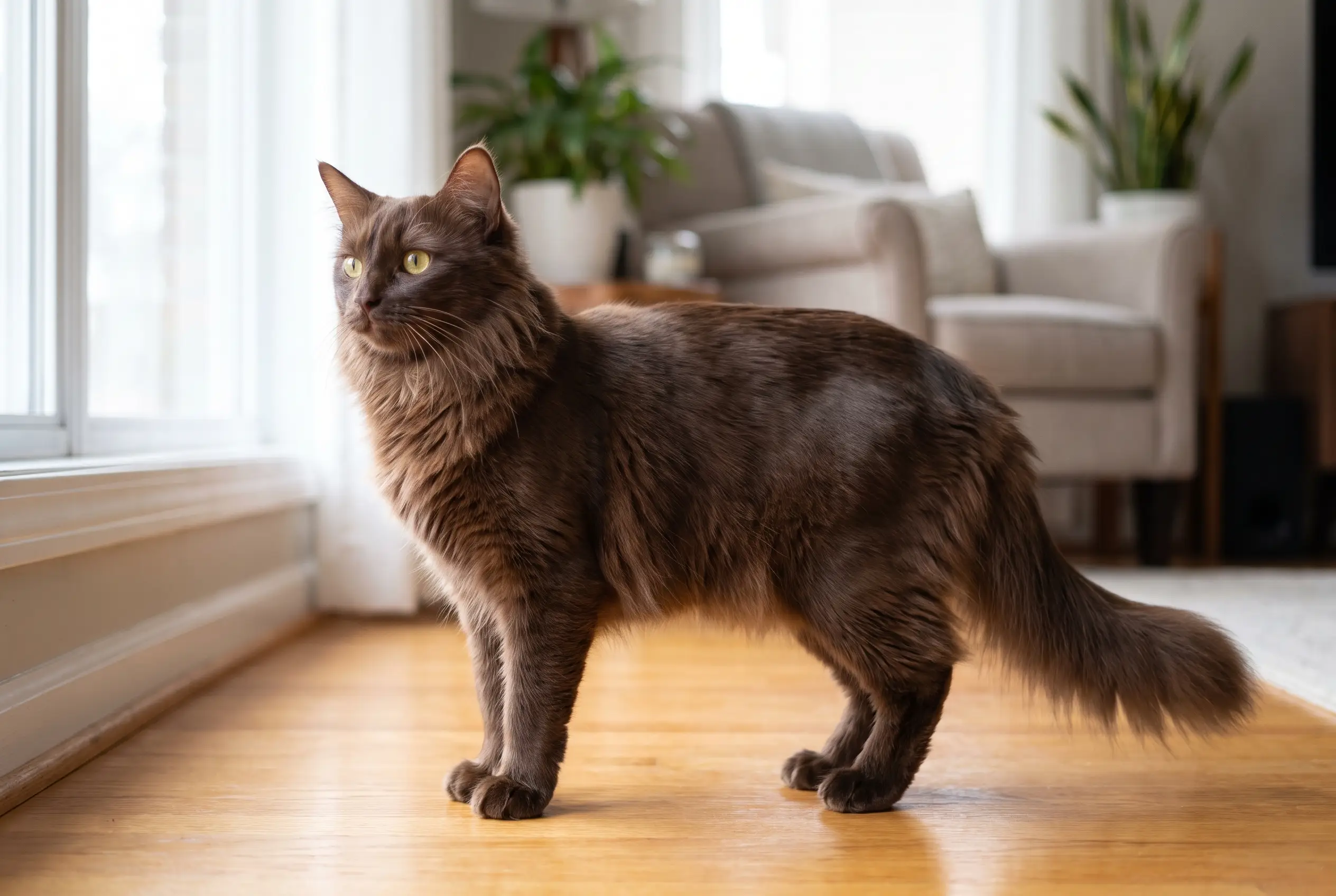
Asian Semi-Longhair
The Burmilla's long-coated sibling, and the last of Britain's Asian cats to earn full recognition.
Vital stats
| Size | Medium to large · lean, muscular Burmese-type build |
| Weight | 3.5–7 kg · males heavier |
| Life expectancy | 16–18 years — GCCF's Asian-group figure, matching the range independently sourced for the Burmilla |
| Energy | High — playful well into adulthood |
| Shedding | Low to moderate, no thick undercoat |
| Coat | Medium-length, fine, silky; plumed tail, tufted ears |
| Group | Longhair |
| Origin | United Kingdom |
Breed traits
Friendliness
Care
Mind
The Asian Semi-Longhair by the numbers
The Asian Semi-Longhair facts owners search for most — price, lifespan, weight, shedding and colours, in one place.
Less common, so expect a waitlist and some travel to a reputable breeder — which pushes the price up. Ongoing costs stay modest — it eats little and routine vet care sits at the lower end.
We don't quote a single figure: the real price swings with breeder, region, bloodline and health testing — and a rescue costs a fraction of a breeder's litter. Adopting is almost always the cheapest route.
Temperament
Tiffanies behave like Burmillas with more hair, which in practice means Burmese manners with the volume turned down a notch. They want to be wherever the household is: on the desk, in the kitchen doorway, draped over a shoulder, and they'll fetch a scrunched ball of paper if you throw it enough times that they decide the game is worth the effort. The voice is a real feature, not loud but constant, and a Tiffanie answers when spoken to rather than only ever initiating. Put two together and they compete for status, the best chair, the best lap, the last word, so a second confident cat suits this breed better than a shy one. Left alone all day in a quiet house a Tiffanie gets bored rather than distressed, and bored in this breed still means opened cupboards and a knocked-over plant.
Habits & quirks
Plays fetch when the mood is right
A thrown paper ball or hair tie gets chased down and carried back, at least until the cat decides the game is over. It's one of the more dog-like habits owners bring up first.
Answers when spoken to
The voice stays soft and gets used constantly rather than saved for demands. Say its name and a Tiffanie will usually chirp back before deciding whether it's worth coming over.
Negotiates for the good chair
Two Tiffanies in one house work out a hierarchy over the best cushion, the warmest patch of sun and whichever lap is occupied, and they are not quiet about the negotiation.
Watches from height
The plumed tail and tufted ears show best when the cat is up on a shelf or the back of the sofa, which is where it spends a large part of its day.
Care
| Grooming | There's no thick undercoat, so a comb once or twice a week through the ruff and tail keeps the silky coat free of the mats that plague true longhairs. There's no seasonal blowout to build a routine around. |
| Health screening | Two DNA tests matter, one from each side of the family. Hypokalaemia, a WNK4 mutation causing episodic muscle weakness inherited from the Burmese line, has been mandatory for GCCF-registered breeding Asians since January 2018. Polycystic kidney disease, PKD1, an autosomal dominant cyst disorder inherited from the founding Persian, sits at moderate risk in this line rather than the high risk it carries in Persians themselves; it's the same UC Davis DNA test either way, and worth asking for. |
| Weight | The Burmese side of the pedigree carries a real diabetes tendency. Keep a Tiffanie lean and feed measured meals rather than leaving a full bowl down. |
| Company | Less clingy than a Burmese but still a cat that wants an audience. A second confident cat, or a household that's rarely empty, suits it better than a quiet flat all day. |
Life expectancy
This breed has a typical life expectancy of 16–18 years — GCCF's Asian-group figure, matching the range independently sourced for the Burmilla.
Similar breeds
Breeds with a similar build and background — worth a look if this one isn't quite the fit.
Common questions
Is the Tiffanie the same cat as the Chantilly-Tiffany?
No, and the two names have been confused for decades, including by breeders. The Tiffanie is British: a semi-longhaired member of GCCF's Asian group, bred from Burmese and Chinchilla Persian lines, registered in the full range of Asian self, tabby, smoke and shaded colours. The Chantilly-Tiffany was American: a solid chocolate-coated semi-longhair of disputed origin, developed in New York and Florida from the late 1960s, never recognised by CFA or TICA, and considered extinct since around 2015. If a listing calls the cat a 'Tiffany', shows a uniform chocolate coat with amber eyes and carries no GCCF paperwork, it isn't this breed.
What's the difference between a Tiffanie and a Burmilla?
Coat length, and not much else. Both trace to the same 1981 Chinchilla Persian by Burmese litter, share the Asian group's body type, colours and temperament standard, and a Tiffanie is simply a Burmilla carrying the recessive long-hair gene handed down from the Persian side. Two carriers paired together are what produced the first Tiffanies out of an ordinary Burmilla breeding programme.
Can I find a Tiffanie outside the United Kingdom?
With difficulty, and under a different name. GCCF recognises it, a handful of European clubs that follow GCCF's lead register a few, and Australia runs its own breeding programme under a separate, colour-restricted standard known locally as the Australian Tiffanie. Neither CFA nor TICA uses the Tiffanie name or GCCF's Asian-group framework, but the same cross does have a foothold in North America: CFA recognises it as the longhair Burmilla, registered in 2011 and moved to full championship in 2014, and TICA registers it too, at a lower, registration-only tier. A buyer in the US or Canada should search under 'longhair Burmilla' rather than 'Tiffanie', and still expect a long wait list or an import.
Does the Asian Semi-Longhair shed a lot?
Moderately. The Asian Semi-Longhair sheds a fair amount, steadily through the year with heavier seasonal patches. A weekly brush keeps most of the loose hair off your floors and clothes.
Are Asian Semi-Longhair cats hypoallergenic?
No cat breed is truly hypoallergenic, and the Asian Semi-Longhair isn't one of the easier ones. The trigger is Fel d 1, a protein in a cat's saliva and skin that ends up on the coat during grooming and then spreads on loose hair and dander — and this breed sheds enough to move plenty of it around. If someone at home is allergic to cats, this is a hard breed to live with; spend real time around one first.
Are Asian Semi-Longhair cats good with children?
Usually yes. The Asian Semi-Longhair is a sociable cat that tends to tolerate the noise and handling of family life better than most, which is why it comes up so often for homes with kids. It still needs somewhere high and quiet to retreat to, and children need teaching that a cat walking away is allowed to.
How much grooming does a Asian Semi-Longhair need?
A weekly comb is usually enough for the Asian Semi-Longhair, with a second pass during a seasonal moult. That keeps loose hair off your furniture and cuts down on hairballs, since everything the cat doesn't shed onto the sofa it swallows while washing.