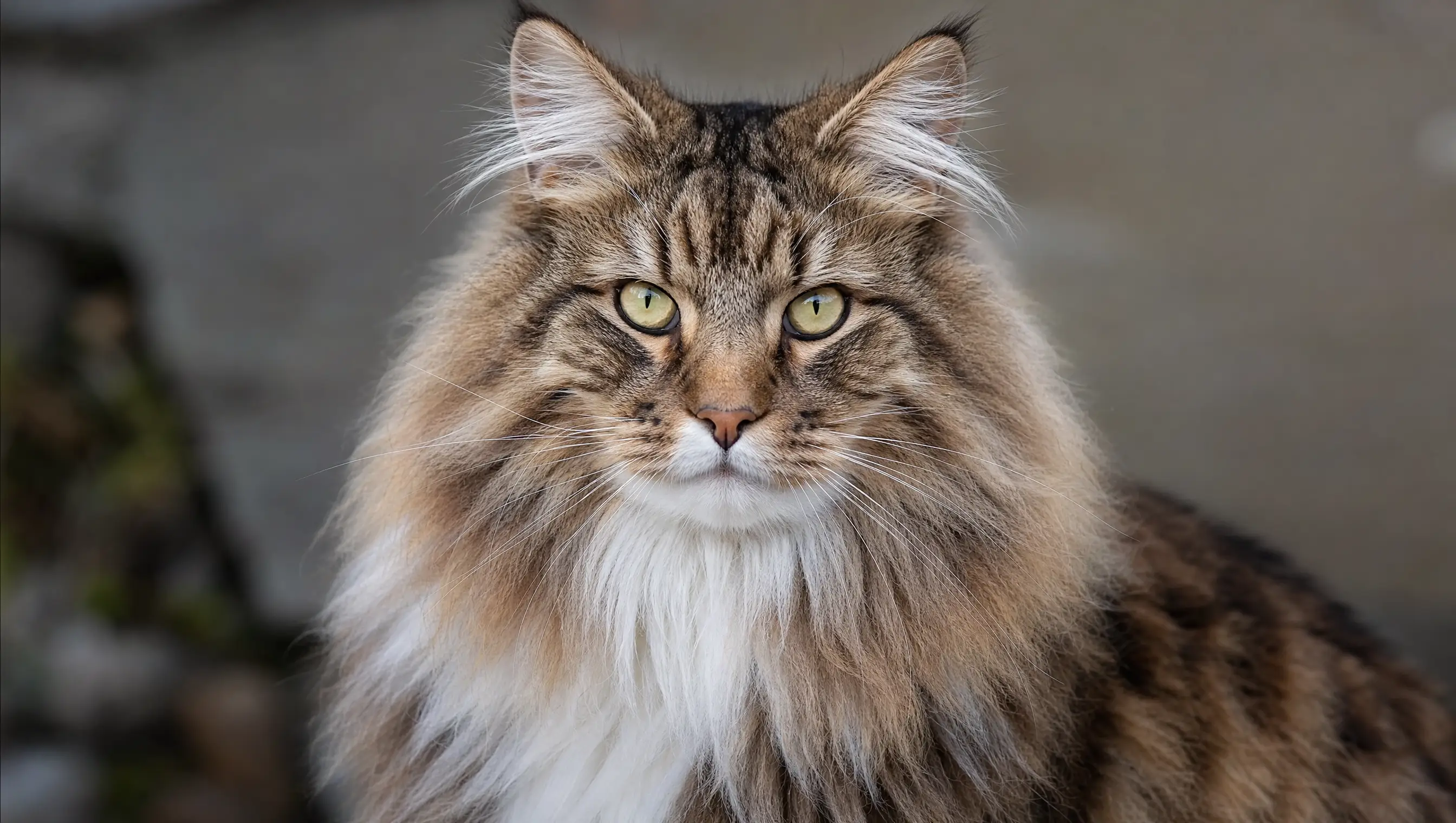
Norwegian Forest Cat
Norway's forest cat — a climber built for snow, calm in the house and happiest up high.
Vital stats
| Size | Large · long-bodied, muscular build |
| Weight | 4–9 kg · toms markedly heavier |
| Life expectancy | 14–16 years |
| Energy | Moderate — active climber, settles indoors |
| Shedding | Heavy, strongly seasonal |
| Coat | Long double coat, water-resistant |
| Group | Longhair |
| Origin | Norway |
Breed traits
Friendliness
Care
Mind
The Norwegian Forest Cat by the numbers
The Norwegian Forest Cat facts owners search for most — price, lifespan, weight, shedding and colours, in one place.
Less common, so expect a waitlist and some travel to a reputable breeder — which pushes the price up. Ongoing costs stay modest — it eats little and routine vet care sits at the lower end. Its coat also needs a professional groom every few weeks — a real line in the budget.
We don't quote a single figure: the real price swings with breeder, region, bloodline and health testing — and a rescue costs a fraction of a breeder's litter. Adopting is almost always the cheapest route.
Temperament
The Norwegian Forest Cat is friendly on its own terms. It bonds hard with its household and likes company, but it won't drape itself over strangers or demand attention every waking minute — count on it choosing the top of the bookcase over your lap more often than not. Quiet, too: a soft chirp or trill rather than a running commentary. It stays playful and physically busy well into adulthood, and those long hind legs make it a serious climber that treats tall furniture as a starting point. Slow to mature, taking up to five years to fill out, and slow to fluster once it does. Patient with children and other pets when introduced properly, it makes a steady, low-drama housemate that keeps a bit of its wildcat self-possession.
Habits & quirks
Climber, not a lap cat
Long back legs make it a natural climber that heads for the highest shelf; it can descend a tree head-first, which most cats can't.
Two-part shed
The coat blows out heavily in spring as the woolly undercoat drops, then thickens again for winter — grooming load swings with the seasons.
Quietly affectionate
It follows you between rooms and wants to be near, but stays independent and rarely vocal about it — a soft trill is usually all you'll get.
Slow to grow up
Won't reach full size and coat until four or five, so expect a long, leggy adolescent stage before it fills out.
Health
The Norwegian Forest Cat is a hardy, slow-maturing breed, but there are three things a good breeder screens for. It carries a risk of HCM, the inherited heart-muscle disease, and of hip dysplasia — unusual in cats and worth knowing in a heavy, climbing breed. It also has a specific inherited disorder, glycogen storage disease type IV (GSD IV), which a reliable DNA test can rule out, so buy only from a breeder who tests the parents. Beyond that, the main everyday job is the coat and the weight: that double coat hides a lot, including extra kilos.
Nutrition
| Grooming | Comb once or twice a week most of the year, then daily during the spring moult when the undercoat sheds; focus on the ruff, armpits and britches where mats form. |
| Health | The breed carries risk of HCM (a heart condition) and hip dysplasia; it also has a specific inherited disorder, glycogen storage disease type IV (GSD IV), for which a reliable DNA test exists — buy only from a breeder who screens the parents. |
| Space to climb | This is a cat that needs vertical room. A tall, sturdy tree or well-placed shelves keep it exercised and content; without height it gets bored and heavy. |
| Feeding | A big, slow-maturing frame does best on steady measured meals; once it stops growing, watch portions, because the heavy coat can hide weight gain until it's a problem. |
A big, slow-growing carnivore does best on steady, measured meals rather than a bowl left out. This cat takes up to five years to fill out its frame, so feed for real size and let it grow without pushing weight on. Once it stops growing, portion control becomes the priority, because the thick double coat can hide weight gain until it's a problem — go by ribs and waist you can feel, not by how it looks. Wet food helps with hydration for a large cat.
Kitten guide
A Norwegian Forest kitten grows slowly and stays leggy and half-formed for a long while, so don't rush it or overfeed to fill it out. Give it height from the start — a tall, sturdy cat tree or shelves — because this is a serious climber and it needs somewhere to go up. Socialise it early with people and other pets, since the adult is friendly but reserved with strangers, and get it used to combing so the seasonal moult is easy later. Set up a safe indoor space, start vaccinations and vet visits, and ask the breeder about GSD IV and hip testing.
Training
Norwegian Forest Cats are calm, self-possessed cats that don't ask for much managing. Litter habits come easily; the real need is vertical space and enrichment for a strong natural climber. Give it a tall tree and high shelves and it exercises itself; leave it grounded and bored and it puts on weight. A sturdy scratching post suits a big, powerful cat — redirect it there from the furniture. It's quiet and independent, so let it come to you, get it used to a carrier early, and keep grooming a normal, unhurried part of the routine.
Life expectancy
Norwegian Forest Cats live 14–16 years. A Wegie from tested parents, kept lean and given room to climb, is a long-lived, low-drama cat. Weight is the quiet lever — the heavy coat hides it — so stay ahead of the portions, screen for the breed's inherited conditions, and keep up the yearly checks as it ages.
Similar breeds
Breeds with a similar build and background — worth a look if this one isn't quite the fit.
Compare this breed
Common questions
What's the difference between a Norwegian Forest Cat and a Maine Coon?
They look similar but aren't related. The Wegie has a triangular head with a straight profile and long, level back legs built for climbing; the Maine Coon has a squarer muzzle, tends to be even larger, and is generally more openly attention-seeking. The Norwegian is a touch more reserved with strangers.
Are Norwegian Forest Cats high-maintenance to groom?
Less than the coat suggests for most of the year — the outer coat resists tangling, so a weekly comb usually does it. The exception is the spring shed, when the undercoat comes out in earnest and you'll want to groom daily for a few weeks.
Do they make good indoor pets?
Yes, provided you give them height. They're calm and quiet enough for a flat, but they're strong climbers by nature, so a tall cat tree or shelving matters more than floor space. Bored and grounded, they put on weight.
Does the Norwegian Forest Cat shed a lot?
Yes — the Norwegian Forest Cat is a heavy shedder, dropping hair year-round or in big seasonal moults. Brush it several times a week and expect regular vacuuming; it isn't the coat for you if loose fur is a dealbreaker.
Are Norwegian Forest Cat cats hypoallergenic?
No cat breed is truly hypoallergenic, and the Norwegian Forest Cat isn't one of the easier ones. The trigger is Fel d 1, a protein in a cat's saliva and skin that ends up on the coat during grooming and then spreads on loose hair and dander — and this breed sheds enough to move plenty of it around. If someone at home is allergic to cats, this is a hard breed to live with; spend real time around one first.
Are Norwegian Forest Cat cats good with children?
Usually yes. The Norwegian Forest Cat is a sociable cat that tends to tolerate the noise and handling of family life better than most, which is why it comes up so often for homes with kids. It still needs somewhere high and quiet to retreat to, and children need teaching that a cat walking away is allowed to.
Stories featuring this breed
All stories →
The longest-lived cat breeds, and what actually adds years
Siamese and Russian Blues regularly see their late teens; some cats double a dog's run. The breeds with the long odds — and the honest truth that how a cat lives beats what it was born as.
Where cat breeds come from, and why there are so few
Cats have a fraction of the breeds dogs do, and most of them are younger than the microwave. The story is landraces with paperwork versus cats made on purpose.