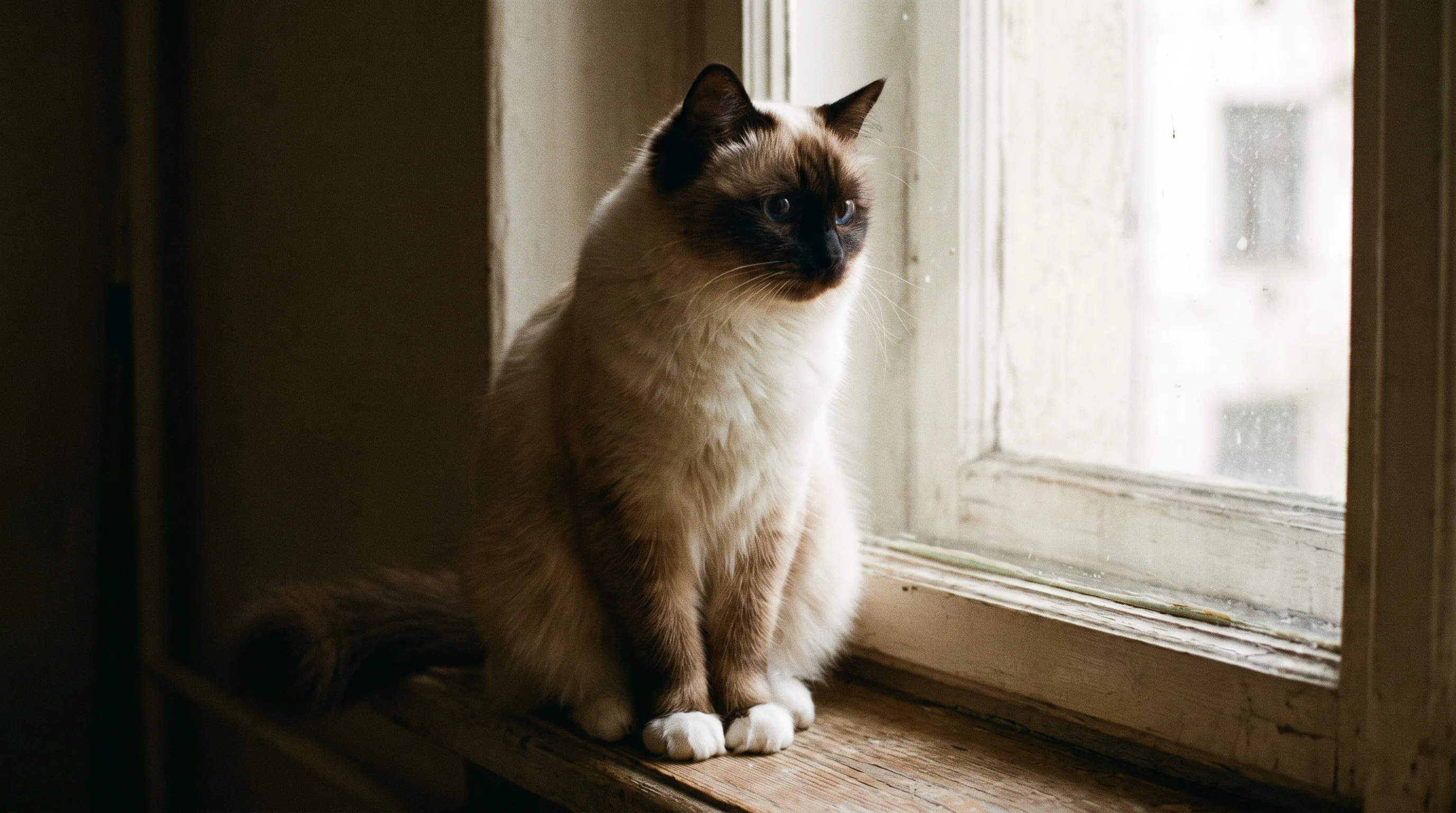
Birman
Pointed like a Siamese, calm like nothing else, and wearing four white gloves.
On these lists: Family cats · Cats for first-time owners · Indoor cats · Cats for seniors
Vital stats
| Size | Medium · stocky, low on the leg |
| Weight | 4–6 kg · males up to 7 kg |
| Life expectancy | 12–16 years |
| Energy | Moderate — plays in bursts, then settles |
| Shedding | Moderate, heaviest in spring |
| Coat | Long, silky, little undercoat; pointed with white gloves |
| Group | Longhair |
| Origin | Myanmar |
Breed traits
Friendliness
Care
Mind
The Birman by the numbers
The Birman facts owners search for most — price, lifespan, weight, shedding and colours, in one place.
Widely bred, so you can usually find a litter from a registered breeder without a long wait. Ongoing costs stay modest — it eats little and routine vet care sits at the lower end.
We don't quote a single figure: the real price swings with breeder, region, bloodline and health testing — and a rescue costs a fraction of a breeder's litter. Adopting is almost always the cheapest route.
Temperament
Birmans are the quiet ones in a room full of pointed cats. They keep the Siamese habit of following their person around but drop the volume: a Birman asks with a look and a small chirp rather than a yowl. They're gentle with children who have been shown how to handle a cat, and they generally accept dogs and other cats without much drama, which is why they're a common choice for busy family homes. The trade-off is that they don't do well ignored. A Birman left alone all day gets flat and withdrawn rather than destructive, which is easier to miss and no kinder. Expect a cat that supervises your work, sits on the newspaper, and sleeps against your legs at night.
Habits & quirks
Keeps the gloves clean
White feet on a cat that walks through a litter tray is a design flaw the breed carries with dignity. Most Birmans are fastidious washers; a clumping litter and a clean tray do the rest.
Talks quietly
The voice is soft and used sparingly — chirps, trills and short questions rather than the Siamese howl. People who want a pointed cat without the noise usually end up here.
Room supervisor
Wherever you are, a Birman is a metre away, sitting upright, watching. Not on your lap every minute, but never in another room either.
Slow to colour
Birman kittens are born white and darken over weeks; the full point colour takes two years or more to settle, and the gloves are already there from the start.
Health
The Birman is generally a robust cat, but there are a few things to raise with a breeder before you commit. The main one is hypertrophic cardiomyopathy, a thickening of the heart muscle that runs in many pedigree cats; ask to see heart-scan results on the parents. The breed also carries a documented congenital condition where kittens are born hairless and fail to thrive, and some lines have shown a higher rate of feline infectious peritonitis. None of that should scare you off a well-run breeder. It's a reason to ask an honest one what they've lost and to what, and to walk away from anyone who won't answer. A placid cat like this also hides weight gain well, so keeping it lean is part of keeping it healthy.
Nutrition
| Grooming | Less than the coat suggests. With very little undercoat it mats far less than a Persian, so a thorough comb twice a week — more during the spring shed, with attention to the ruff and the trousers — keeps it in order. |
| Health screening | Hypertrophic cardiomyopathy is the main concern; ask for scan results on the parents. The breed also carries a documented congenital hypotrichosis with thymic aplasia (hairless kittens that fail to thrive) and a higher rate of feline infectious peritonitis in some lines, so ask what a breeder has lost and to what. |
| Weight | Placid cats put on weight quietly. Feed to a measured amount rather than free-feeding, check the ribs monthly, and keep a couple of daily play sessions in the routine even when the cat doesn't demand them. |
| Company | A Birman is not a cat to leave alone from Monday to Friday. If everyone in the house works out, get two, or accept a subdued cat and plan proper time together morning and evening. |
Cats are obligate carnivores, so build a Birman's diet around animal protein and a complete food rather than fillers. The trap with this breed is its own calmness: a Birman plays in short bursts and then settles, so it burns less than a restless cat and gains weight quietly. Feed measured meals to a set amount rather than topping up a bowl all day, and check the ribs by hand once a month, because under that silky coat the shape is easy to miss. Lean towards wet food or a wet-and-dry mix for the moisture, since cats drink little on their own, and keep fresh water where the cat likes to sit. Count treats inside the daily total.
Kitten guide
Birman kittens are born pure white and darken over the following weeks; the white gloves are there from the start, while the full point colour takes two years or more to settle, so don't judge the markings on a young kitten. Feed a complete kitten food in small, frequent meals through the growing months, and keep to whatever the breeder was using at first to avoid an upset stomach. This is a gentle, people-oriented breed, and early handling brings out the calm adult it's famous for: introduce it quietly to children, other pets and household noise, and teach any children in the house to let a cat walk away. Give it a comb from kittenhood so grooming is a normal part of life, and a Birman raised with company will settle into being the steady, in-the-room cat the breed is known for.
Training
A Birman asks little in the way of training and rewards a bit of routine. Litter habits are usually easy, because the breed is fastidious about those white feet, so a clean, scooped tray with clumping litter, kept away from the food, is most of the job. Put out a scratching post and a few climbing spots, though a Birman is as likely to sit beside you as scale the bookcase. It's a quiet, biddable cat that will learn its name and enjoy a gentle puzzle feeder, and short daily play sessions matter more than they look, because a placid cat left to its own devices tends to eat and sleep and little else. Keep it involved, keep it moving a little every day, and handling stays easy for life.
Life expectancy
Birmans live 12–16 years. Where a Birman lands in that range comes down to the heart and the waistline more than anything else. Hypertrophic cardiomyopathy is the condition to stay ahead of, so buy from lines that scan and keep up with vet checks as the cat gets older. The rest is the quiet work: a measured diet and a hand-check of the ribs every month, because a calm cat under a thick coat puts on weight without anyone noticing, and carrying it shortens a life. Keep the Birman lean, keep it seen by a vet, and the top of that range is well within reach.
Similar breeds
Breeds with a similar build and background — worth a look if this one isn't quite the fit.
Common questions
Is the Birman related to the Burmese?
No, despite the names. The Burmese is a solid-coloured shorthair developed in the United States from a single cat called Wong Mau. The Birman is a long-coated pointed breed rebuilt in France. They share a country in their names and almost nothing else.
What causes the white gloves?
A recessive mutation in the KIT gene, specific to the breed and separate from ordinary white spotting. It's also why gloves are so hard to breed evenly — the gene sets the pattern, but where the white stops is a matter of luck, and an uneven glove ends a show career without affecting the cat at all.
Are Birmans good with children?
Usually yes, and they're one of the calmer choices for a family. They tolerate handling better than most pointed breeds and rarely scratch in protest. Teach children to let a cat walk away, give the Birman a high shelf it can retreat to, and the arrangement generally works.
Does the Birman shed a lot?
Moderately. The Birman sheds a fair amount, steadily through the year with heavier seasonal patches. A weekly brush keeps most of the loose hair off your floors and clothes.
Are Birman cats hypoallergenic?
No cat breed is truly hypoallergenic, and the Birman isn't one of the easier ones. The trigger is Fel d 1, a protein in a cat's saliva and skin that ends up on the coat during grooming and then spreads on loose hair and dander — and this breed sheds enough to move plenty of it around. If someone at home is allergic to cats, this is a hard breed to live with; spend real time around one first.
How much grooming does a Birman need?
A weekly comb is usually enough for the Birman, with a second pass during a seasonal moult. That keeps loose hair off your furniture and cuts down on hairballs, since everything the cat doesn't shed onto the sofa it swallows while washing.