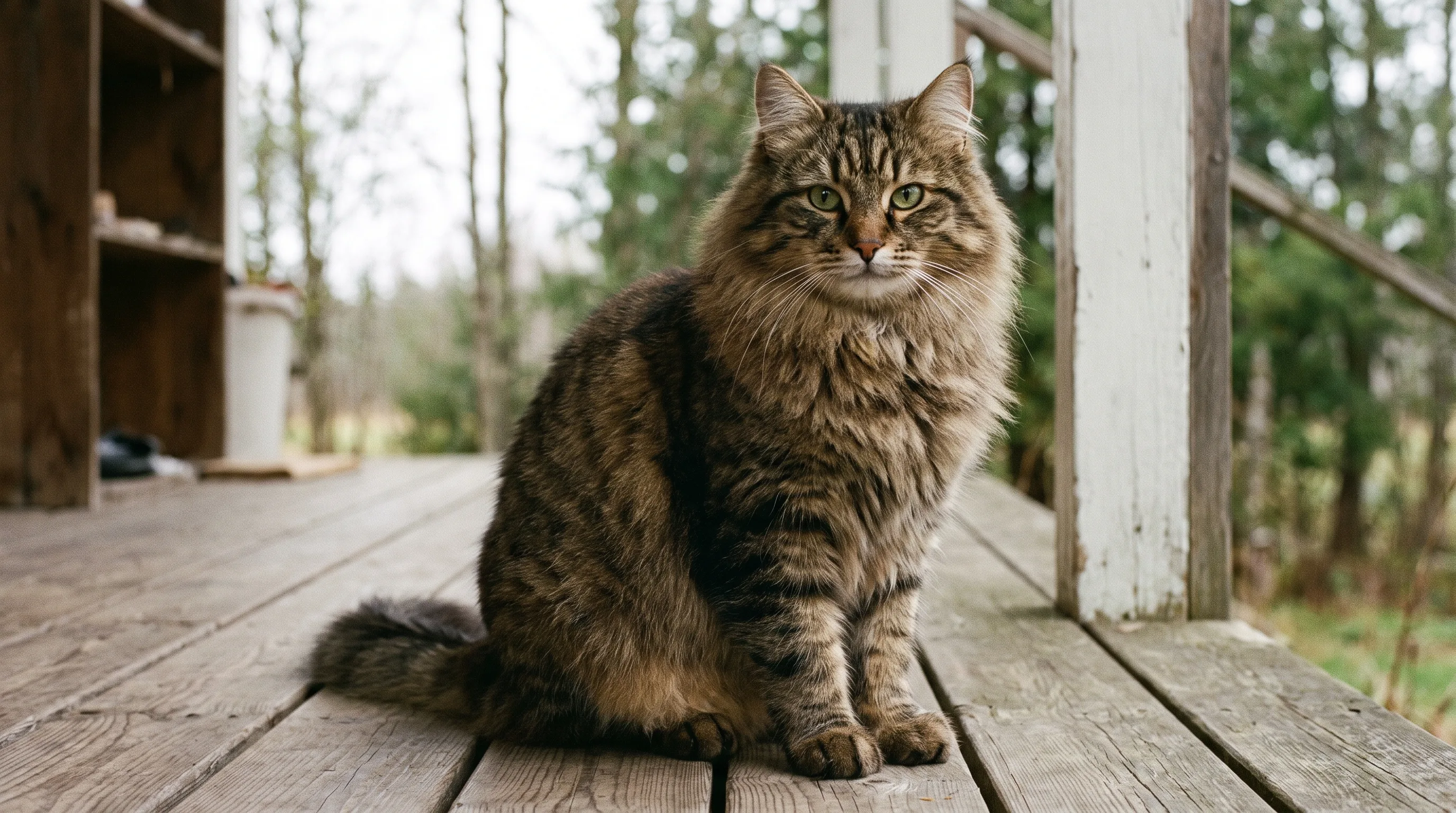
Siberian
Built for a Russian winter, and still convinced your bathroom sink needs supervising.
On these lists: Hypoallergenic cats
Vital stats
| Size | Medium to large · powerful, barrel-chested |
| Weight | 4–6 kg females · 6–9 kg males |
| Life expectancy | 12–15 years |
| Energy | Moderate to high — playful, then flat out asleep |
| Shedding | High, with two heavy seasonal moults |
| Coat | Semi-long triple coat, water-resistant |
| Group | Longhair |
| Origin | Russia |
Breed traits
Friendliness
Care
Mind
The Siberian by the numbers
The Siberian facts owners search for most — price, lifespan, weight, shedding and colours, in one place.
Less common, so expect a waitlist and some travel to a reputable breeder — which pushes the price up. Ongoing costs stay modest — it eats little and routine vet care sits at the lower end.
We don't quote a single figure: the real price swings with breeder, region, bloodline and health testing — and a rescue costs a fraction of a breeder's litter. Adopting is almost always the cheapest route.
Temperament
Siberians are level-headed in a way that big cats often are: not much startles them, they take visitors, vacuum cleaners and new dogs in stride, and they'd rather investigate a noise than run from it. They stay playful for life without the manic edge of an Oriental breed — a Siberian will fetch, wrestle a toy for ten minutes, then sleep on the highest shelf in the house. They're affectionate on their own schedule, often quietly following one person from room to room, and they use a soft chirping voice rather than a demand. Water is the odd one: many Siberians will paddle in a bath, sit in a shower tray, or dunk toys in the water bowl, which is unusual for a cat and comes up in nearly every owner's account.
Habits & quirks
Goes in the water
Taps, baths, shower trays, the washing-up bowl. The triple coat sheds water rather than soaking, and a lot of Siberians treat that as an invitation.
Jumps further than it should
Powerful back legs on a heavy cat make for surprising leaps — the top of a wardrobe from a standing start is normal, and shelving needs to be secure.
Chirps instead of meowing
The voice is soft, trilling and used conversationally. For a cat this size the sound is comically small.
Grows for years
A Siberian is not finished at one. Full size, full coat and the adult ruff take three to five years, so a lanky teenage phase is normal.
Care
| Grooming | Two combs a week through the ruff, breeches and behind the ears keeps the triple coat clear. Twice a year that becomes daily: the spring moult in particular is enormous, and skipping it produces mats behind the elbows that have to be cut out. |
| Health screening | Hypertrophic cardiomyopathy is the main inherited concern and the breed has its own known variants; ask for a cardiologist scan on both parents, not just a DNA test. Pyruvate kinase deficiency also runs in some lines and has a straightforward DNA test. |
| Weight | A big frame hides weight gain, and Siberians are enthusiastic eaters. Judge by ribs and waist rather than the scales, since a fit 8 kg male and an overweight 8 kg male look nearly identical under that coat. |
| Space and height | This is a cat that wants to climb and patrol. Solid, tall cat furniture rated for a heavy animal, secured shelves, and a window with something happening outside will do more for a Siberian's temperament than any toy. |
Life expectancy
This breed has a typical life expectancy of 12–15 years.
Similar breeds
Breeds with a similar build and background — worth a look if this one isn't quite the fit.
Common questions
Are Siberians hypoallergenic?
No cat is, and the honest answer is that the evidence is thin. Some Siberians do produce less Fel d 1 than average, and plenty of allergy sufferers report living comfortably with one — but it varies between individual cats, there's no reliable way to predict it from pedigree, and 'hypoallergenic' Siberian kittens are sold at a premium on a claim nobody has demonstrated. If allergies are the reason you're buying, spend time with the actual cat first.
Is the Neva Masquerade a different breed?
It's the colourpointed Siberian — same breed, blue eyes and a masked face from a Siamese-type gene in the Russian population. Most registries treat it as a variety of the Siberian; a few list it separately. Coat, size and temperament are unchanged.
How much does that coat shed?
A lot, twice a year. Day to day the triple coat is manageable with two combs a week, but the seasonal moults are dramatic — expect undercoat in drifts for two or three weeks in spring, and plan on daily grooming through it.
Are Siberian cats good with children?
Usually yes. The Siberian is a sociable cat that tends to tolerate the noise and handling of family life better than most, which is why it comes up so often for homes with kids. It still needs somewhere high and quiet to retreat to, and children need teaching that a cat walking away is allowed to.
How much grooming does a Siberian need?
A weekly comb is usually enough for the Siberian, with a second pass during a seasonal moult. That keeps loose hair off your furniture and cuts down on hairballs, since everything the cat doesn't shed onto the sofa it swallows while washing.