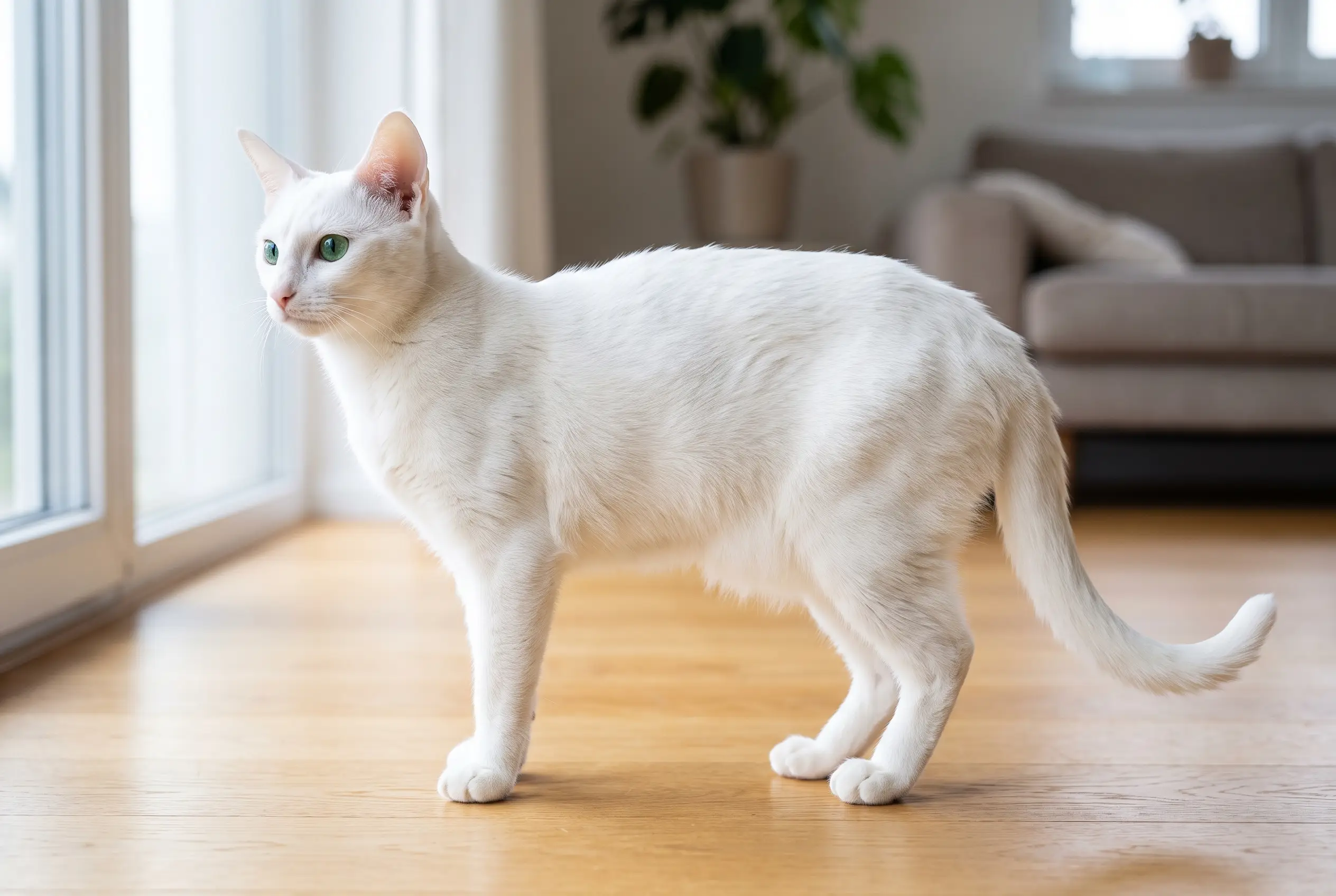
Russian White, Black and Tabby
A Russian Blue in every way except colour — and a few registries still won't call it one.
Vital stats
| Size | Small to medium · fine-boned, identical build to the Russian Blue |
| Weight | 3.5–5.5 kg — breed literature; no registry publishes a figure |
| Life expectancy | 10–15 years — breed literature, not survey data |
| Energy | Moderate — playful in short bursts, then settled |
| Shedding | Low year-round |
| Coat | Short, dense double coat; solid white, solid black, or tabby |
| Group | Shorthair |
| Origin | Russia |
Breed traits
Friendliness
Care
Mind
The Russian White, Black and Tabby by the numbers
The Russian White, Black and Tabby facts owners search for most — price, lifespan, weight, shedding and colours, in one place.
Less common, so expect a waitlist and some travel to a reputable breeder — which pushes the price up. Ongoing costs stay modest — it eats little and routine vet care sits at the lower end.
We don't quote a single figure: the real price swings with breeder, region, bloodline and health testing — and a rescue costs a fraction of a breeder's litter. Adopting is almost always the cheapest route.
Temperament
Take the temperament off a Russian Blue and it lands here unchanged, because the lines that built this colour were bred back into Russian Blue stock for generations until only the coat was different. Expect a cat that studies a stranger from the doorway before deciding anything, bonds hard to one or two people, and picks a quiet room over a rowdy one every time. It's a poor fit for a chaotic house — loud visitors, moved furniture and late meals all register as small offences — and a good one for an owner who wants a calm, undemanding shadow rather than a cat that leaps into laps. Vocally it's close to silent: a soft chirp, not a conversation.
Habits & quirks
Wears a kitten cap
White kittens are often born with a faint coloured patch or cap on the head, a trace of the original outcross; it almost always fades out by the first birthday.
Green eyes, any coat
The standard asks for the same vivid green eyes in white, black and tabby as it does in blue — the colour changed, the eye clause never did.
The coat stands up, not down
Whatever the colour, the dense double coat is springy enough to hold a comb's part line for a few seconds, the texture breeders describe as plush rather than fur.
Sizes up a stranger from the doorway
A new face gets watched from a few feet back for a good while before this cat commits to anything, visitor or housemate.
Care
| Grooming | The dense double coat looks demanding and isn't — a weekly brush keeps it glossy in any of the three colours and clears the little it sheds. |
| Hearing | The standard calls for green eyes in every colour, including white, which keeps this line largely clear of the deafness risk tied to blue-eyed white cats — but ask the breeder for a BAER (brainstem auditory evoked response) test on any white kitten before you commit, especially one with blue or odd eyes, since the dominant white gene can still throw those off-standard. |
| Weight | Food-motivated like any Russian and easily bored into snacking; measure meals rather than free-feeding, since the fine-boned frame hides extra weight badly. |
| Settling in | Give a new arrival one quiet room first and let it expand outward on its own schedule; this is a cat that retreats rather than lashes out when pushed, and forcing introductions backfires. |
Life expectancy
This breed has a typical life expectancy of 10–15 years — breed literature, not survey data.
Similar breeds
Breeds with a similar build and background — worth a look if this one isn't quite the fit.
Common questions
Is a Russian White, Black or Tabby a real breed, or just a Russian Blue that came out the wrong colour?
Genetically, the second description is closer to the truth than any registry likes to put in writing: these are Russian Blue lines carrying a domestic-cat outcross a few generations back, bred until the colour changed and nothing else did. Whether that counts as a breed depends entirely on who you ask. The Australian Cat Federation and Britain's GCCF register white and black as full colours of the Russian breed, judged to the same standard as blue. CFA, FIFe, TICA and WCF disqualify any Russian that isn't blue, full stop — to them it's an off-colour Russian Blue, not a breed at all. The honest answer is both, and which one applies depends on the paperwork in the country you're standing in.
Are white Russian cats deaf?
Not usually, and that's the point of the standard: it calls for green eyes in every Russian colour, including white, and green-eyed white cats carry a much lower deafness risk than the blue-eyed white cats most people picture. It isn't zero risk — the dominant white gene can still throw a blue-eyed or odd-eyed kitten off-standard — so ask any breeder for BAER test results on a white kitten before buying, the same way you would for a Turkish Van or any other white breed.
Can I get one outside Australia or the UK?
Harder than a Russian Blue, and much harder than an ordinary tabby. The white and black lines are established in Australia, New Zealand, South Africa and, through the GCCF, the UK, with a scattering of ACFA-registered breeders in the US. CFA, FIFe and TICA breeders won't have them at all, because those registries don't recognise the colour. Expect a wait list, possibly some travel, and treat a tabby as rare even by this breed's own small numbers.
Does the Russian White, Black and Tabby shed a lot?
Not much. The Russian White, Black and Tabby is a low-shedding breed, so loose hair around the home stays minimal. It still needs regular grooming, but you won't be fighting drifts of fur.
Are Russian White, Black and Tabby cats hypoallergenic?
No cat breed is truly hypoallergenic. The trigger is Fel d 1, a protein in a cat's saliva and skin that transfers to the coat during grooming and then travels on loose hair and dander — so a cat that sheds less, like the Russian White, Black and Tabby, spreads less of it around the house, but still produces it. If someone at home reacts to cats, spend real time with this breed before deciding, and no breeder should promise you an allergy-free cat.
Are Russian White, Black and Tabby cats good with children?
Often, in the right home. The Russian White, Black and Tabby is reasonably sociable and can settle well with children who already know how to handle a cat gently. Give it high perches and a room the kids don't own, and introductions go far better.
How much grooming does a Russian White, Black and Tabby need?
A weekly comb is usually enough for the Russian White, Black and Tabby, with a second pass during a seasonal moult. That keeps loose hair off your furniture and cuts down on hairballs, since everything the cat doesn't shed onto the sofa it swallows while washing.