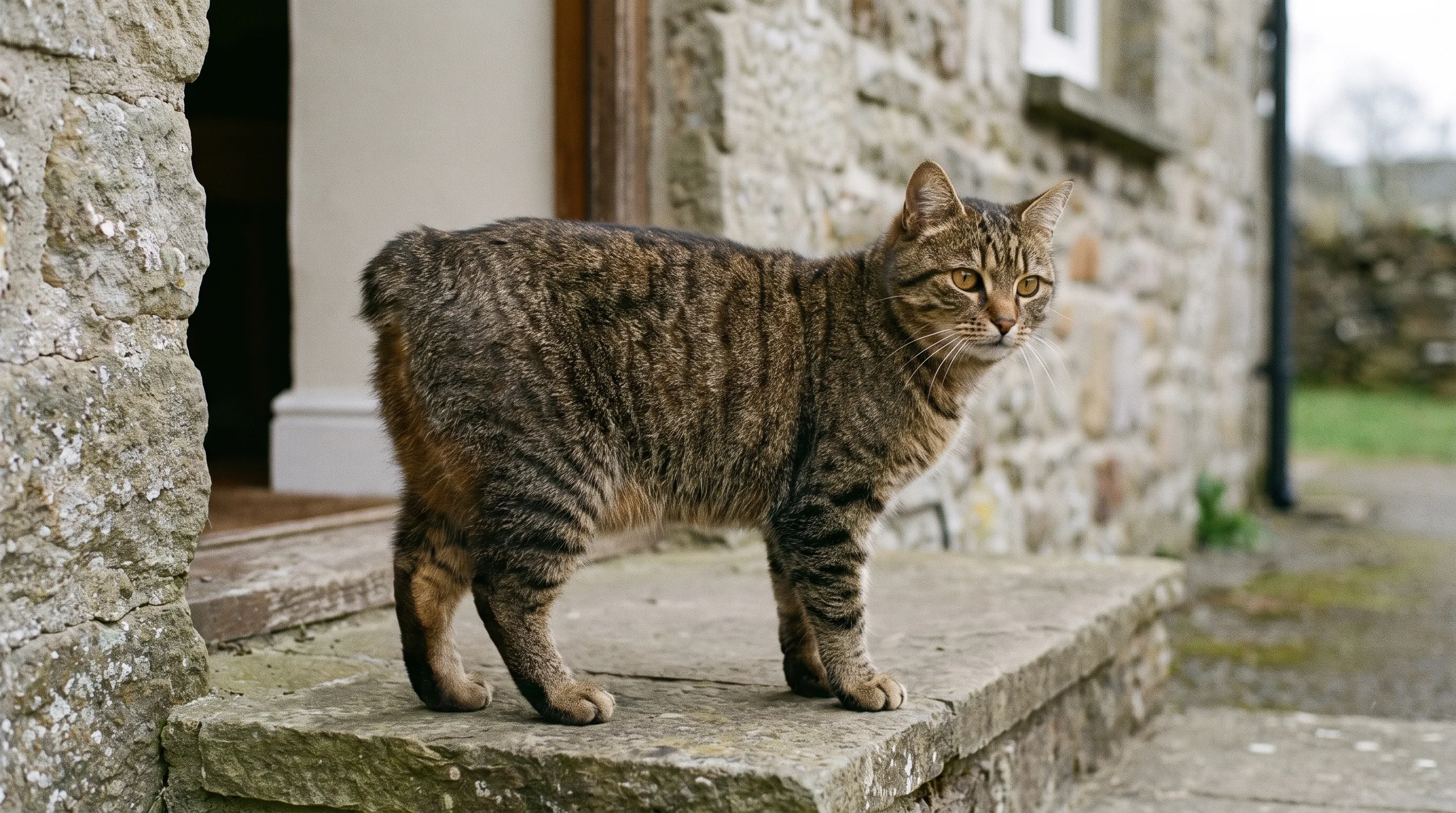
Manx
Round, powerful and famously tailless — with a gene that deserves a straight answer.
Vital stats
| Size | Medium · compact, round, muscular |
| Weight | 3.5–5.5 kg · males heavier |
| Life expectancy | 12–16 years |
| Energy | Moderate to high — powerful jumper |
| Shedding | Moderate, dense double coat |
| Coat | Short, dense double coat (long in the Cymric) |
| Group | Shorthair |
| Origin | Isle of Man |
Breed traits
Friendliness
Care
Mind
The Manx by the numbers
The Manx facts owners search for most — price, lifespan, weight, shedding and colours, in one place.
Less common, so expect a waitlist and some travel to a reputable breeder — which pushes the price up. Ongoing costs stay modest — it eats little and routine vet care sits at the lower end.
We don't quote a single figure: the real price swings with breeder, region, bloodline and health testing — and a rescue costs a fraction of a breeder's litter. Adopting is almost always the cheapest route.
Temperament
Manx are the cats people describe as dogs: they follow you around, greet visitors at the door, carry toys back, and a fair number will learn to come when called. They're attached to their household rather than to one person, patient with children who behave, and usually fine with a cat-tolerant dog. The build shows in how they move — those back legs make for standing jumps that clear a kitchen worktop without a run-up, and a Manx tends to pick a high vantage point and hold it. They're quiet, with a small trilling voice, and they're steady in a house with noise and traffic. Not a cat that wants to be left alone all day, but not a clinging one either.
Habits & quirks
Bounds rather than walks
Longer back legs and no tail for counterbalance give the Manx a hopping, powerful gait and a standing jump that surprises people.
Answers the door
Manx tend to investigate arrivals rather than hide from them. Many will greet a stranger before the resident human does.
Carries things
Toys, socks, bottle caps — moving objects from one room to another is a common Manx habit, often with a proud trill attached.
Digs in water
A recurring quirk: pawing at the water bowl, patting a dripping tap, sometimes emptying the bowl entirely across the kitchen floor.
Care
| Manx syndrome — ask first | The same gene that shortens the tail can shorten the spine too far, causing sacrocaudal dysgenesis: spina bifida, a hopping gait, and bowel or bladder incontinence. Veterinary sources put some degree of it in up to about a fifth of the breed. Signs show in the first months, which is why reputable breeders keep kittens until four months. Ask what the breeder tests, what they've produced, and refuse any tailless × tailless mating. |
| Grooming | A dense double coat needs a comb twice a week and more during the seasonal moult. The long-coated version of the breed is registered separately as the Cymric and needs the same routine done more often. |
| Rump handling | Some Manx are tender at the base of the spine, and a rumpy riser has a small knot of fused bone under the skin there. Teach children not to press it, and mention any flinching to your vet rather than assuming it's temperament. |
| Weight and joints | A heavy, compact cat that jumps hard is unforgiving of extra weight. Keep a Manx lean, feed measured meals, and give it solid landing platforms rather than one long drop from the top of a wardrobe. |
Life expectancy
This breed has a typical life expectancy of 12–16 years.
Similar breeds
Breeds with a similar build and background — worth a look if this one isn't quite the fit.
Common questions
Do all Manx cats have no tail at all?
No. A litter can contain every grade: rumpies with a dimple where the tail would be, rumpy risers with a small knob, stumpies with a short kinked tail, and longies with something close to a full one. Only rumpies and rumpy risers can be shown, but all of them are Manx, and the tailed ones are essential to breeding the breed safely.
Is buying a Manx unethical?
That's a fair question and the answer depends on the breeder. The gene is a real welfare risk and homozygous kittens die before birth. A breeder who mates tailless to tailed, keeps kittens to four months to screen for spinal problems, and is straightforward about what they've produced is doing the thing that keeps the breed sound. One who advertises tailless-to-tailless litters is not — and that's the line to check before you visit.
What's the difference between a Manx and a Cymric?
Coat length only. The Cymric is the semi-longhaired Manx, from a recessive gene in the same population. TICA and CCA register it as its own breed; CFA treats it as a long-haired Manx variety. Body, temperament and the tailless gene are identical.
Does the Manx shed a lot?
Moderately. The Manx sheds a fair amount, steadily through the year with heavier seasonal patches. A weekly brush keeps most of the loose hair off your floors and clothes.
Are Manx cats hypoallergenic?
No cat breed is truly hypoallergenic, and the Manx isn't one of the easier ones. The trigger is Fel d 1, a protein in a cat's saliva and skin that ends up on the coat during grooming and then spreads on loose hair and dander — and this breed sheds enough to move plenty of it around. If someone at home is allergic to cats, this is a hard breed to live with; spend real time around one first.
Are Manx cats good with children?
Usually yes. The Manx is a sociable cat that tends to tolerate the noise and handling of family life better than most, which is why it comes up so often for homes with kids. It still needs somewhere high and quiet to retreat to, and children need teaching that a cat walking away is allowed to.
How much grooming does a Manx need?
A weekly comb is usually enough for the Manx, with a second pass during a seasonal moult. That keeps loose hair off your furniture and cuts down on hairballs, since everything the cat doesn't shed onto the sofa it swallows while washing.