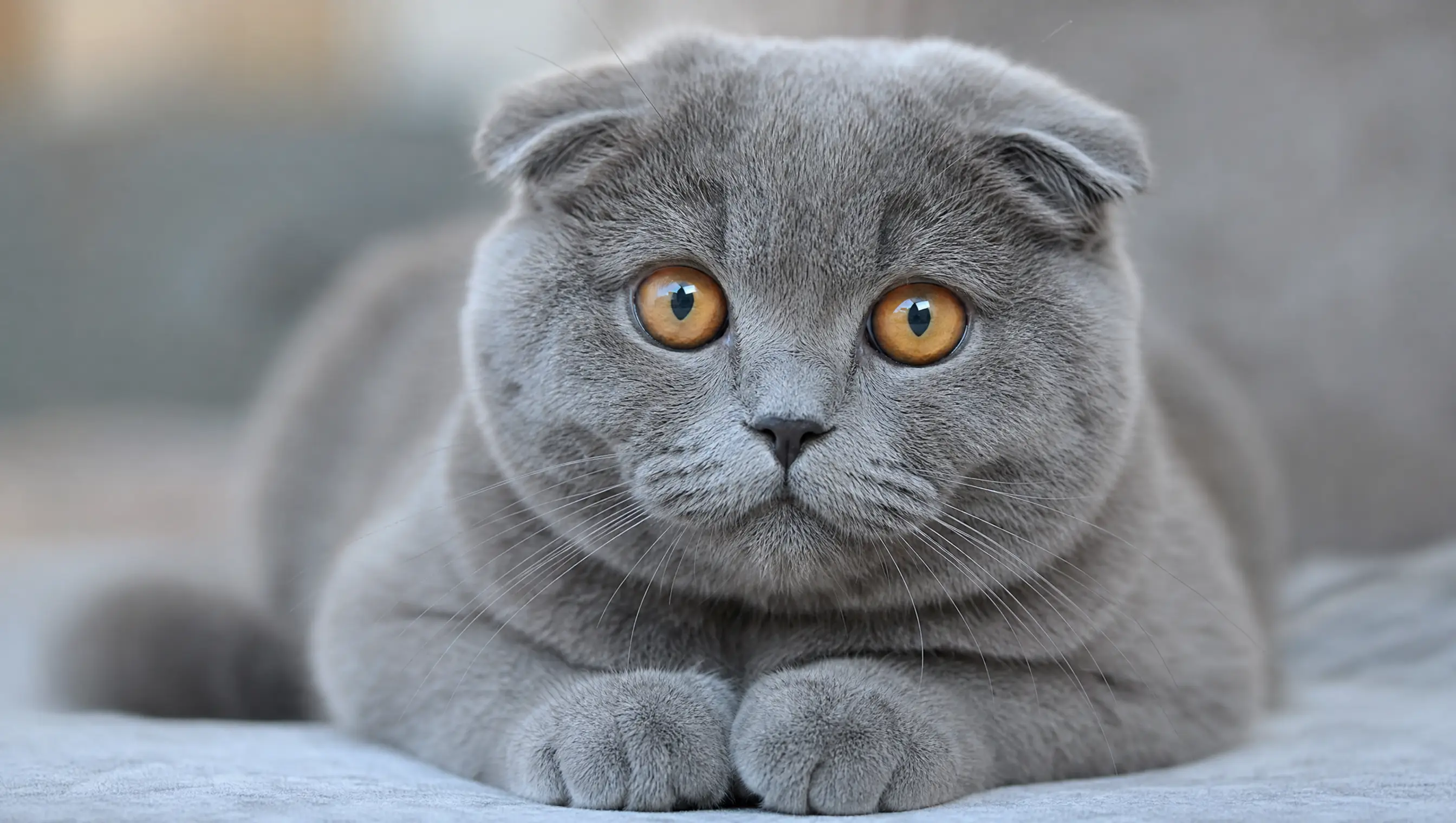
Scottish Fold
The owl-faced charmer whose signature ears come with a hard genetic catch.
On these lists: Cats for apartments · Indoor cats
Vital stats
| Size | Medium · rounded, compact build |
| Weight | 3–6 kg · males heavier |
| Life expectancy | 11–14 years |
| Energy | Low to moderate — calm homebody |
| Shedding | Moderate, seasonal |
| Coat | Short and dense (or longhair 'Highland') |
| Group | Shorthair |
| Origin | Scotland |
Breed traits
Friendliness
Care
Mind
The Scottish Fold by the numbers
The Scottish Fold facts owners search for most — price, lifespan, weight, shedding and colours, in one place.
Widely bred, so you can usually find a litter from a registered breeder without a long wait. Ongoing costs stay modest — it eats little and routine vet care sits at the lower end.
We don't quote a single figure: the real price swings with breeder, region, bloodline and health testing — and a rescue costs a fraction of a breeder's litter. Adopting is almost always the cheapest route.
Temperament
Scottish Folds are easygoing, people-oriented cats that stay close without demanding constant attention. They're quiet — a soft, occasional voice rather than a running commentary — and tend to settle wherever the household is rather than patrol from a height. They handle children, other cats and calm dogs well, and cope with routine better than most. You'll often catch one sitting bolt upright with legs splayed or flat on its back like it's been switched off; these poses are part of the breed's charm but, given the joint issues below, some owners read a cat that sits oddly still as comfort-seeking rather than clowning. Affectionate, undramatic, and content to be a shadow rather than a supervisor.
Habits & quirks
The Buddha sit
Folds often sit upright on their haunches with legs stuck out front — endearing, and worth noticing, since discomfort can drive some of the odd postures.
Ears that aren't fixed
Kittens are all born straight-eared; the fold appears around three weeks, and littermates who never fold ('Straights') are healthier but just as sweet.
Quiet company
A low-volume cat that trails you room to room and asks for closeness with a chirp rather than a yell.
Cool head
Takes noise, visitors and change in stride, which makes them steady in busy or child-filled homes.
Health
There is no honest Scottish Fold health note that doesn't start with the ears. The gene that folds them is tied to osteochondrodysplasia, a malformation of cartilage and bone that can bring on painful, progressive arthritis — often in the tail, ankles and knees — and there is no cure. Some cats stay comfortable for years, others don't, and every Fold carries the gene, not just the stiff ones. Breeding two folded cats together makes it worse and is condemned by welfare and veterinary bodies. A responsible breeder pairs a Fold only with a straight-eared cat and screens for HCM. Watch the joints for life: stiffness, a thick or inflexible tail, reluctance to jump or an odd gait all warrant a vet and X-rays.
Nutrition
| The fold gene (read this first) | The gene that folds the ears is linked to osteochondrodysplasia — a malformation of cartilage and bone that can cause painful, progressive arthritis, especially in the tail, ankles and knees. There is no cure. Breeding two folded cats together is condemned by welfare bodies and vet associations for exactly this reason. |
| Watch the joints | Stiffness, a thick or inflexible tail, reluctance to jump, or an odd gait warrant a vet and X-rays. Pain relief, joint supplements and a soft, low-effort environment help, but you're managing a lifelong condition, not fixing it. |
| Ears and coat | The tight fold traps wax and debris, so check and gently clean the ears regularly. The short coat is low-maintenance — a weekly comb, more for the longhaired Highland Fold. |
| Buying honestly | A responsible breeder pairs a Fold only with a straight-eared cat, screens for heart disease (HCM), and won't sell tiny kittens as 'guaranteed folded'. Steer clear of anyone breeding fold-to-fold for a fuller ear crease. |
A Scottish Fold is a straightforward carnivore to feed, but keeping it lean does double duty here: every extra kilo loads joints that may already be sore. Measure meals rather than leaving food out, count treats into the day, and use wet food to help with hydration and fullness. Aim for ribs you can feel but not see. A slim Fold moves more easily and asks less of the cartilage that the breed's gene puts at risk.
Kitten guide
All Scottish Fold kittens are born straight-eared; the fold appears at around three weeks, and littermates who never develop it are just as sweet and generally healthier. Whichever you bring home, socialise it early with people and other pets, get it used to gentle handling — including the ears, which trap wax and need regular cleaning — and set up a soft, low-effort space: easy steps up to favourite spots rather than big jumps, so young joints aren't stressed. Start the vet and vaccination routine early, and ask about the parents' health testing before anything else.
Training
Scottish Folds are gentle, people-oriented and easy to live with. Litter habits come naturally; the useful work is enrichment that keeps the cat active without hammering its joints. Favour ground-level play and gentle climbing over big leaps — a wand toy, a puzzle feeder, low platforms with easy steps. Give it a sturdy scratching post and redirect it there from the furniture. Keep the ears clean and make handling normal, and get it comfortable in a carrier early, because this is a breed that will see the vet regularly.
Life expectancy
Scottish Folds live 11–14 years. With this breed, comfort matters as much as length. A Fold kept lean, with its joints watched and pain managed early, and from a breeder who screens for HCM and never breeds fold-to-fold, has the best shot at the top of that range. The cartilage condition built into the breed is the thing that shapes its later years.
Similar breeds
Breeds with a similar build and background — worth a look if this one isn't quite the fit.
Common questions
Are Scottish Folds in pain?
Not all of them, but the risk is real and built into the breed: the same gene that folds the ears affects cartilage everywhere, and many develop arthritis over time — sometimes early. Some cats stay comfortable for years, others don't. Regular vet checks and joint care matter for every Fold, not just the obviously stiff ones.
Why are some kittens in the litter not folded?
Ear fold is caused by a single dominant gene, so in a typical Fold-to-Straight pairing only about half the kittens fold. The straight-eared 'Straights' have the same temperament and appearance minus the crease, and they avoid the worst of the cartilage problems — many people consider them the kinder choice.
Is it ethical to buy one?
It's genuinely debated, and several countries and registries restrict or ban the breeding. If you want one, at minimum insist on Fold-to-Straight breeding, health-tested parents, and a breeder honest about the risks — or consider a straight-eared Fold or a rescue instead of funding fold-to-fold litters.
Does the Scottish Fold shed a lot?
Moderately. The Scottish Fold sheds a fair amount, steadily through the year with heavier seasonal patches. A weekly brush keeps most of the loose hair off your floors and clothes.
Are Scottish Fold cats hypoallergenic?
No cat breed is truly hypoallergenic, and the Scottish Fold isn't one of the easier ones. The trigger is Fel d 1, a protein in a cat's saliva and skin that ends up on the coat during grooming and then spreads on loose hair and dander — and this breed sheds enough to move plenty of it around. If someone at home is allergic to cats, this is a hard breed to live with; spend real time around one first.
Are Scottish Fold cats good with children?
Usually yes. The Scottish Fold is a sociable cat that tends to tolerate the noise and handling of family life better than most, which is why it comes up so often for homes with kids. It still needs somewhere high and quiet to retreat to, and children need teaching that a cat walking away is allowed to.
How much grooming does a Scottish Fold need?
A weekly comb is usually enough for the Scottish Fold, with a second pass during a seasonal moult. That keeps loose hair off your furniture and cuts down on hairballs, since everything the cat doesn't shed onto the sofa it swallows while washing.