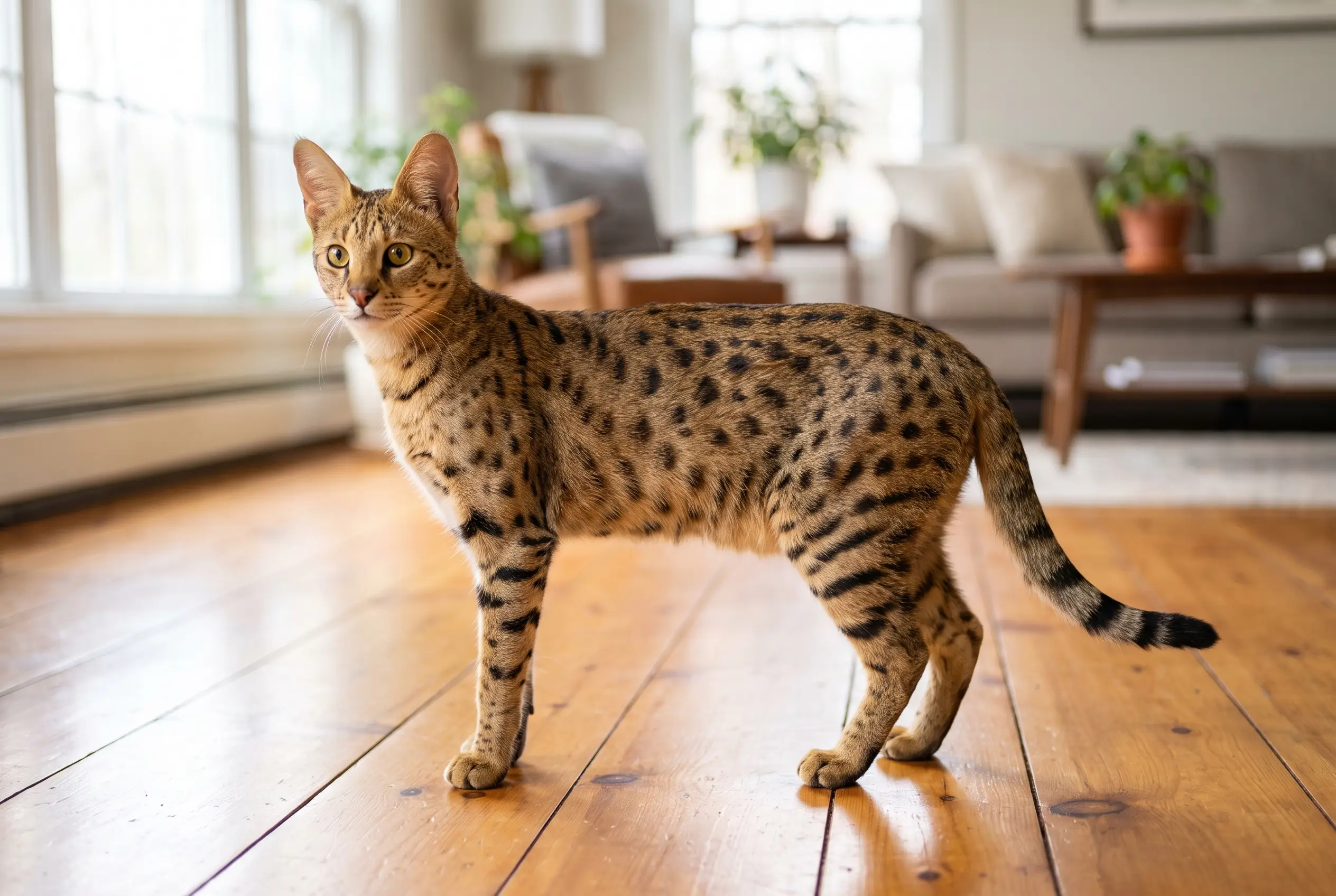
Serengeti
A serval look, built without a single drop of wildcat blood.
Vital stats
| Size | Medium · long legs, upright stance |
| Weight | 3.6–6.8 kg · males heavier |
| Life expectancy | 8–12 years — a repeated web figure, not survey-verified |
| Energy | Very high — jumps, plays, wants a job |
| Shedding | Low — short, close coat |
| Coat | Short, tight, glossy; spotted tabby, silver, smoke or solid black |
| Group | Shorthair |
| Origin | United States |
Breed traits
Friendliness
Care
Mind
The Serengeti by the numbers
The Serengeti facts owners search for most — price, lifespan, weight, shedding and colours, in one place.
Less common, so expect a waitlist and some travel to a reputable breeder — which pushes the price up. Ongoing costs stay modest — it eats little and routine vet care sits at the lower end.
We don't quote a single figure: the real price swings with breeder, region, bloodline and health testing — and a rescue costs a fraction of a breeder's litter. Adopting is almost always the cheapest route.
Temperament
Where the Bengal can run aloof and the Oriental can run relentless, the Serengeti lands in the gentler middle: an open, confident cat that follows people from room to room and treats a closed door as a personal insult. It jumps rather than climbs — those long legs are built for a single vertical leap onto a fridge or wardrobe top, not for scaling curtains the way a Bengal will. It plays hard and stays loyal to its household, chasing a toy well past the point a calmer cat would give up. It talks, though in a running commentary of chirps and trills rather than the Siamese-line shriek an Oriental inherited. It gets on well with other cats and cat-friendly dogs, and it does badly with long stretches alone — this is a cat that wants people in the house, not just a view of one.
Habits & quirks
Jumps rather than climbs
Those long legs are a launch pad. A Serengeti will land on top of a fridge or a wardrobe in one bound rather than scrabble up curtains the way a Bengal might.
Runs a commentary, not a shriek
It's vocal most of the day, but in chirps and trills — a quieter, more conversational voice than the carrying yowl an Oriental inherited from Siamese lines.
Shows ghost spots in black light
Solid-black Serengetis often reveal faint tabby spotting in bright or angled light. The pattern doesn't disappear with the colour, it just goes underground.
Treats a shut door as an insult
This is a follow-you-room-to-room cat. Shut it out of one, and expect a paw under the gap or a sustained protest at the threshold.
Care
| Grooming | The short, tight coat needs almost nothing — a weekly wipe with a damp hand or rubber brush keeps the shine up, and there's no undercoat to speak of. |
| Health screening | The breed is too new and too small in number to have its own DNA panel, so ask about what its founders carry: Bengal-line progressive retinal atrophy (PRA-b) and pyruvate kinase deficiency, both DNA-testable, plus hypertrophic cardiomyopathy from either founder line, screened by ultrasound rather than a blood test. |
| Diet & urinary health | Several breed sources flag a higher-than-average rate of urinary crystals and bladder stones. Wet food, steady water access and keeping weight in check are the practical response; ask for a urinalysis at annual visits rather than waiting for a blocked cat. |
| Exercise & enrichment | This is a high-energy cat built to jump, not just play. Tall furniture, a real climbing route and two proper sessions of interactive play a day are the baseline, not an extra. |
Life expectancy
This breed has a typical life expectancy of 8–12 years — a repeated web figure, not survey-verified.
Similar breeds
Breeds with a similar build and background — worth a look if this one isn't quite the fit.
Common questions
Is the Serengeti part serval, like the Savannah?
No. The Savannah is bred directly from the African serval and carries real wildcat genes, diluted more or less depending on the filial generation (F1 through F5 and beyond). The Serengeti was designed to look like a serval using two domestic breeds only, Bengal and Oriental Shorthair, and has no serval ancestry at all. Even its Bengal side comes from cats many generations removed from the Asian leopard cat — chosen specifically to avoid the legal and temperament questions that come with an early-generation wild hybrid.
Is the Serengeti just a Bengal with longer legs?
It shares a founding breed, not an identity. Bengal and Oriental Shorthair are the two breeds behind it, and at a glance the spotted coat invites the comparison. But the Serengeti stands taller on longer legs, carries a longer neck and noticeably larger, rounder ears, and runs more sociable and less independent than a typical Bengal.
What's its official registry status?
TICA is the only registry that recognizes it, and even there it's still climbing the ladder — Advanced New Breed as of its 2025 breed report, one rung below Championship, so it can be entered in shows but doesn't yet earn titles or annual points. CFA, GCCF and FIFe don't recognize the breed.
Does the Serengeti shed a lot?
Not much. The Serengeti is a low-shedding breed, so loose hair around the home stays minimal. It still needs regular grooming, but you won't be fighting drifts of fur.
Are Serengeti cats hypoallergenic?
No cat breed is truly hypoallergenic. The trigger is Fel d 1, a protein in a cat's saliva and skin that transfers to the coat during grooming and then travels on loose hair and dander — so a cat that sheds less, like the Serengeti, spreads less of it around the house, but still produces it. If someone at home reacts to cats, spend real time with this breed before deciding, and no breeder should promise you an allergy-free cat.
Are Serengeti cats good with children?
Usually yes. The Serengeti is a sociable cat that tends to tolerate the noise and handling of family life better than most, which is why it comes up so often for homes with kids. It still needs somewhere high and quiet to retreat to, and children need teaching that a cat walking away is allowed to.
How much grooming does a Serengeti need?
Very little. The Serengeti handles its own coat and a comb once a week or so is plenty — mostly to catch loose hair before the cat swallows it. Claws, teeth and ears still want the usual checks, which is the part people skip on an easy-coated cat.