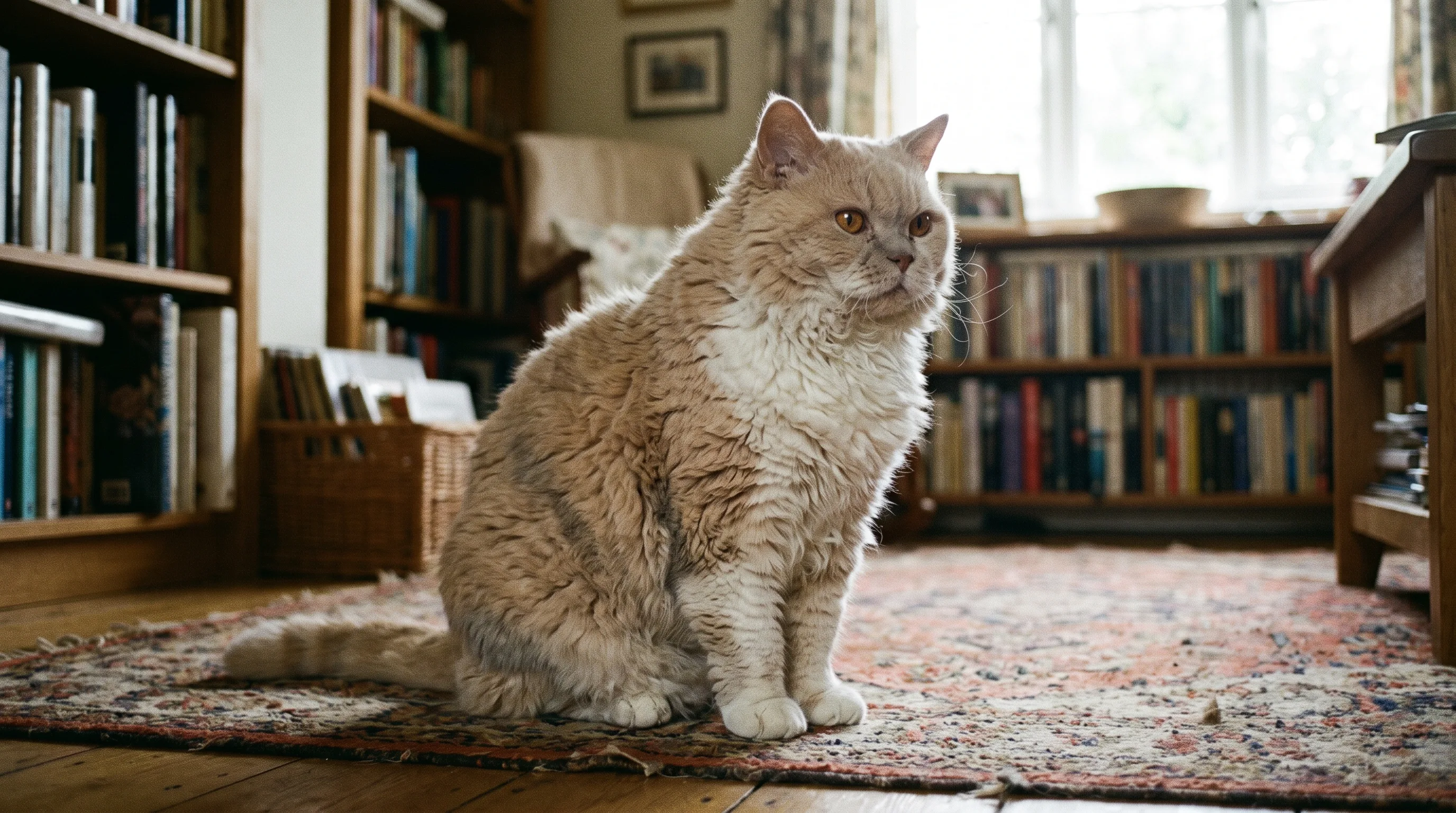
Selkirk Rex
The one rex that came out heavy, plush and calm — a curly cat built like a British Shorthair.
Vital stats
| Size | Medium to large · heavy-boned, round, powerful |
| Weight | 3.5–5 kg females · 5–7 kg males |
| Life expectancy | 14–15 years |
| Energy | Moderate — playful without being frantic |
| Shedding | Moderate to high, worse in the longhair |
| Coat | Short or long, thick and plush, in loose random curls |
| Group | Shorthair |
| Origin | United States |
Breed traits
Friendliness
Care
Mind
The Selkirk Rex by the numbers
The Selkirk Rex facts owners search for most — price, lifespan, weight, shedding and colours, in one place.
Less common, so expect a waitlist and some travel to a reputable breeder — which pushes the price up. Ongoing costs stay modest — it eats little and routine vet care sits at the lower end.
We don't quote a single figure: the real price swings with breeder, region, bloodline and health testing — and a rescue costs a fraction of a breeder's litter. Adopting is almost always the cheapest route.
Temperament
Selkirks are the patient ones. They took their build and their temperament from the British Shorthair and Persian lines used to establish the breed, so you get a cat that is affectionate, tolerant and content to sit near you rather than orbit you. They play, but in bursts, and they'd rather be picked up than chased. Most are calm with children, unbothered by dogs, and happy in a flat. They're not silent — many keep up a small conversational chirp — but there is none of the Oriental urgency. This is a good breed for someone who wants an unusual-looking cat and an ordinary, easy household.
Habits & quirks
Curls come and go
Kittens are born curly, straighten out over the first months, and curl again from about eight months, reaching a full coat at two years. Humidity, season and hormones all change the curl on a given day.
Breaks its whiskers
Curled whiskers on a rex are brittle and frequently snap short. It looks odd, it doesn't hurt, and they regrow curled.
Asks to be held
The Persian and British Shorthair behind the breed show up here: a Selkirk generally accepts being picked up, carried and turned over, which is not true of most cats.
Sits rather than climbs
Heavy and unbothered. Selkirks will use a cat tree but they aren't the cats on top of the kitchen cupboards, which suits a lot of households.
Care
| Grooming — comb, never brush | Brushing pulls the curl out and can leave the coat frizzy for weeks. Use a wide-toothed comb once or twice a week, working gently and letting the coat fall back into place. The longhaired version needs the same routine more often, with attention to the ruff and behind the ears. |
| Health screening | The Persian outcrosses brought polycystic kidney disease into the breed's history, so ask for a negative PKD1 DNA test on both parents. Hypertrophic cardiomyopathy is screened by scan, and patellar luxation appears in some lines. |
| Bathing | Occasional, and done properly. Bathe, then let the coat air-dry — a towel rub or a hairdryer will straighten the curl. Some Selkirks need a bath every few weeks for greasy skin, most need one rarely. |
| Weight | A naturally heavy, calm cat under a thick coat is easy to overfeed and hard to assess by eye. Feed measured meals, check the ribs by hand once a month, and keep a play session in the daily routine. |
Life expectancy
This breed has a typical life expectancy of 14–15 years.
Similar breeds
Breeds with a similar build and background — worth a look if this one isn't quite the fit.
Common questions
Is the Selkirk Rex related to the Cornish or Devon Rex?
No. Three separate mutations. The Cornish curl is recessive and sits in LPAR6; the Devon's is recessive and sits in KRT71; the Selkirk's is dominant and sits in a different KRT71 variant. The Selkirk is also the only one of the three built heavy, because it was developed with British Shorthair and Persian rather than kept fine.
Why do breeders avoid two curly parents?
Because the gene is dominant, one copy already gives a full curly coat, and two copies tend to produce a tighter, sparser, sometimes patchy coat with more brittle hair. Breeding curly to straight keeps the coat quality and the gene pool wide, and the straight-coated kittens are perfectly good pets.
Does the coat need a lot of work?
More than a shorthair, less than a Persian. A comb once or twice a week for the short coat, more for the long, and a careful hand — the mistake people make is brushing it smooth. It sheds moderately and mats less than you'd expect for the volume.
Does the Selkirk Rex shed a lot?
Moderately. The Selkirk Rex sheds a fair amount, steadily through the year with heavier seasonal patches. A weekly brush keeps most of the loose hair off your floors and clothes.
Are Selkirk Rex cats hypoallergenic?
No cat breed is truly hypoallergenic, and the Selkirk Rex isn't one of the easier ones. The trigger is Fel d 1, a protein in a cat's saliva and skin that ends up on the coat during grooming and then spreads on loose hair and dander — and this breed sheds enough to move plenty of it around. If someone at home is allergic to cats, this is a hard breed to live with; spend real time around one first.
Are Selkirk Rex cats good with children?
Usually yes. The Selkirk Rex is a sociable cat that tends to tolerate the noise and handling of family life better than most, which is why it comes up so often for homes with kids. It still needs somewhere high and quiet to retreat to, and children need teaching that a cat walking away is allowed to.
How much grooming does a Selkirk Rex need?
A weekly comb is usually enough for the Selkirk Rex, with a second pass during a seasonal moult. That keeps loose hair off your furniture and cuts down on hairballs, since everything the cat doesn't shed onto the sofa it swallows while washing.