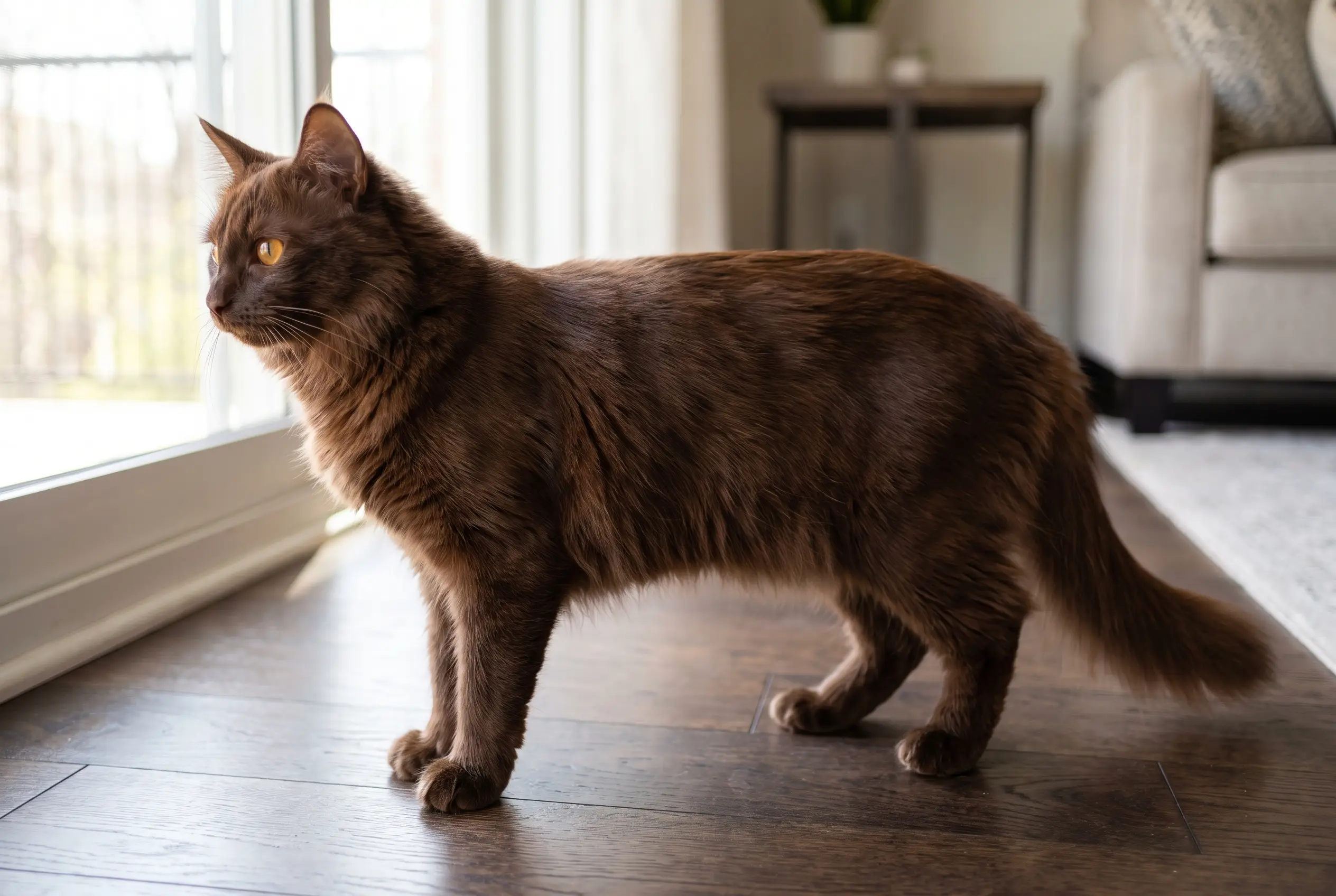
Chantilly-Tiffany
It talks in soft chirps and trills instead of a meow — and there are almost none left to hear it.
Vital stats
| Size | Medium · broad wedge head, sturdy build |
| Weight | 3.5–5.5 kg · males heavier |
| Life expectancy | 11–15 years — breed literature, not survey data |
| Energy | Moderate — calmer than an Oriental, busier than a Persian |
| Shedding | Low — no undercoat |
| Coat | Semi-long, silky, single coat; ~2 years to reach full length |
| Group | Longhair |
| Origin | United States |
Breed traits
Friendliness
Care
Mind
The Chantilly-Tiffany by the numbers
The Chantilly-Tiffany facts owners search for most — price, lifespan, weight, shedding and colours, in one place.
Less common, so expect a waitlist and some travel to a reputable breeder — which pushes the price up. Ongoing costs stay modest — it eats little and routine vet care sits at the lower end.
We don't quote a single figure: the real price swings with breeder, region, bloodline and health testing — and a rescue costs a fraction of a breeder's litter. Adopting is almost always the cheapest route.
Temperament
The Chantilly-Tiffany is a one-person cat more often than a family cat: affectionate and demonstrative with whoever it picks, reserved with everyone else, and unhappy left alone for long stretches. Breed literature describes it as calmer than an Oriental and busier than a Persian — sociable, playful in short bursts, and vocal in its own quiet way. Instead of a standard meow it produces soft chirps and trills, mostly aimed at its person. None of this comes from a large sample: the breed has never had enough cats in enough households to generate real survey data, so treat these as consistent breeder and owner reports rather than settled fact.
Habits & quirks
Talks in chirps, not meows
Soft chirps and trills are its main vocabulary, usually reserved for the one person it's bonded to. A loud, ordinary meow isn't typical of the breed.
Takes two years to finish growing up
Kittens are born the right chocolate colour, but the golden eyes deepen and the coat reaches its full silky length only around the two-year mark. Judge an adult, not a kitten.
Picks one person
This isn't a cat that spreads affection evenly around a household. It attaches to one person, follows them room to room, and doesn't do well left alone for long stretches.
Looks like more grooming than it is
There's no undercoat, so the coat doesn't mat the way a Persian's does. A weekly comb-through is plenty; daily brushing is more than this coat needs.
Care
| Grooming | Once or twice a week with a metal comb is enough — the single coat has no undercoat to mat or trap loose hair. Daily brushing isn't required and can do more harm than good to a coat this fine. |
| Health | No breed-specific DNA test exists for the Chantilly-Tiffany, because the population has never been large enough for one to be developed. The real risk behind any cat sold under the name is a small, poorly documented gene pool — ask for actual pedigree paperwork, not just a description of the coat colour. |
| Company | This isn't a cat that does well alone all day. It bonds tightly to one person and needs that person, or at least another animal, around for real stretches of the day. |
| Finding one | Treat any 'Chantilly-Tiffany kitten' listing with real skepticism. The breed has no confirmed active breeding programme in North America as of this writing; most cats advertised under the name are chocolate-coated domestic longhairs without a documented pedigree behind them. |
Life expectancy
This breed has a typical life expectancy of 11–15 years — breed literature, not survey data.
Similar breeds
Breeds with a similar build and background — worth a look if this one isn't quite the fit.
Common questions
Is the Chantilly-Tiffany the same breed as the British Tiffanie?
No — they only share half a name. The Tiffanie is a British breed, GCCF-recognized, built in the 1980s by crossing a Burmese with a Chinchilla Persian; it comes in silver, shaded and tortoiseshell patterns and carries Burmese type. The Chantilly-Tiffany is American, descends from two cats of unknown ancestry bought in 1967, was originally solid chocolate only, and has never been recognized by the GCCF. The near-identical names are a historical accident — the American breed was renamed Tiffany first, and Chantilly was added later specifically to stop the two from being confused.
Is the Chantilly-Tiffany extinct?
Functionally, most sources say yes, or close to it. A 2012 fire destroyed the pedigree records at the last well-documented American cattery, and the last confirmed purebred individuals are usually dated to around 2015. A small advocacy group disputes 'extinct' and points to outcross-based revival lines, but that claim comes from the group itself and hasn't been verified against any registry stud book.
Can I actually buy one?
Realistically, not from a confirmed pedigree — there's no active, documented breeding programme to buy from. Most cats sold as 'Chantilly-Tiffany' today are chocolate-brown domestic longhairs that look the part without the paperwork behind them.
Does the Chantilly-Tiffany shed a lot?
Not much. The Chantilly-Tiffany is a low-shedding breed, so loose hair around the home stays minimal. It still needs regular grooming, but you won't be fighting drifts of fur.
Are Chantilly-Tiffany cats hypoallergenic?
No cat breed is truly hypoallergenic. The trigger is Fel d 1, a protein in a cat's saliva and skin that transfers to the coat during grooming and then travels on loose hair and dander — so a cat that sheds less, like the Chantilly-Tiffany, spreads less of it around the house, but still produces it. If someone at home reacts to cats, spend real time with this breed before deciding, and no breeder should promise you an allergy-free cat.
Are Chantilly-Tiffany cats good with children?
Usually yes. The Chantilly-Tiffany is a sociable cat that tends to tolerate the noise and handling of family life better than most, which is why it comes up so often for homes with kids. It still needs somewhere high and quiet to retreat to, and children need teaching that a cat walking away is allowed to.
How much grooming does a Chantilly-Tiffany need?
Very little. The Chantilly-Tiffany handles its own coat and a comb once a week or so is plenty — mostly to catch loose hair before the cat swallows it. Claws, teeth and ears still want the usual checks, which is the part people skip on an easy-coated cat.