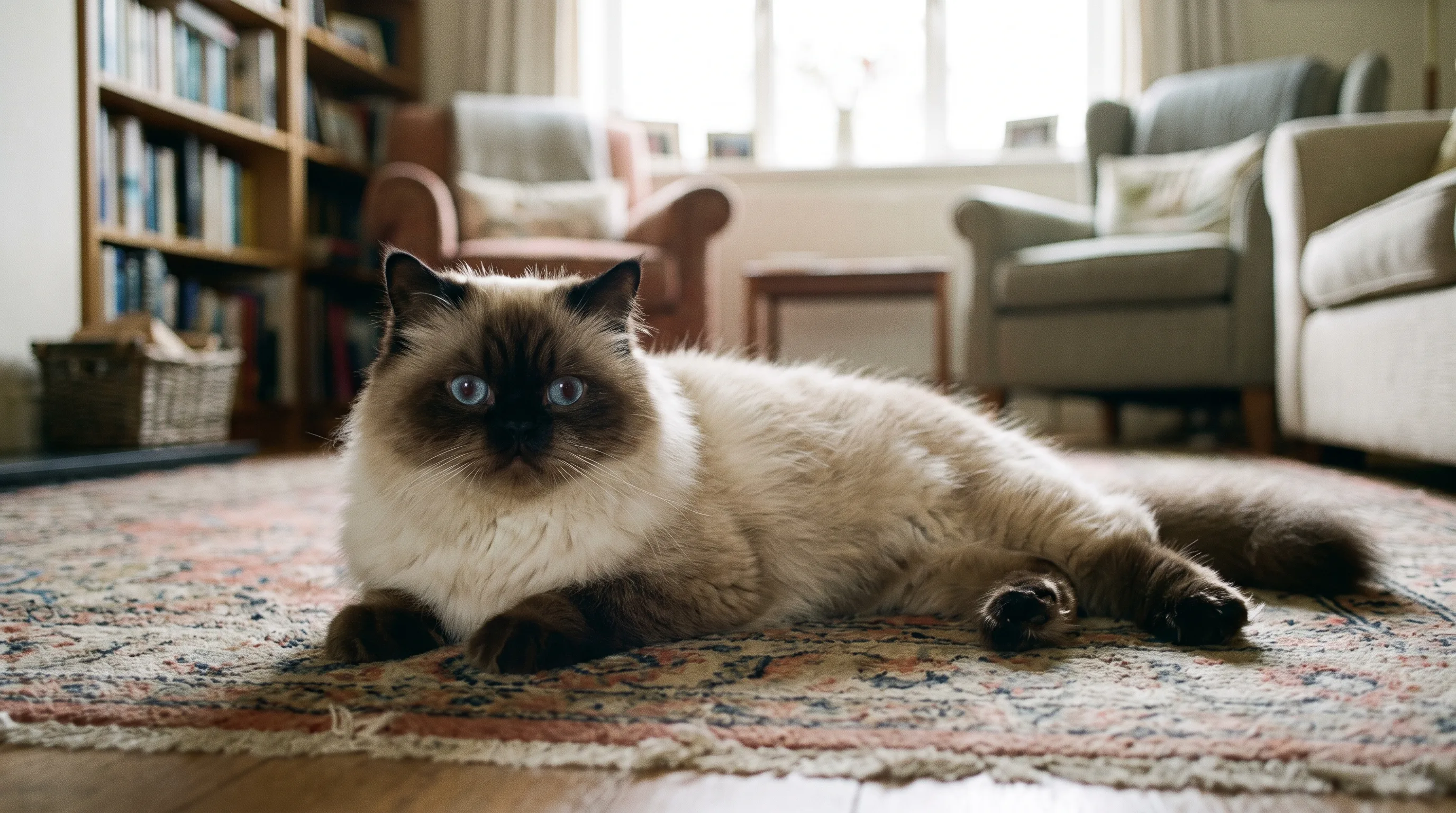
Himalayan
A Persian in Siamese colours — and a Persian's workload to go with them.
On these lists: Cats for seniors
Vital stats
| Size | Medium to large · cobby, heavy-boned, short-legged |
| Weight | 3–6 kg · males heavier |
| Life expectancy | 12–15 years |
| Energy | Low — short bursts of play, long rests |
| Shedding | High, with a dense undercoat |
| Coat | Long, thick double coat with a full ruff; pointed |
| Group | Longhair |
| Origin | United States |
Breed traits
Friendliness
Care
Mind
The Himalayan by the numbers
The Himalayan facts owners search for most — price, lifespan, weight, shedding and colours, in one place.
Widely bred, so you can usually find a litter from a registered breeder without a long wait. Ongoing costs stay modest — it eats little and routine vet care sits at the lower end.
We don't quote a single figure: the real price swings with breeder, region, bloodline and health testing — and a rescue costs a fraction of a breeder's litter. Adopting is almost always the cheapest route.
Temperament
Himalayans are the quiet, sweet-natured end of the cat world. They're affectionate on their own terms, happier beside you than on you, and they greet a familiar routine with real pleasure and an unfamiliar one with a retreat under the bed. The Siamese ancestry shows a little: most Himalayans are livelier than a standard Persian, will play in short bursts, and have more to say — though the voice is still soft. They're poorly suited to chaos, to unpredictable young children, and to being left with nothing happening for long stretches. Give one a settled, indoor, warm household and it will spend fifteen years being extremely pleased with the arrangement.
Habits & quirks
Sits in one place
A Himalayan picks a spot — a chair, a rug, a patch of sun — and holds it. Low energy is the breed, not boredom.
Talks a little
The Siamese side left a voice, but a soft one. Expect occasional chirps and short requests rather than the Oriental running commentary.
Points darken with age
Kittens are born almost white and colour up over weeks. The points keep darkening slowly for years, and a cold house darkens them further, because the pigment is temperature-sensitive.
Follows the warm room
Thick coat notwithstanding, Himalayans move with the heating. Radiators, sunny floors and laps get occupied in order of temperature.
Care
| Grooming — daily | Not negotiable. A long double coat with a dense undercoat mats within days if left, and mats near the skin have to be cut out by a vet or groomer. A full comb every day, with attention to the ruff, the armpits and the trousers, plus a sanitary trim under the tail. |
| The face — daily too | The flat face crowds the tear ducts, so the eyes run and stain. Wipe the eyes and the nose fold with a soft damp cloth every day, and check the nostrils are open. Noisy breathing at rest is a vet conversation, not a breed sound. |
| Health screening | Ask for a negative PKD1 DNA test on both parents — polycystic kidney disease was widespread in Persian lines and is the single most important test here — plus a cardiologist's echo for hypertrophic cardiomyopathy, and about progressive retinal atrophy, which the Siamese side contributes. |
| Heat and weight | A short muzzle cools badly, so keep a Himalayan indoors and cool in hot weather. A low-energy cat under a thick coat also gains weight invisibly: judge by feeling the ribs, not by looking. |
Life expectancy
This breed has a typical life expectancy of 12–15 years.
Similar breeds
Breeds with a similar build and background — worth a look if this one isn't quite the fit.
Common questions
Is the Himalayan a breed or a Persian?
Depends who you ask, and both answers are defensible. It is genetically a Persian carrying the Siamese pointing gene, and CFA registers it as the Persian's colourpoint division. TICA, FIFe and others list it separately as the Himalayan. The cat is the same either way — the label changes what class it's shown in.
How much grooming does it really need?
Every day, for ten to fifteen minutes, for the whole of its life. This is the part people underestimate. A Himalayan that isn't combed daily ends up matted to the skin, which is painful and usually ends in a full shave-down at the vet. If a daily routine isn't realistic, the Exotic Shorthair is the same cat with a short coat.
Are they good with children?
With calm, older children, yes. They're patient and they rarely scratch. But they're slow, they don't like being chased, and they're physically fragile in the face — a Himalayan needs a raised retreat it can reach easily, and a household that will actually leave it alone when it goes there.
Does the Himalayan shed a lot?
Moderately. The Himalayan sheds a fair amount, steadily through the year with heavier seasonal patches. A weekly brush keeps most of the loose hair off your floors and clothes.
Are Himalayan cats hypoallergenic?
No cat breed is truly hypoallergenic, and the Himalayan isn't one of the easier ones. The trigger is Fel d 1, a protein in a cat's saliva and skin that ends up on the coat during grooming and then spreads on loose hair and dander — and this breed sheds enough to move plenty of it around. If someone at home is allergic to cats, this is a hard breed to live with; spend real time around one first.