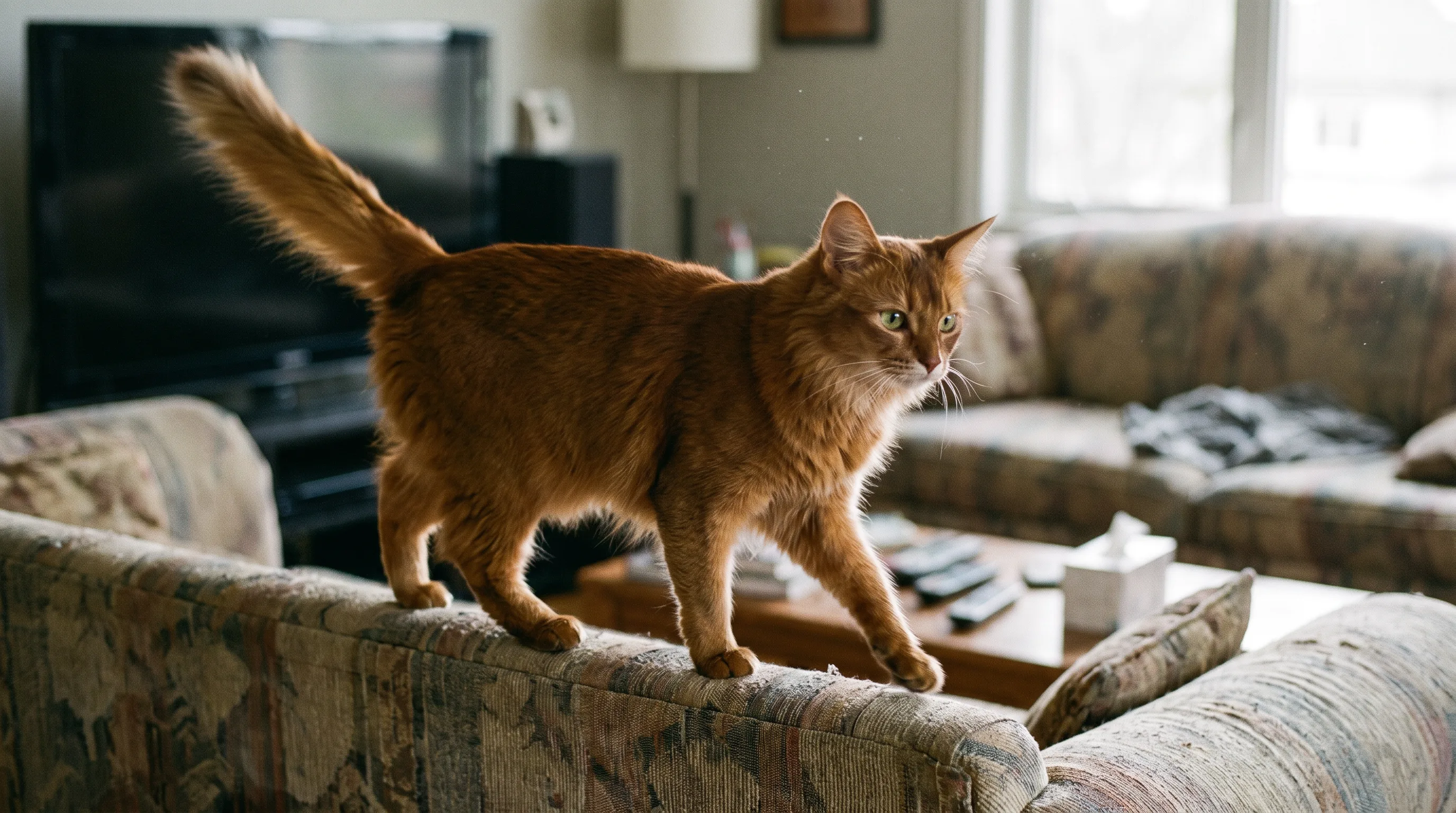
Somali
An Abyssinian that grew a tail, and never once sat still to show it off.
Vital stats
| Size | Medium · fine-boned, athletic |
| Weight | 3.5–5 kg · males heavier |
| Life expectancy | 11–16 years |
| Energy | Very high — the busiest longhair there is |
| Shedding | Moderate, worst at the spring change |
| Coat | Semi-long, fine, double; ticked |
| Group | Longhair |
| Origin | United States |
Breed traits
Friendliness
Care
Mind
The Somali by the numbers
The Somali facts owners search for most — price, lifespan, weight, shedding and colours, in one place.
Less common, so expect a waitlist and some travel to a reputable breeder — which pushes the price up. Ongoing costs stay modest — it eats little and routine vet care sits at the lower end.
We don't quote a single figure: the real price swings with breeder, region, bloodline and health testing — and a rescue costs a fraction of a breeder's litter. Adopting is almost always the cheapest route.
Temperament
Somalis are Abyssinians with a coat, and the personality came through unchanged: curious to the point of nosiness, physically bold, and busy from the moment the house wakes up. They use their front paws like hands — lifting lids, fishing things out of glasses, working a door handle — and they'd rather be up high than on your lap. That doesn't mean aloof; a Somali wants to be in the middle of whatever you're doing, just usually standing on it. They get on well with other active cats and cat-savvy dogs, and badly with boredom. Give one a quiet, empty flat and you'll get a cat that opens cupboards for something to do.
Habits & quirks
Uses its paws like hands
Somalis scoop, lift and fish. Water glasses, lidded jars and anything on a shelf edge are all fair targets, and they're accurate enough to be annoying.
Lives at head height
Wardrobes, door frames, the top of the fridge. This is a cat that maps a room vertically first and treats the floor as a corridor.
Shows the tail off
The full brush tail is the breed's flag — carried up when the cat is pleased, and the reason for the 'fox cat' nickname.
Learns by watching you
Light switches, taps, cupboard catches. Somalis copy what they see people do, which is charming until it involves the bin.
Care
| Grooming | Easier than it looks. With little undercoat the coat rarely mats — a comb once or twice a week keeps the ruff and britches tidy, stepping up when the winter coat comes out in spring, which is dramatic and short. |
| Health screening | Ask for three: a DNA test for pyruvate kinase deficiency (an inherited anaemia common in Abyssinian lines), a DNA test for progressive retinal atrophy (rdAc), and honest answers about renal amyloidosis in the line — it damages the kidneys, has no test, and shows up in middle age. |
| Teeth | Abyssinian-line cats get gingivitis young. Start brushing while the cat is a kitten and have the vet check the gums at every annual visit rather than waiting for a problem you can smell. |
| Enrichment | This is the breed's actual requirement. Tall climbing routes, puzzle feeders, rotated toys and two proper play sessions a day. A second active cat is usually the cheapest solution. |
Life expectancy
This breed has a typical life expectancy of 11–16 years.
Similar breeds
Breeds with a similar build and background — worth a look if this one isn't quite the fit.
Common questions
Is the Somali just a long-haired Abyssinian?
Genetically that's exactly what it is — a recessive long-coat gene in Abyssinian stock. Registries treat it as its own breed with its own standard, and Somali-to-Abyssinian matings are still permitted in some of them, which is how the gene pool stays wide.
How much grooming does the coat need?
Less than the length suggests. There's not much undercoat, so it doesn't felt the way a Persian's does. A comb once or twice a week is enough for most of the year; the spring moult is heavy but brief.
Are Somalis good first cats?
Only if you want an involved one. They're healthy, affectionate and easy to groom, but they are relentless — a Somali left alone in a quiet flat all day will find its own entertainment, and you won't like the choices. A busy household, or a second cat, makes all the difference.
Does the Somali shed a lot?
Moderately. The Somali sheds a fair amount, steadily through the year with heavier seasonal patches. A weekly brush keeps most of the loose hair off your floors and clothes.
Are Somali cats hypoallergenic?
No cat breed is truly hypoallergenic, and the Somali isn't one of the easier ones. The trigger is Fel d 1, a protein in a cat's saliva and skin that ends up on the coat during grooming and then spreads on loose hair and dander — and this breed sheds enough to move plenty of it around. If someone at home is allergic to cats, this is a hard breed to live with; spend real time around one first.
Are Somali cats good with children?
Usually yes. The Somali is a sociable cat that tends to tolerate the noise and handling of family life better than most, which is why it comes up so often for homes with kids. It still needs somewhere high and quiet to retreat to, and children need teaching that a cat walking away is allowed to.