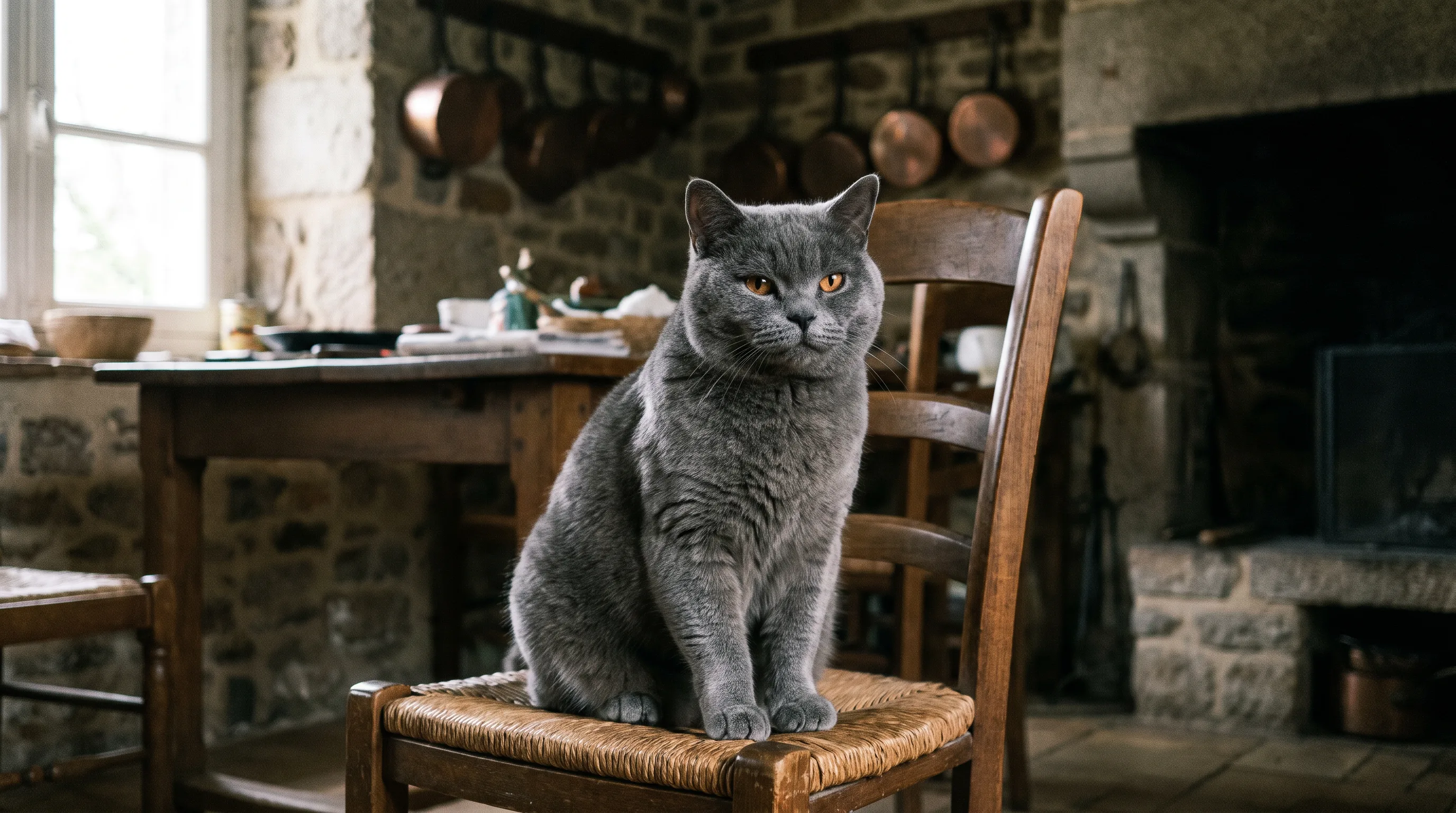
Chartreux
A heavy blue cat on fine legs, with copper eyes and hardly a word to say.
On these lists: Low-maintenance cats · Cats for seniors
Vital stats
| Size | Medium to large · heavy body, fine legs |
| Weight | 3–5 kg females · 5–7 kg males |
| Life expectancy | 11–15 years |
| Energy | Moderate — short bursts, long naps |
| Shedding | High in spring, moderate otherwise |
| Coat | Short, dense, woolly double coat; blue-grey only |
| Group | Shorthair |
| Origin | France |
Breed traits
Friendliness
Care
Mind
The Chartreux by the numbers
The Chartreux facts owners search for most — price, lifespan, weight, shedding and colours, in one place.
Less common, so expect a waitlist and some travel to a reputable breeder — which pushes the price up. Ongoing costs stay modest — it eats little and routine vet care sits at the lower end.
We don't quote a single figure: the real price swings with breeder, region, bloodline and health testing — and a rescue costs a fraction of a breeder's litter. Adopting is almost always the cheapest route.
Temperament
Chartreux are companionable without being demanding. They attach to the household, follow quietly from room to room, and settle nearby rather than on top of you — a cat that would rather share a sofa than a lap. Most are close to mute: some never meow at all, and the ones that do produce a small chirp that seems too high for the body. They're patient with children and unbothered by dogs, adapt well to apartments, and tolerate being alone during a working day better than most pedigree breeds. The hunting instinct stays sharp though; a Chartreux is an efficient mouser and will take a moving toy seriously.
Habits & quirks
Barely speaks
Many Chartreux are effectively silent, communicating by presence and a look. When a voice does appear it is a small chirp, and it surprises people who have lived with the cat for years.
Sits with you, not on you
Affection is proximity. A Chartreux picks the nearest chair, the arm of the sofa, the end of the bed, and considers that a shared evening.
Hunts well
Centuries as a working cat left a real prey drive. Indoors this becomes serious business with a wand toy; outdoors it becomes the reason to keep the cat in.
Slow to grow up
Chartreux mature slowly, taking two to three years to fill out into the heavy adult body, so a lanky year-old is normal.
Care
| Grooming | The coat is the commitment. Dense, water-resistant and woolly, it should be combed rather than brushed — a wide-toothed comb once or twice a week, daily through the heavy spring moult. Left alone it felts into pads near the skin that have to be cut out. |
| Health screening | Ask about patellar luxation, which runs in some lines, and about polycystic kidney disease — the post-war rebuild used Persian outcrosses, so a negative PKD1 DNA test on the parents is worth having. Struvite urinary crystals are also reported in the breed. |
| Weight | A naturally heavy, calm cat is easy to overfeed, and the coat hides the outline. Judge by feeling the ribs, feed measured meals, and keep a daily play session even when the cat seems content without one. |
| Company | Undemanding, but not indifferent. Chartreux cope with a working day better than most breeds, and they still want the household back in the evening — this is a cat for people who are out and then genuinely in. |
Life expectancy
This breed has a typical life expectancy of 11–15 years.
Similar breeds
Breeds with a similar build and background — worth a look if this one isn't quite the fit.
Common questions
Is the Chartreux the same as a British Shorthair or a Russian Blue?
No, though all three are blue and get confused constantly. The Russian Blue is finer-boned with green eyes and a silver-tipped coat; the British Shorthair is rounder and denser all through, with a thicker face; the Chartreux sits between them — heavy body, fine legs, copper eyes, and a woolly coat that breaks like sheep's wool when you push against it.
Are they really silent?
Close to it. Many Chartreux never meow, and most that do use a chirp or trill rather than a real voice. It's a genuine breed trait rather than shyness — the same cat will come running, purr loudly and sit on your book, just without commentary.
Is the monk story true?
Almost certainly not. There's no record of the Carthusians breeding cats, and the order has said as much. The likelier origin is the name of a Spanish wool the coat resembles. The cats themselves are old in France regardless — the name is what's uncertain.
Does the Chartreux shed a lot?
Moderately. The Chartreux sheds a fair amount, steadily through the year with heavier seasonal patches. A weekly brush keeps most of the loose hair off your floors and clothes.
Are Chartreux cats hypoallergenic?
No cat breed is truly hypoallergenic, and the Chartreux isn't one of the easier ones. The trigger is Fel d 1, a protein in a cat's saliva and skin that ends up on the coat during grooming and then spreads on loose hair and dander — and this breed sheds enough to move plenty of it around. If someone at home is allergic to cats, this is a hard breed to live with; spend real time around one first.
Are Chartreux cats good with children?
Usually yes. The Chartreux is a sociable cat that tends to tolerate the noise and handling of family life better than most, which is why it comes up so often for homes with kids. It still needs somewhere high and quiet to retreat to, and children need teaching that a cat walking away is allowed to.
How much grooming does a Chartreux need?
A weekly comb is usually enough for the Chartreux, with a second pass during a seasonal moult. That keeps loose hair off your furniture and cuts down on hairballs, since everything the cat doesn't shed onto the sofa it swallows while washing.