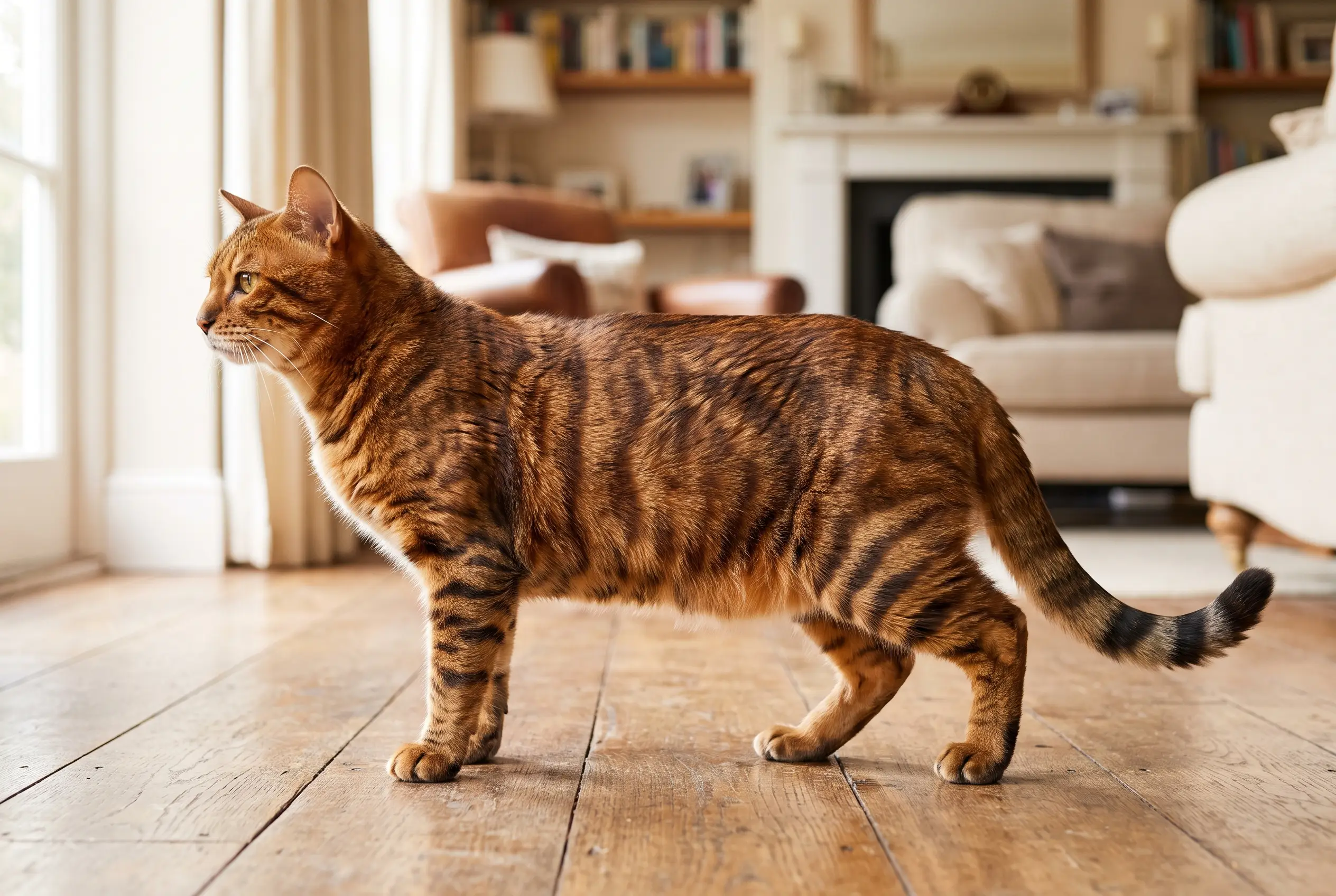
Toyger
Bred stripe by stripe to look like a tiger, with none of a tiger in it.
Vital stats
| Size | Medium · lean, muscular, long-bodied |
| Weight | 3–7 kg · males heavier |
| Life expectancy | 12–15 years — breed literature, not survey data; one veterinary source puts it as low as 9–13 |
| Energy | High but people-focused — calmer and more biddable than a Bengal |
| Shedding | Low — short, close-lying coat |
| Coat | Short, dense, plush; broken vertical mackerel-tabby stripes with gold glitter |
| Group | Shorthair |
| Origin | United States |
Breed traits
Friendliness
Care
Mind
The Toyger by the numbers
The Toyger facts owners search for most — price, lifespan, weight, shedding and colours, in one place.
Less common, so expect a waitlist and some travel to a reputable breeder — which pushes the price up. Ongoing costs stay modest — it eats little and routine vet care sits at the lower end.
We don't quote a single figure: the real price swings with breeder, region, bloodline and health testing — and a rescue costs a fraction of a breeder's litter. Adopting is almost always the cheapest route.
Temperament
Toygers read as gentler and more biddable than their Bengal grandparents: playful and physical, but just as happy pressed against you as chasing a toy across the floor. Owners and breeders describe a cat that trails its person from room to room and dislikes being shut out of whatever is happening, and one that keeps a kitten's enthusiasm for play well past kittenhood. Most get on easily with children and other pets, and the breed has a reputation for being straightforward to train to basic cues. The Bengal ancestry still surfaces in small ways — a fondness for running water, a habit of batting at anything that moves — but the temperament gap from a Bengal is real and was bred in on purpose, alongside the stripes.
Habits & quirks
No two stripe patterns match
Like a real tiger's coat, the pattern is unique to the individual cat. Breeders study a kitten's head markings almost like a fingerprint when choosing future breeding stock.
Still chases the tap
The Bengal side shows up at the sink. Many Toygers paw at a running tap, prefer dripping water to a bowl, and some will follow you into the shower.
Stays at your level
Where a Bengal maps a room vertically, a Toyger tends to stay near you at floor and furniture height — it would rather be in the room than above it.
Plays like a kitten for years
Owners routinely describe adult Toygers pouncing on toys and chasing string with the enthusiasm of a six-month-old; the breed is slow to grow out of kitten play.
Care
| Grooming | The short coat needs only a weekly brush and sheds lightly. There's little undercoat, so the plush feel doesn't turn into mats. |
| Health screening | Ask for what a careful Bengal buyer would also ask for: an echocardiogram for hypertrophic cardiomyopathy (there's no DNA test, only ultrasound, ideally annually), a DNA test for pyruvate kinase deficiency, and a DNA test for the Bengal-linked PRA-b retinal atrophy mutation. Some lines also report cataracts — ask the breeder directly rather than assume a clean bill of health just because the breed is rare. |
| Buying one | This is still a young breed with a small gene pool and a handful of active breeders worldwide; a waiting list is normal and kittens routinely cost well over a thousand dollars. Ask to see the parents, and expect the pattern to keep sharpening as the kitten matures — even experienced breeders rarely produce a cat that matches the standard's ideal exactly. |
| Exercise & enrichment | Calmer than a Bengal doesn't mean sedentary. Daily interactive play and a proper scratching post keep that energy from landing on the furniture; the breed is food-motivated enough that puzzle feeders work well. |
Life expectancy
This breed has a typical life expectancy of 12–15 years — breed literature, not survey data; one veterinary source puts it as low as 9–13.
Similar breeds
Breeds with a similar build and background — worth a look if this one isn't quite the fit.
Common questions
Is a Toyger part tiger?
No. There is no tiger, or any wild cat, in a Toyger's pedigree. It's a domestic tabby crossed with a Bengal, bred to reproduce a tiger-like broken-stripe pattern and round facial markings through ordinary selective breeding, not hybridization. Judy Sugden, who developed the breed, said the goal was to get people to care about tiger conservation, not to create a wild animal in miniature.
How rare are Toygers, and what do they cost?
Very rare. Fewer than 500 were registered worldwide as of 2020, with only a handful of active breeders, and kittens typically start around $1,200 and run higher for cats that match the standard closely. Expect a waiting list, not a same-week kitten.
Why don't Toyger kittens look as striped as the breed standard describes?
Because the breed is still being refined. TICA's standard calls for bold, random vertical stripes and circular facial rings, but most Toygers alive today fall short of that ideal. Breeders are working toward it generation by generation, which is also why the gene pool stays small and prices stay high.
Does the Toyger shed a lot?
Not much. The Toyger is a low-shedding breed, so loose hair around the home stays minimal. It still needs regular grooming, but you won't be fighting drifts of fur.
Are Toyger cats hypoallergenic?
No cat breed is truly hypoallergenic. The trigger is Fel d 1, a protein in a cat's saliva and skin that transfers to the coat during grooming and then travels on loose hair and dander — so a cat that sheds less, like the Toyger, spreads less of it around the house, but still produces it. If someone at home reacts to cats, spend real time with this breed before deciding, and no breeder should promise you an allergy-free cat.
Are Toyger cats good with children?
Usually yes. The Toyger is a sociable cat that tends to tolerate the noise and handling of family life better than most, which is why it comes up so often for homes with kids. It still needs somewhere high and quiet to retreat to, and children need teaching that a cat walking away is allowed to.
How much grooming does a Toyger need?
Very little. The Toyger handles its own coat and a comb once a week or so is plenty — mostly to catch loose hair before the cat swallows it. Claws, teeth and ears still want the usual checks, which is the part people skip on an easy-coated cat.