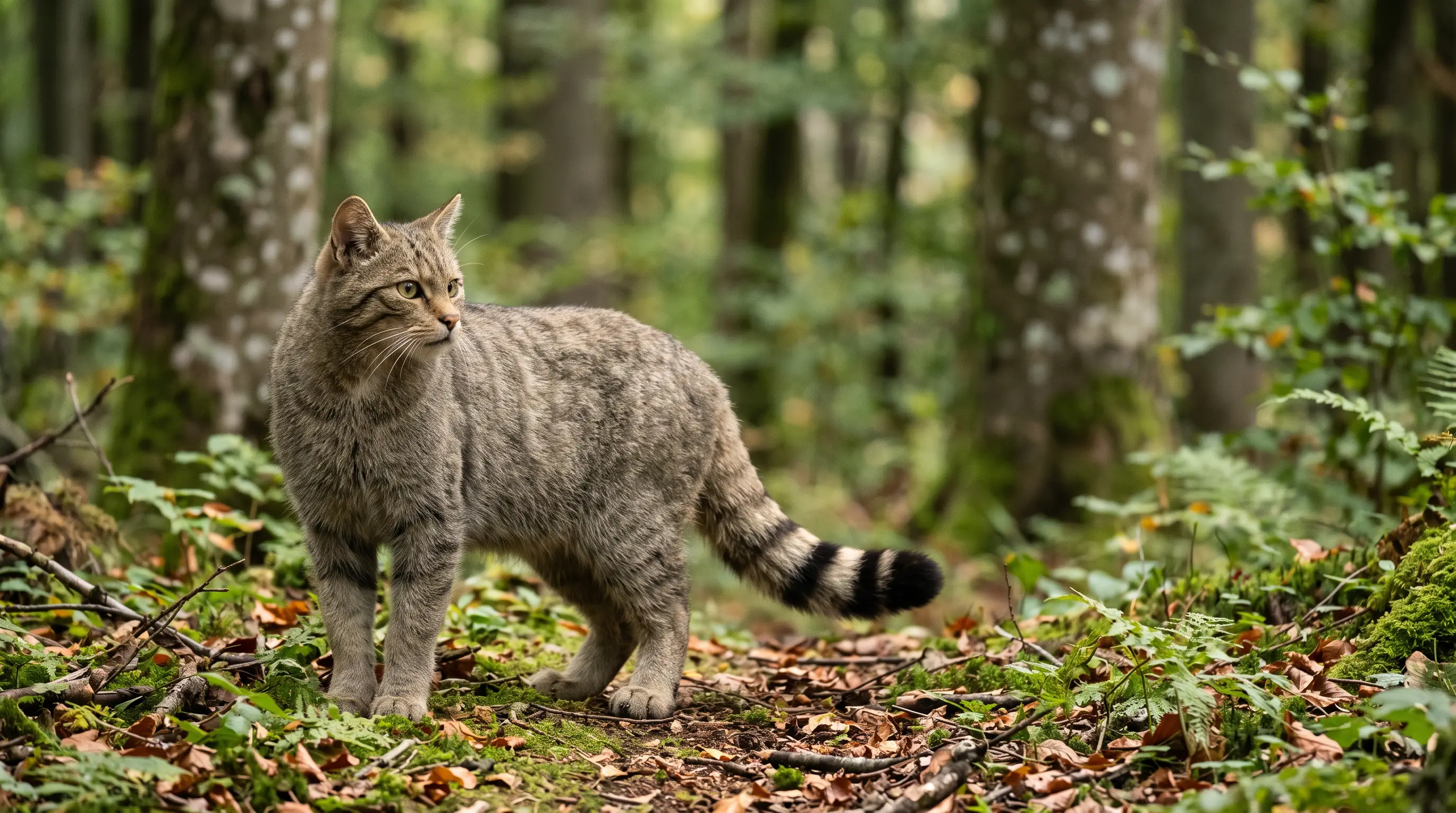
European wildcat: the cat Europe cannot count
The European wildcat, Felis silvestris, is a stocky forest cat native to Europe, Anatolia and the Caucasus, and it is not the animal your house cat descends from. That honour belongs to the African wildcat, a separate species since 2017. Felis silvestris has only been assessed on the Red List in its own right since 2022, and that assessment records its population trend as unknown. Europe protects this animal strictly in more than twenty countries and still cannot say how many there are.
What the 2017 taxonomy split changed
The 2017 revision by the Cat Classification Task Force of the IUCN/SSC Cat Specialist Group cut the old wildcat in two. Kitchener and colleagues published it as A revised taxonomy of the Felidae in Cat News Special Issue 11, the work of a 22-expert group that recognised 41 cat species and 77 subspecies across the family. Before that report, the wildcat of Europe and the wildcat of Africa were subspecies of one polytypic Felis silvestris. After it, Felis silvestris is the wildcat of Europe and Anatolia, and Felis lybica is the wildcat of Africa and Asia, and the ancestor of every domestic shorthair alive.
The reshuffle matters for anyone reading older field guides. Felis silvestris now holds two subspecies: F. s. silvestris across Europe, including Scotland, Sicily and Crete, and F. s. caucasica through the Caucasus and Anatolia. The Scottish animal, described as Felis grampia by Miller in 1907 and long carried as F. s. grampia, was judged doubtfully distinct by the task force and dropped as a valid subspecies. It is a subpopulation of the European wildcat, which makes the Highland collapse no less serious, only differently labelled. Cat domestication ran through Felis lybica on its own branch, much as dog domestication ran through the grey wolf.
Where European wildcats live
The IUCN Cat Specialist Group divides the range into five continental metapopulations, and they are not all moving the same way. Western-Central Europe covers France, Germany, Luxembourg, Belgium, the Netherlands and Switzerland, with expansion recorded in Germany and France. The Apennine peninsula and Sicily are expanding and increasing. Eastern-Central and Southeast Europe take in around twenty countries where the cat is relatively widespread but fragmented and the trend is unknown. The Iberian peninsula is declining and highly fragmented. Turkey and the Caucasus complete the picture, with the cat common in European and northern Turkey and F. s. caucasica holding Anatolia, Georgia, Azerbaijan, Armenia and Russia. Two island populations survive, on Sicily and on Crete.
The recent history is a retreat followed by a partial return. The species disappeared completely from the Netherlands, Austria and the Czech Republic, then recolonised Belgium, France, Germany, Scotland, Slovakia and Switzerland between roughly 1920 and 1940, and there is now fresh evidence of presence again in all three countries it had lost. Italy is the clearest recovery story in the south, and it has its own field guide in the Italian wildcat. For how the European animal fits alongside its African and Asian relatives, see where every wildcat species lives.
How many are left, and why nobody can say
There is no reliable total for the European wildcat, and the honest answer to the population question is that the data does not exist. Felis silvestris is listed as Least Concern, assessed in 2021 and published in 2022, the first Red List assessment of the species on its own after the split. The same assessment gives the population trend as unknown, and the Cat Specialist Group's account states plainly that reliable conservation-status information is missing across much of the range. The category describes how widely the cat is spread. It says nothing about how well it is watched.
The round figure that circulates in press coverage comes from taking one low average density and multiplying it across the mapped range. Observed densities span 0.7 to 250 cats per 100 km², so that sum yields an order of magnitude, not a count. Germany is among the better-studied countries and even there published estimates disagree by thousands depending on the year and the method. As with most of the world's small wild cats, the legal protection is far ahead of the monitoring. That gap is the real story: a strictly protected European mammal whose numbers are guessed at, which is why so much of wildcat conservation work goes into camera surveys and laboratory time rather than into fences.
Telling a wildcat from a tabby
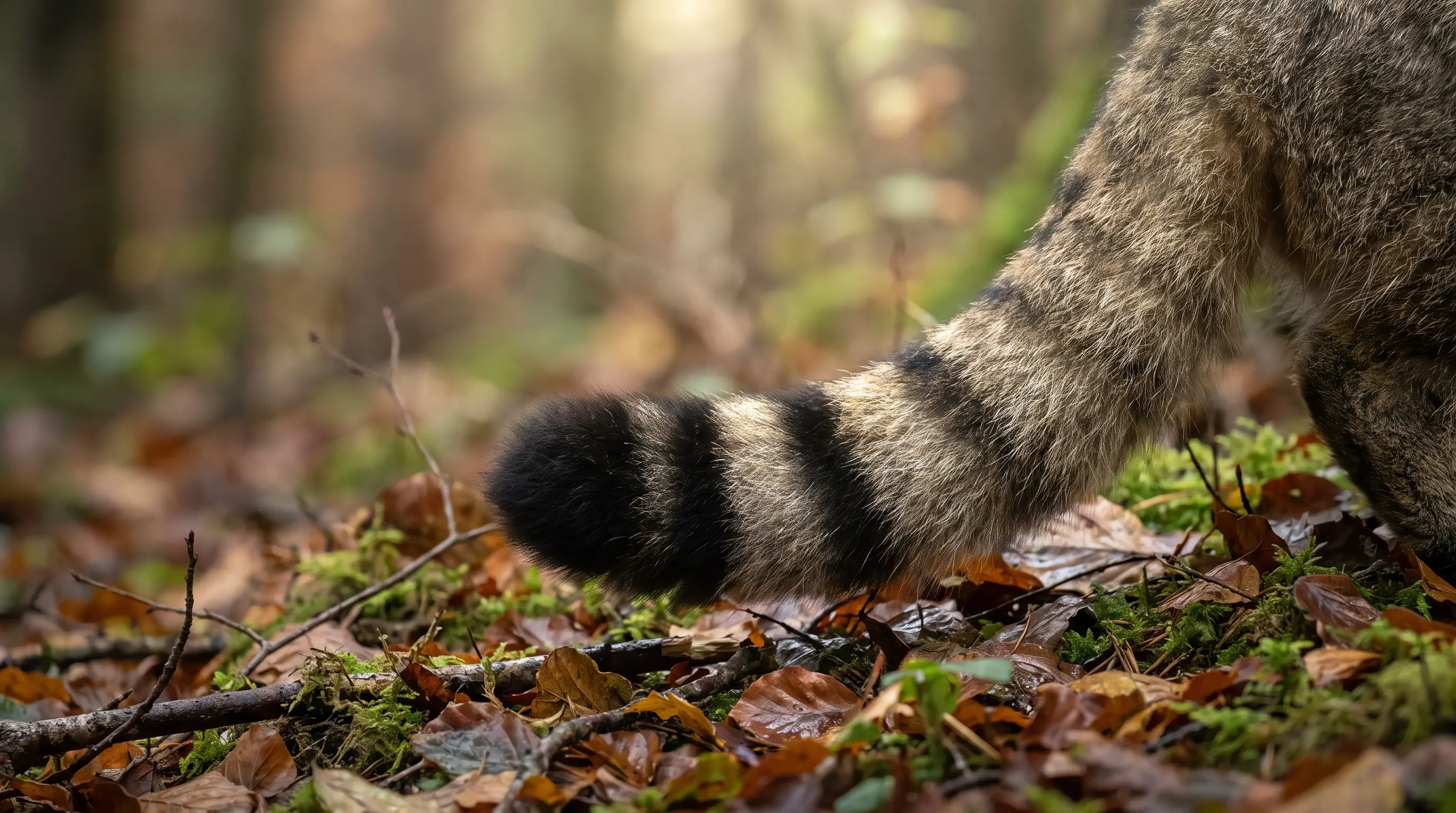
Size and the tail do most of the work in the field. The Cat Specialist Group gives a weight of 3 to 8 kg, a body length of 45 to 80 cm and a tail of about 30 cm. The 2019 Cat Specialist Group report on wildcat conservation in Scotland, by Breitenmoser, Lanz and Breitenmoser-Würsten, sets out finer measurements: males 82.3 to 98.1 cm from nose to tail-tip and 3.3 to 7.26 kg, females 73 to 89.5 cm and 2.4 to 4.7 kg. The tail is thickly furred and club-shaped, with three to five black rings, a blunt black tip and a mean length of 27 cm. Body stripes number 7 to 11 and are dark but soft-edged.
Marks alone will not settle an argument. Kitchener and colleagues in 2005 combined 20 pelage characters, 40 skull parameters and relative intestine length, and found seven pelage characters that significantly separate wildcats from domestic cats, scored at 19 or above for dead or immobilised animals and relaxed to 14 or above for cats identified in the field. A heavy grey-brown moggie or a rangy European Shorthair can pass every casual test. If you want the method rather than the checklist, how wildcat testing actually works explains it, and wildcat versus feral cat covers the case that trips up most walkers. Comparing against the cat breed profiles is a useful reality check on how ordinary a wildcat can look.
Voles, night shifts and very large territories
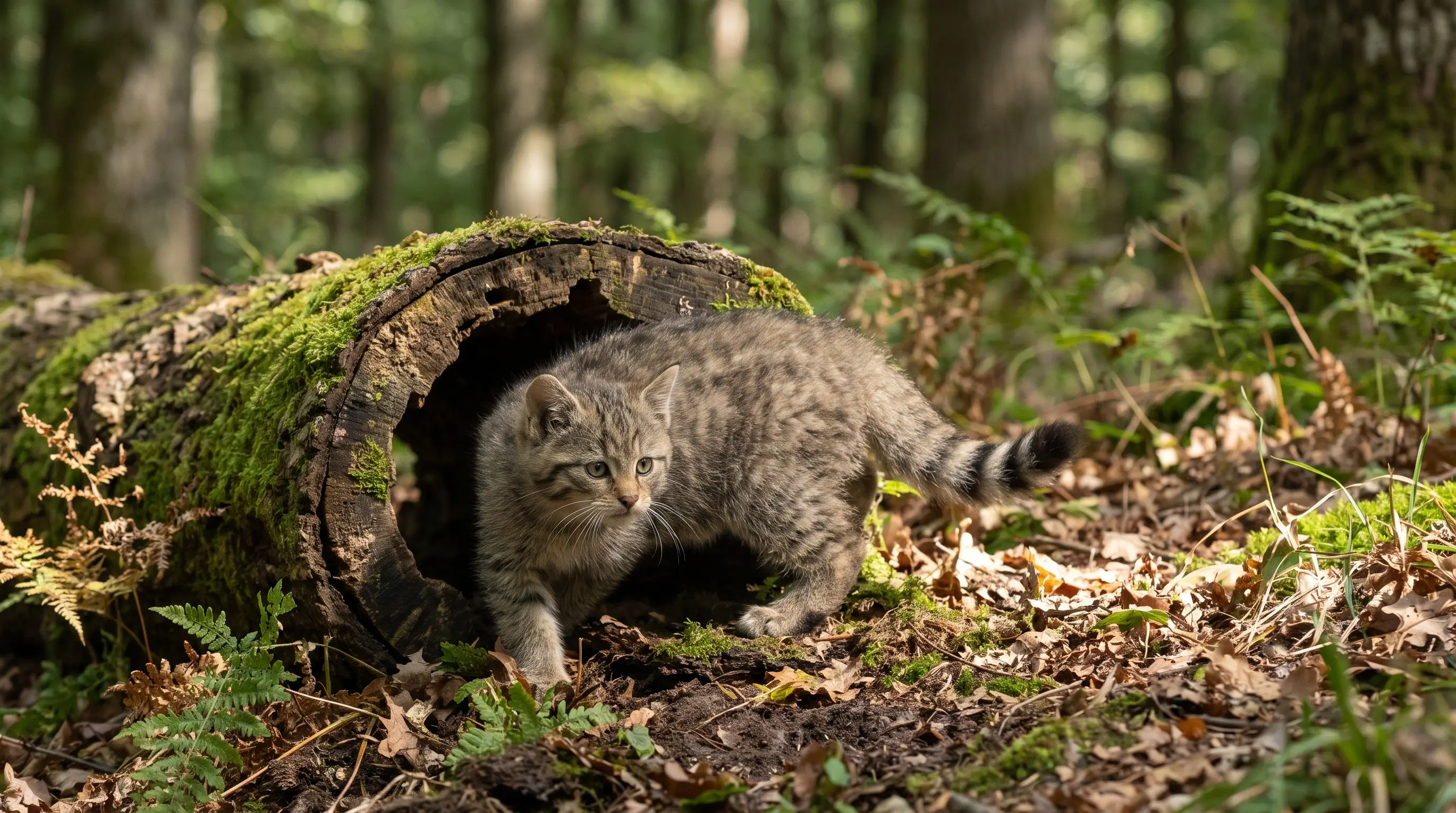
Voles, mostly, taken at night. The Cat Specialist Group describes the staple diet as rodents, predominantly voles along with rats and mice, with rabbits preferred where they are available and birds and insects taken occasionally. Wildcats are solitary, mostly nocturnal and territorial, though they hunt by day where human activity is low, with peaks around dawn and dusk. That night shift is the pressure behind the eye anatomy that makes a cat's eyes glow in a torch beam.
Territory size tracks prey density and the spread is startling. Home ranges reach up to 60 km² in Spain, run 1.5 to 8.7 km² in Hungary, 8 to 18 km² on Scotland's west coast where cats depend on small rodents, and about 1.8 km² in north-east Scotland where rabbits are dense; recent Scottish GPS studies give 15 to 25 km². A male's range overlaps those of three to five females, while female ranges are exclusive of each other. Subadult males move hardest, dispersing up to 55 km and covering more than 10 km in a single night, which is how a fragmented species reappears in countries that had written it off. It also means roads, hedgerows and open farmland decide a great deal, the subject of the forest a wildcat needs.
Hybridization is the threat the law cannot reach

A wildcat and a farm cat produce fertile kittens, and that single fact drives the hardest conservation problem in the range. Repeated crossing pushes domestic genes into wild populations through introgression, so a wood can hold cats that look wild while carrying substantial domestic ancestry. Where it has gone furthest the result is called a hybrid swarm, mapped in the hybrid swarm problem. The countermeasure is unglamorous: neutering and TNR work among the free-roaming and feral cat population around wildcat forest. That makes ordinary decisions into conservation ones, including what you do when you have found a stray cat and how you handle feeding a neutered cat so it stays close to home.
The paperwork, by contrast, is strong. The European wildcat has been on CITES Appendix II since 1977, sits in Annex IV of the EU Habitats Directive 92/43/EEC as a strictly protected species of Community interest, and appears in Appendix II of the Bern Convention as strictly protected fauna. Hunting is prohibited in 18 range countries and regulated in three others. None of that stops an unneutered tom from walking into a wood. In the pedigree world the same biology gets used deliberately, with outcrossing to wild species behind breeds like the Bengal and the Chausie.
Could wildcats return to England?
Not yet, and no release has been approved. The European wildcat is extinct in England and Wales: it had gone from southern England by the 16th century, was reduced to Wales and Northumberland by the mid-19th, confined to western and northern Scotland by 1880 and to the north-west of Scotland by 1915. The Cat Specialist Group now describes the Scottish population as virtually extinct and no longer deemed viable, which makes the Scottish case the reference point for any British reintroduction.
The South West Wildcat Project, run by Devon Wildlife Trust with Forestry England and Derek Gow Consultancy and advised by the University of Exeter, the IUCN Cat Specialist Group and Wildwood Trust, published a feasibility report concluding that reintroduction to south-west England is feasible, with 80% of surveyed residents positive about the idea. Feasible is not the same as licensed or funded. There are no approved releases and no release date, and the identification and hybridization questions above would have to be answered first for any released population to stay wild. Until then, the closest most of us get is a camera-trap frame or a long look through the wild stories.
Common questions
What is the European wildcat?
The European wildcat is Felis silvestris, a wild cat native to Europe, Anatolia and the Caucasus with two subspecies: F. s. silvestris across Europe, including Scotland, Sicily and Crete, and F. s. caucasica in the Caucasus and Anatolia. It looks like a heavy, soft-striped tabby but is a different species from the domestic cat.
Is the European wildcat endangered?
Not by Red List category. Felis silvestris was assessed as Least Concern in 2021 and published in 2022, its first assessment as a species in its own right, but the trend is recorded as unknown, the Iberian population is declining and fragmented, and the Scottish population is described by the IUCN Cat Specialist Group as virtually extinct.
How many European wildcats are left in the world?
No reliable total exists. The Cat Specialist Group says conservation-status information is lacking across much of the range, and the widely quoted round number is an extrapolation from one low average density applied to the whole range, while measured densities span 0.7 to 250 cats per 100 km².
How big is the European wildcat?
The IUCN Cat Specialist Group gives 3 to 8 kg, a body length of 45 to 80 cm and a tail of about 30 cm. Scottish measurements are tighter: males 82.3 to 98.1 cm nose to tail-tip and 3.3 to 7.26 kg, females 73 to 89.5 cm and 2.4 to 4.7 kg.
Are European wildcats related to domestic cats?
Closely related, but not the ancestor. The 2017 revision by the IUCN Cat Specialist Group's task force separated Felis silvestris from Felis lybica, the African and Asiatic wildcat that domestic cats descend from. The two still interbreed and produce fertile hybrids, which is why hybridization is the main threat to wild populations.
Are European wildcats nocturnal?
Mostly, yes. The Cat Specialist Group describes them as solitary, mostly nocturnal and territorial predators, with activity peaks around dawn and dusk, though they will hunt during daylight in places where human activity is low.
See also
More in Wild
Scottish wildcat: not extinct, not a subspecies
The most-quoted fact about the Scottish wildcat misstates its own source. What the 2019 IUCN review really said, and where the cats stand in 2026.
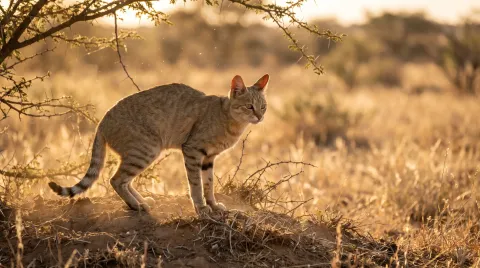
African wildcat: the real ancestor of your cat
Your cat descends from Felis lybica, a North African animal most people cannot name. In November 2025 the standard account of how it reached Europe broke.
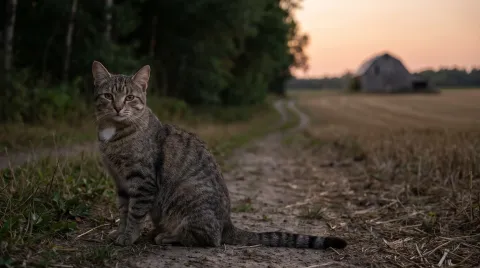
Wildcat hybridisation: how a species gets absorbed
Even a low crossbreeding rate assimilates a wildcat population past halfway inside a century. Why "only a few hybrids" is not the reassurance it sounds like.

European wildcat vs domestic cat: how to tell
You cannot do it by eye. On the same cats, coat scoring rated 0.854 and the genome 0.984, and the strict visual cut-off loses real wildcats.

The forest a European wildcat actually needs
Woodland to shelter and den in, open edge to hunt over, and corridors between the two. What the radio-tracking and genetics really show.

Wildcat conservation: law, cameras and cryptic extinction
How you save a species you cannot count: the law, the genetics labs, and the honest gap between what works and what is only worth trying.