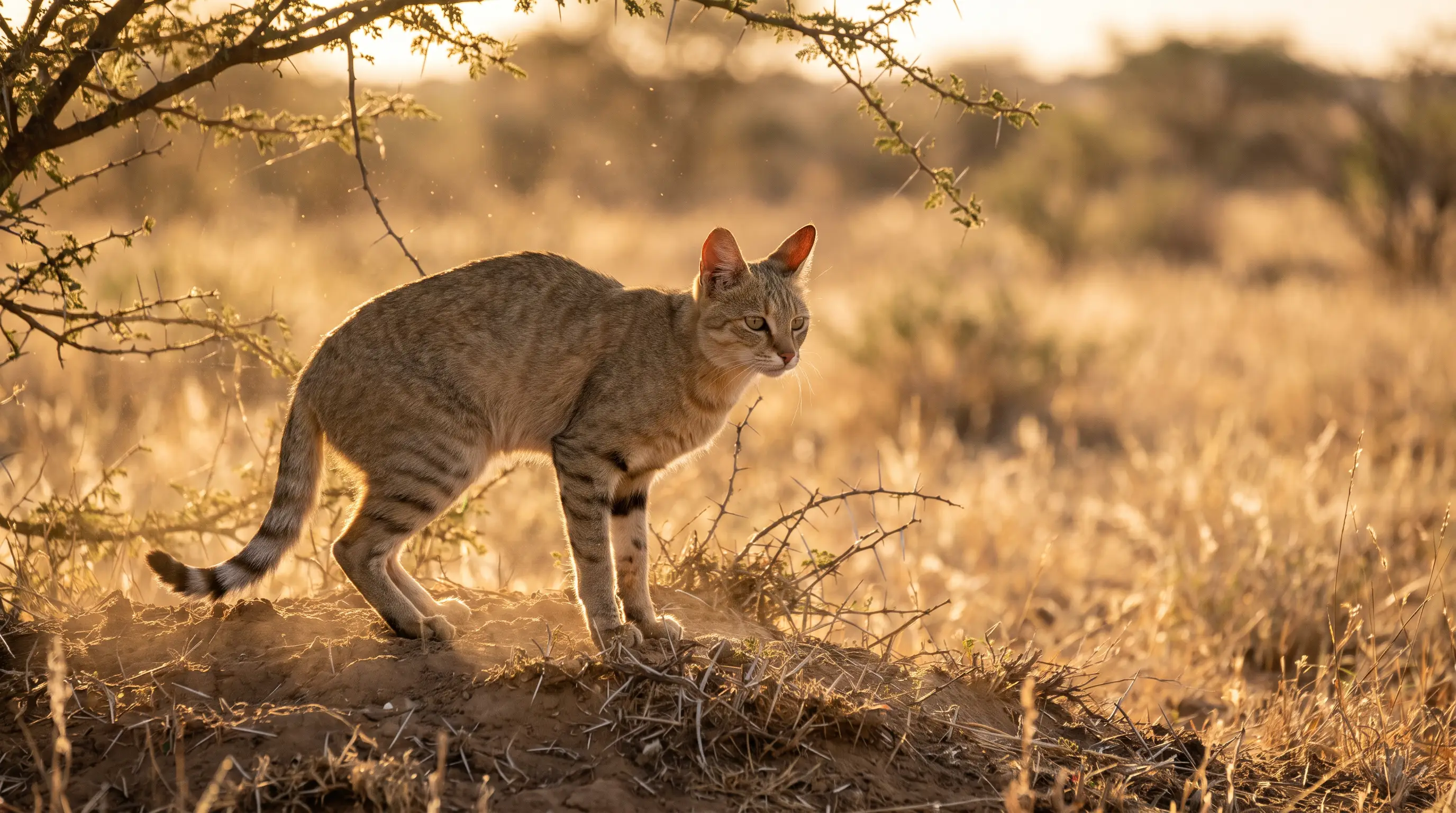
African wildcat: the real ancestor of your cat
Every domestic cat alive descends from the African wildcat, Felis lybica, a sandy, long-legged animal of Africa and western Asia that almost nobody outside cat genetics can name. The IUCN Cat Specialist Group calls it the only ancestor of the domestic cat. The European wildcat, Felis silvestris, is a separate species, and no house cat descends from it. The part of the story that changed recently is not the animal but the route: on 27 November 2025, the largest ancient-genome study of cats yet published moved the arrival of domestic cats in Europe several thousand years later than the textbooks had it.
What Felis lybica actually is
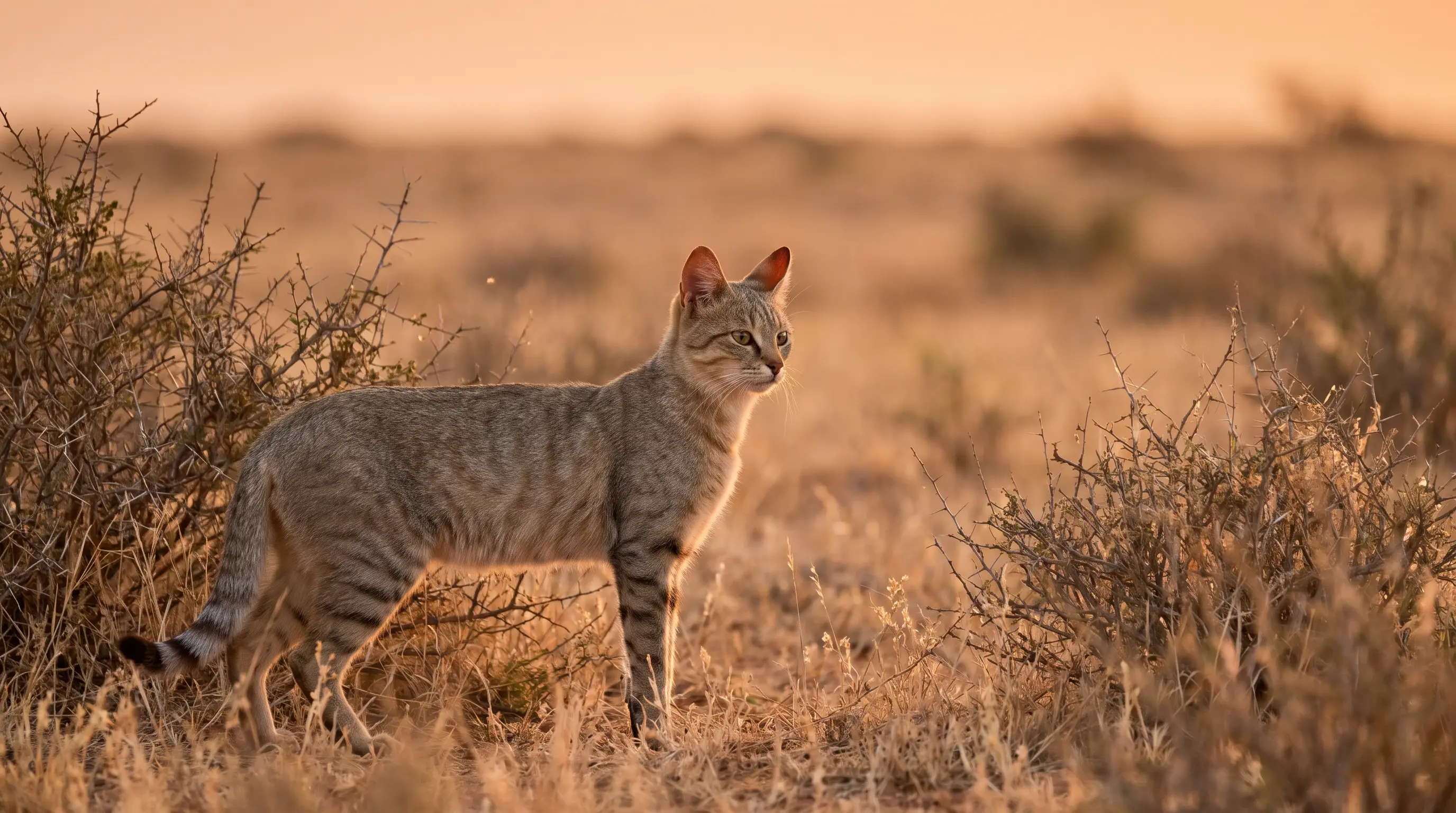
Felis lybica is the wildcat of Africa and western and central Asia, and since 2017 it has been a full species rather than a subspecies. The revision by Kitchener and colleagues for the IUCN/SSC Cat Classification Task Force, published in Cat News Special Issue 11, pulled the bush and steppe cats of Africa and Asia out of Felis silvestris and gave them their own binomial. Before that, everything from Scotland to Mongolia sat inside one species, which is why older field guides and most web pages still call your cat's ancestor Felis silvestris lybica.
Three subspecies stand under the 2017 arrangement. F. l. lybica covers East, West and North Africa, the Arabian peninsula and the Middle East, and also Corsica, Sardinia and Crete. F. l. cafra holds southern Africa, with the boundary between the two possibly running through Mozambique or Tanzania. F. l. ornata covers south-west and Central Asia, Afghanistan, Pakistan, India, Mongolia and China.
One name you will meet and should distrust is Felis lybica sarda, for the cats of Sardinia and Corsica. It is not a valid subspecies. It began life in 1885, when Fernand Lataste described a male skin and skull from Sarrabus in Sardinia as Felis libyca var. sarda, redder and greyer than mainland African wildcats with longer hair along the back. Under the current taxonomy those island cats sit inside F. l. lybica. Felis lybica and Felis silvestris split from a common ancestor roughly 1.4 million years ago, on the reading of Johnson and colleagues in 2006.
How to tell one from a European wildcat
Look at the tail. The IUCN Cat Specialist Group describes the African wildcat's tail as “slim and tapered”, ringed near the end and finished with a dark tip, against the broad bushy tail of the European wildcat. That single feature does more work in the field than coat colour.
The rest follows the same pattern. Felis lybica is the smaller animal and lighter in build: 2 to 8 kg, a body of 40.6 to 80 cm, a tail of 21.5 to 37.5 cm. The coat runs reddish, sandy or tawny brown through to greyish, and the tabby stripes and spots on it are faint and unremarkable, distinctly less pronounced than the heavy marbling of a European forest cat. If you have spent time with the Scottish wildcat, the contrast is obvious the moment you see the two side by side.
None of this settles an individual animal's ancestry, which is why field identification has largely given way to laboratory work. We cover that in detail in how you actually tell a wildcat from a hybrid, and the short version is that coat scoring alone misclassifies animals in both directions.
How to tell one from the cat on your sofa
The legs give it away. An African wildcat's legs are noticeably longer than a house cat's, and when the animal sits with its front legs extended, the body is pushed up into an almost vertical posture that a domestic shorthair simply does not adopt. Then check the ears: the backs carry a reddish or rusty-brown tint. The tail is long and thin with two or three black rings and a black tip, the legs are banded with black bars, and black-tipped hairs across the coat produce a speckled effect at close range.
This matters practically, because a sandy tabby in North Africa or the Middle East may be a wildcat, a domestic cat living wild, or a cross. If you want the working checklist, see how a wildcat differs from a stray or free-ranging domestic cat. A feral cat carries no special markings that announce itself, and in most of the African wildcat's range there is no reliable visual test.
Worth clearing up a common confusion: the breeds that look most like small wild animals are not throwbacks to Felis lybica. The Bengal, the Savannah and the Chausie get their look from recent crosses with entirely different wild species. Your ordinary tabby is the one with the African wildcat in it.
Where it lives, and where the two species meet
Felis lybica is the most widely distributed wild cat on Earth. It occupies Africa outside the rainforest belt, the Arabian peninsula, the Middle East, and south-west and central Asia through Afghanistan, Pakistan, India, Mongolia and China. That spread is a large part of why it survives so well while its European cousin does not, and it puts the species in a different position from every animal in our map of where each wildcat species lives.
The two species probably overlap in Anatolia and the Caucasus, and the IUCN assessment explicitly asks for genetic work focused there. That gap in the record turns out to matter for the domestication story below.
Behaviour is mostly what you would expect of a small cat. It hunts mainly at night, more so in hot country and near human settlement, though it is seen by day too, and it has the same reflective eye structure that makes a cat's eyes glow in a torch beam. Diet is dominated by rodents, jerboas, gerbils, voles and mice, plus hares and rabbits, with insectivores, birds, amphibians, insects, lizards, snakes and fish taken as they come. Adults are solitary and territorial and scent-mark their ground, but females will form temporary groups with offspring from more than one litter. Home ranges vary enormously: one radio-tracked female in the United Arab Emirates used 52.7 km², females in South Africa 6 to 10 km², one male in Kenya 4.3 km². Where the ground is poor, a cat needs far more of it, which is the same relationship that governs the forest a European wildcat needs.
How a North African cat became the house cat
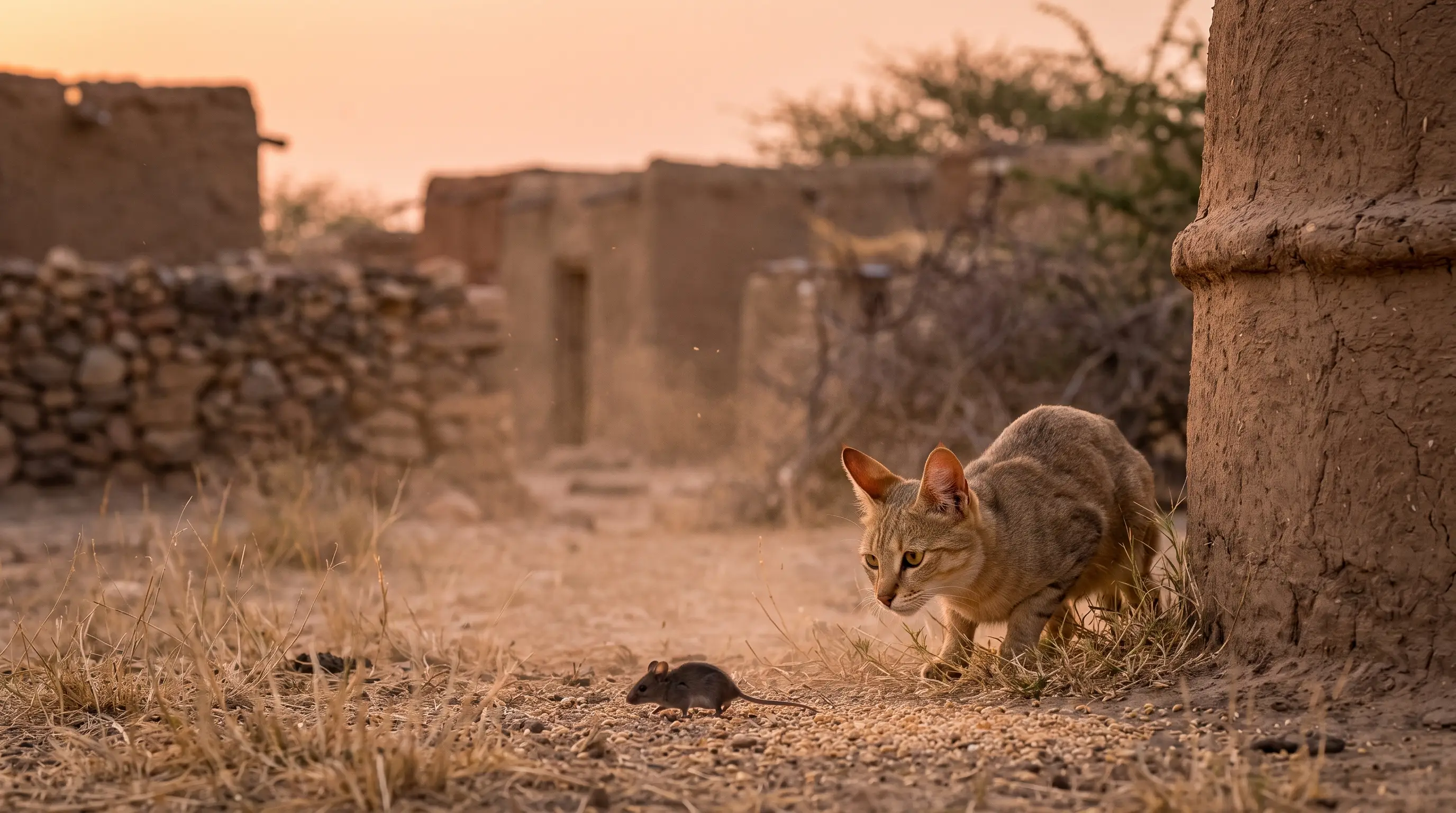
Grain stores did it. The standard account comes from Driscoll and colleagues, whose 2007 paper in Science, “The Near Eastern Origin of Cat Domestication”, genetically assessed 979 domestic cats and their wild relatives and concluded that cats were domesticated in the Near East, probably alongside the first agricultural villages of the Fertile Crescent, from at least five maternal founder lines, around 9,500 years ago. Settled farming meant stored grain, stored grain meant rodents, and rodents meant a living for any wildcat willing to work close to people. Note that Driscoll's team used the pre-2017 taxonomy and wrote about subspecies of a single Felis silvestris, so the names in that paper do not match the ones used here.
The earliest hard evidence of cats and humans in close company is from Cyprus. Vigne and colleagues reported in 2004, in “Early Taming of the Cat in Cyprus”, a roughly 9,500-year-old burial at the Neolithic site of Shillourokambos near Limassol: a cat of about eight months, its bones still articulated, placed some 40 cm from a human burial. Cats are not native to Cyprus, so somebody carried that animal across water by boat. It is evidence of taming and deliberate transport, which is what Vigne argued. It is not evidence that the animal was an African wildcat or that it stands in the ancestry of modern domestic cats.
Ottoni and colleagues added ancient DNA in 2017, in Nature Ecology & Evolution, and concluded that both the Near Eastern and the Egyptian populations of the African wildcat fed the domestic gene pool, at different times: a Neolithic expansion out of the Near East, then a second surge in the Classical period as the Egyptian cat travelled the Old World along sea and land trade routes. The shape of it rhymes with how the wolf became the dog, with one difference: nobody selected cats for a job. They selected themselves, and their communication with us, including the meow they mostly aim at humans, came later.
What changed in November 2025
The date cats reached Europe moved by several thousand years. De Martino and colleagues published “The dispersal of domestic cats from North Africa to Europe around 2000 years ago” in Science on 27 November 2025, with Claudio Ottoni of the University of Rome Tor Vergata as corresponding author and a commentary by Losos, “The cat diaspora out of Africa”, alongside it. They sampled 225 ancient cat specimens from 97 archaeological sites across Europe and Anatolia, recovered 70 low-coverage ancient genomes spanning more than ten millennia, from the 9th millennium BCE to the 19th century CE, and added 17 modern and museum genomes for 87 in total. Thirty-seven of the remains, from 30 sites, were directly radiocarbon-dated.
Here is the part that breaks the old account. Cats in Europe and Anatolia dated between 9,500 and 6,300 years ago had been read as early domestics because they carried African wildcat mitochondrial DNA. On nuclear data they are not domestic at all. All 22 samples from the 9th millennium to the 3rd century BCE fall in the European wildcat cluster: they were Felis silvestris wildcats whose ancestors had crossed with F. l. lybica at some point. The mitochondrial signal was misleading, and the amount of African wildcat ancestry in those animals climbs as you move east, from 9% in Bulgaria to 34% in central Anatolia.
The earliest cat that does sit in the African wildcat and domestic cluster in Europe comes from Genoni in Sardinia, about 2,200 years ago. It resembles present-day Sardinian wildcats and is closely related to an African wildcat from Morocco. Every other European and Anatolian cat in that cluster dates from roughly 2,000 years ago onward. The authors read this as two waves: north-west African wildcats founding the Sardinian population, then a distinct and still-unidentified North African population sourcing the dispersal, no later than 2,000 years ago, that established the gene pool of modern European domestic cats. From there the spread was fast, often along Roman military routes, with cats in Britain by the 1st century CE.
Be precise about the scope of this. Near Eastern domestication still stands, and the domestic cat still originated from the African wildcat, F. l. lybica. What moved is when cats arrived in Europe and which population they came from. The line that cats walked into Europe with Neolithic farmers, taught for the better part of two decades, is what the 2025 genomes contradict.
Least Concern, and what that hides
Felis lybica is listed as Least Concern, assessed as a distinct species for the first time in 2022 by Ghoddousi and colleagues, on the grounds that it is the most common and most widely distributed wild felid in the assessment region. The population trend is recorded as unknown, because the data to establish one do not exist. Any global figure you see for African wildcat numbers is invented. Arash Ghoddousi, who led the assessment, has said the team struggled to find people who knew anything about these cats at all, and that the species or its subspecies “could vanish before humanity realizes it”.
The named threats are crossing with domestic cats, poaching and retaliatory killing, habitat destruction, road mortality and a historical fur trade. It has been on CITES Appendix II since 1977, with national protection in places including India, under the Wildlife Protection Act 1972, and Afghanistan, under the 2009 Protected Species List. Genetic swamping by free-ranging domestic cats is the threat that legal protection handles worst, for the reasons set out in our piece on the hybrid swarm problem and in what actually works in wildcat conservation.
Sardinia shows the shape of the work. Lecis and colleagues published “Unghosting the Sardinian wildcat” in BMC Ecology and Evolution in 2025, describing the island's cats as a North African lineage that arrived in Neolithic times, and using 29 microsatellite loci on road-killed animals to sort genuinely wild individuals from recent wild-by-domestic crosses. The threats they name are habitat fragmentation, illegal or incidental killing, and interbreeding with free-ranging domestic cats. We go through the island population and the mainland animals in the Italian wildcat field guide.
If you take one practical thing from this: the cat you feed outdoors is a member of the species that is dissolving these populations from the inside. Neutering matters more in wildcat country than anywhere else, and if a cat has adopted you, what to do when you find a stray cat covers the sequence. For the wider set of small wild felids, see eight small wild cats worth knowing and the rest of our wild animal stories; for the domestic side, the cat breed library.
Common questions
Do domestic cats come from African wildcats?
Yes. The IUCN Cat Specialist Group calls Felis lybica, the African wildcat, the only ancestor of the domestic cat, and the 2025 genome study by De Martino and colleagues traces the domestic lineage specifically to F. l. lybica. The European wildcat, Felis silvestris, is a separate species and is not an ancestor.
Where did domestic cats come from originally?
The Near East. Driscoll and colleagues concluded in 2007, from 979 cats assessed genetically, that domestication happened around 9,500 years ago alongside the first farming villages of the Fertile Crescent, from at least five maternal founder lines. What changed in November 2025 is the European chapter: cats appear to have reached Europe from North Africa no later than about 2,000 years ago, not with Neolithic farmers.
Are African wildcats the same as domestic cats?
No, they are a separate wild species that can interbreed with domestic cats. In the field, look for legs longer than a house cat's, a sitting posture that pushes the body almost vertical, a reddish tint to the backs of the ears, and a slim tapered tail with two or three black rings and a black tip.
Is the African wildcat domesticated?
No. Felis lybica is a wild species, solitary, territorial and mostly nocturnal, listed on CITES Appendix II since 1977. Its descendants were domesticated thousands of years ago, but the wild animal itself was not.
Can African wildcats be domesticated?
There is no evidence that a wild-caught African wildcat makes a manageable pet, and it is often illegal to keep one. The assumption that this species is inherently tamer than the European wildcat, which its domestication history makes tempting, is not established by any citable study, and the IUCN accounts describe both species as solitary, territorial and mostly nocturnal.
Are African wildcats endangered?
No. The species was assessed as Least Concern in 2022, in its first assessment as a distinct species, because it is the most common and most widely distributed wild felid in the region assessed. The population trend, though, is listed as unknown for want of data, and individual populations such as Sardinia's are under real pressure from interbreeding with free-ranging domestic cats.
What is the African wildcat descended from?
Felis lybica and the European wildcat, Felis silvestris, diverged from a shared ancestor roughly 1.4 million years ago, on the estimate of Johnson and colleagues in 2006. Both were treated as one species until the 2017 revision by Kitchener and colleagues for the IUCN/SSC Cat Classification Task Force separated them.
See also
More in Wild
European wildcat: the cat Europe cannot count
Felis silvestris was only assessed as a species in its own right in 2022, and its official population trend is one word: unknown.
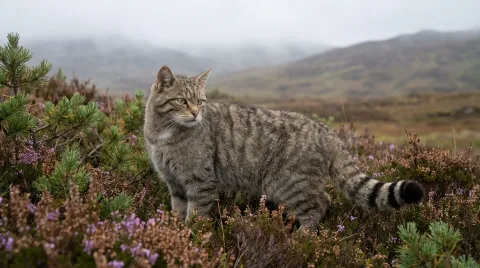
Scottish wildcat: not extinct, not a subspecies
The most-quoted fact about the Scottish wildcat misstates its own source. What the 2019 IUCN review really said, and where the cats stand in 2026.
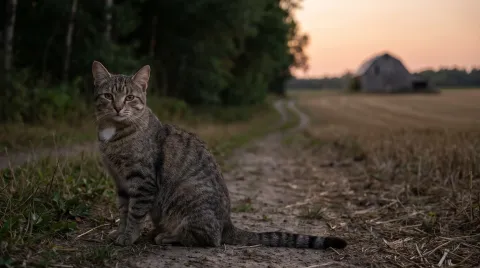
Wildcat hybridisation: how a species gets absorbed
Even a low crossbreeding rate assimilates a wildcat population past halfway inside a century. Why "only a few hybrids" is not the reassurance it sounds like.

European wildcat vs domestic cat: how to tell
You cannot do it by eye. On the same cats, coat scoring rated 0.854 and the genome 0.984, and the strict visual cut-off loses real wildcats.

The forest a European wildcat actually needs
Woodland to shelter and den in, open edge to hunt over, and corridors between the two. What the radio-tracking and genetics really show.

Wildcat conservation: law, cameras and cryptic extinction
How you save a species you cannot count: the law, the genetics labs, and the honest gap between what works and what is only worth trying.