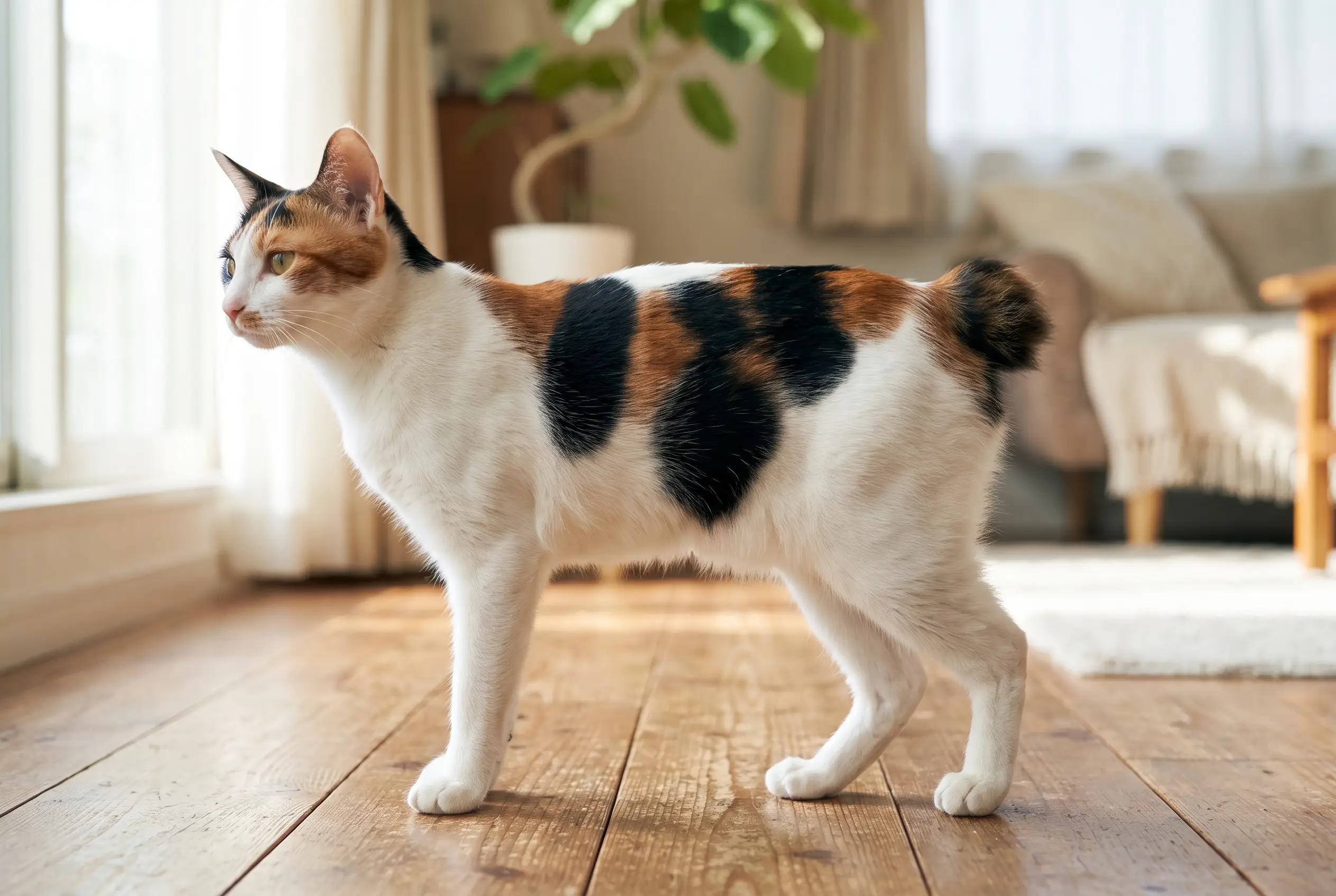
Japanese Bobtail
A pom-pom tail that's a different shape on every cat, and reportedly the shape behind Japan's beckoning-cat figure at the door.
Vital stats
| Size | Medium · lean, athletic; hind legs longer than fore |
| Weight | 2.7–4.5 kg · males heavier — breed literature; the standard sets no weight |
| Life expectancy | 9–13 years, sometimes into the mid-teens — breed literature, not survey data |
| Energy | High — athletic jumper, plays hard well past kittenhood |
| Shedding | Low to moderate — little undercoat; more from the longhair variety |
| Coat | Short or semi-long, soft and silky, little undercoat |
| Group | Shorthair |
| Origin | Japan |
Breed traits
Friendliness
Care
Mind
The Japanese Bobtail by the numbers
The Japanese Bobtail facts owners search for most — price, lifespan, weight, shedding and colours, in one place.
Less common, so expect a waitlist and some travel to a reputable breeder — which pushes the price up. Ongoing costs stay modest — it eats little and routine vet care sits at the lower end.
We don't quote a single figure: the real price swings with breeder, region, bloodline and health testing — and a rescue costs a fraction of a breeder's litter. Adopting is almost always the cheapest route.
Temperament
Japanese Bobtails are talkers. They greet you with a soft chirp or trill rather than a flat meow, seem to carry on something like a conversation if you answer back, and tend to announce themselves walking into a room. They're confident and athletic — those long hind legs make for a standing jump that clears a counter without a run-up — and most would rather ride a doorframe or a bookshelf than sit still on the floor. They bond hard to their household, follow people from room to room, and get bored fast without something to chase or take apart; a bored Bobtail invents its own games, usually with whatever's sitting on a table. They're generally easy around children, other cats, and dogs that respect a cat's space, and more than a few learn to fetch a small toy on their own.
Habits & quirks
No two tails alike
The short 'pom-pom' tail is built from a scatter of curves, kinks and angles set by chance in development, so no two Japanese Bobtails carry quite the same one. Show judges score the tail as a whole — how it carries, how the fur fans at the base — rather than measuring or grading any single kink.
Talks back
Soft chirps, trills and a range of pitched meows stand in for the flat 'meow' most cats use. Owners regularly describe something like a back-and-forth conversation with the cat, which is most of where the breed's reputation for being chatty comes from.
Bounds like a rabbit
Hind legs noticeably longer than the front give the Bobtail a bounding, two-footed launch instead of a walking gait when it's excited, and a standing jump that clears furniture other cats have to climb.
Fetches on its own
Retrieving a small toy and bringing it back shows up often enough in the breed that most breed-club descriptions mention it, usually alongside a willingness to walk on a harness.
Care
| Grooming | The soft, silky coat carries little to no thick undercoat in either variety, so it rarely mats. A comb once a week is enough for the shorthair; the semi-long coat wants it twice a week, more during the spring shed. |
| Tail handling | X-ray studies of the breed have found real vertebral quirks under the pom-pom — kinks and occasional fused segments — but no link to pain, neurological signs, or the spinal malformation seen in the Manx. Treat the tail like any other body part: no yanking, no using it as a handle, and mention any flinching to a vet rather than assuming it's just temperament. |
| Health screening | No inherited disease has been tied to the breed specifically, and there's no DNA test to ask for the way there is for a Manx or a Munchkin. Standard baseline screening — a heart check for HCM, routine bloodwork as the cat ages — is the reasonable ask of any breeder, the same as for a non-pedigreed cat. |
| Exercise | This is an athletic cat built to jump, and an understimulated apartment shows it fastest as scratched furniture and 3am zoomies. Give it vertical space, rotate toys, and expect to play with it, not just pet it. |
Life expectancy
This breed has a typical life expectancy of 9–13 years, sometimes into the mid-teens — breed literature, not survey data.
Similar breeds
Breeds with a similar build and background — worth a look if this one isn't quite the fit.
Common questions
Is the Japanese Bobtail's short tail as risky as the Manx's taillessness?
No, and it's worth being precise about why. The Manx carries a gene that is lethal in double dose — no Manx is ever born with two copies — and even a single copy is linked to sacrocaudal dysgenesis, a spina-bifida-like spinal malformation reported in a real minority of the breed, which is why Manx breeders always mate a tailless cat to a tailed one. The Japanese Bobtail's tail comes from a different gene entirely (HES7, identified in 2016), and while X-rays do show kinked or fused tail vertebrae, no study has tied it to a lethal double dose or to the neurological problems seen in Manx cats. Two Japanese Bobtails can be bred to each other without the tailless-to-tailed restriction Manx breeding requires — there's no lethal-gene management to plan around.
Is the Japanese Bobtail the same breed as the Kurilian Bobtail or the American Bobtail?
No — three separate breeds, three separate natural mutations, three separate origins. The Kurilian Bobtail comes from a distinct spontaneous mutation found in Russia's Kuril Islands and Sakhalin, and is built stockier and more muscular than the leaner Japanese Bobtail. The American Bobtail descends from a single stray tom taken in by a vacationing couple in the American Southwest in the late 1960s and later bred to a Siamese — a third independent mutation, with a heavier, more rectangular body. None of the three shares ancestry with the others; a short tail is just a shape that's turned up more than once in cat populations that never crossed paths.
Is the pom-pom tail docked or cut?
No — it's genetic, present from birth, and can't be created surgically or bred into a longer-tailed cat overnight. The short tail is already forming on a newborn kitten and keeps its shape as the cat grows. Every cat's version is a slightly different arrangement of curves, kinks and angles, which is also why the breed standard scores the tail as a whole rather than by length alone — there's no single 'correct' kink to match.
Does the Japanese Bobtail shed a lot?
Moderately. The Japanese Bobtail sheds a fair amount, steadily through the year with heavier seasonal patches. A weekly brush keeps most of the loose hair off your floors and clothes.
Are Japanese Bobtail cats hypoallergenic?
No cat breed is truly hypoallergenic, and the Japanese Bobtail isn't one of the easier ones. The trigger is Fel d 1, a protein in a cat's saliva and skin that ends up on the coat during grooming and then spreads on loose hair and dander — and this breed sheds enough to move plenty of it around. If someone at home is allergic to cats, this is a hard breed to live with; spend real time around one first.
Are Japanese Bobtail cats good with children?
Usually yes. The Japanese Bobtail is a sociable cat that tends to tolerate the noise and handling of family life better than most, which is why it comes up so often for homes with kids. It still needs somewhere high and quiet to retreat to, and children need teaching that a cat walking away is allowed to.
How much grooming does a Japanese Bobtail need?
A weekly comb is usually enough for the Japanese Bobtail, with a second pass during a seasonal moult. That keeps loose hair off your furniture and cuts down on hairballs, since everything the cat doesn't shed onto the sofa it swallows while washing.