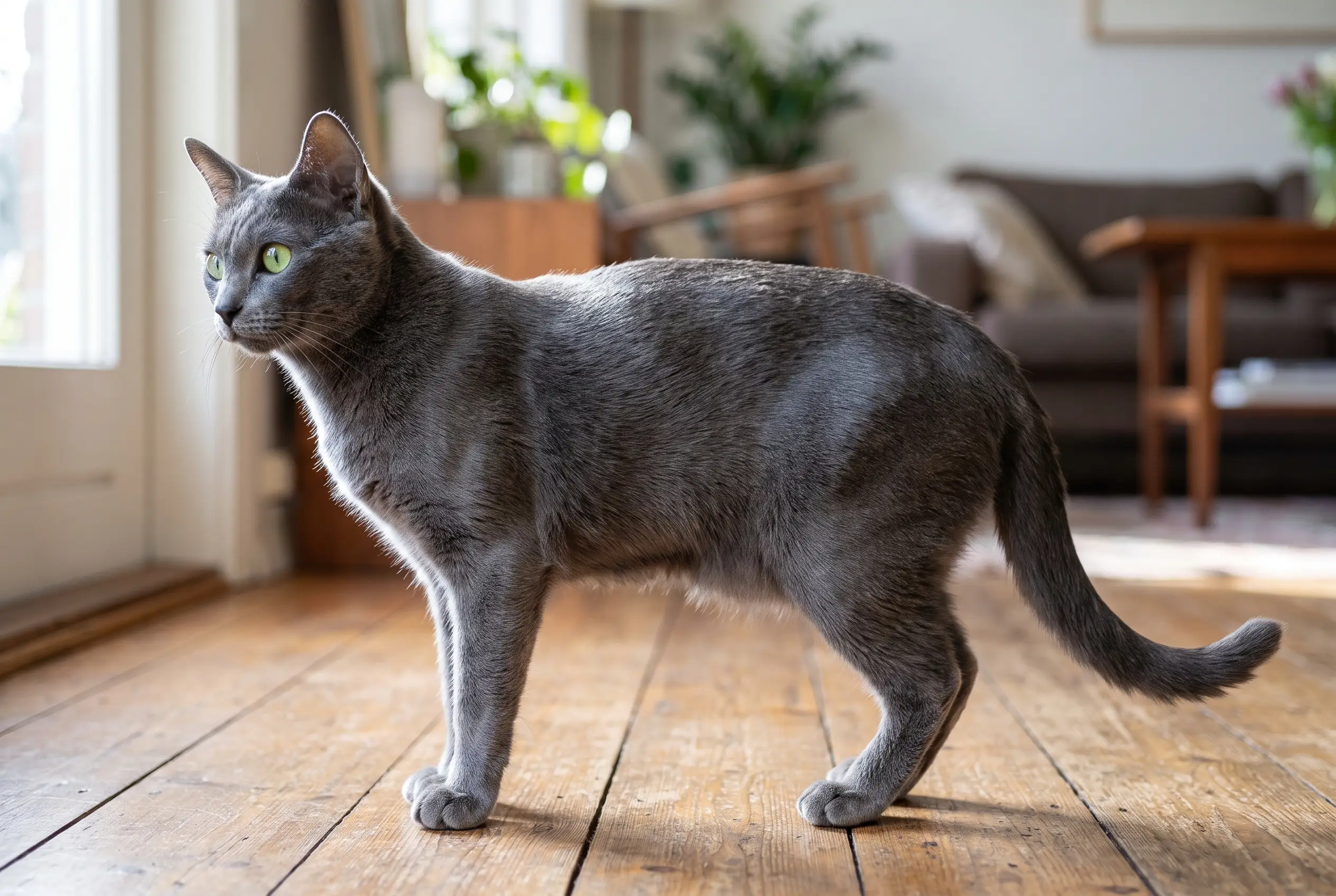
Korat
Thailand's good-luck cat: a single silver-tipped blue coat and green eyes that take years to arrive.
Vital stats
| Size | Small to medium · muscular, semi-cobby |
| Weight | 2.7–4.5 kg · males heavier — breed literature, not a fixed standard figure |
| Life expectancy | 12–15 years — breed literature, not survey data |
| Energy | Moderate to high — playful, alert, rarely idle |
| Shedding | Low — no undercoat to speak of |
| Coat | Short, single, fine, lying close to the body; silver-tipped blue only |
| Group | Shorthair |
| Origin | Thailand |
Breed traits
Friendliness
Care
Mind
The Korat by the numbers
The Korat facts owners search for most — price, lifespan, weight, shedding and colours, in one place.
Less common, so expect a waitlist and some travel to a reputable breeder — which pushes the price up. Ongoing costs stay modest — it eats little and routine vet care sits at the lower end.
We don't quote a single figure: the real price swings with breeder, region, bloodline and health testing — and a rescue costs a fraction of a breeder's litter. Adopting is almost always the cheapest route.
Temperament
Korats are people-cats first: they pick a household, often one person in it, and stay close rather than roam. Alert to the point of jumpy, they notice a new sound or a rearranged room immediately and don't love either. That same intensity makes them strong-willed — a Korat that wants a lap, a door opened, or a bowl refilled will keep asking until it happens, in a soft, conversational voice rather than a yowl. They're not aggressive with children or other pets, but they'd rather be the only animal in the house, and they do badly with chaos, shouting, or being ignored for long stretches. Give one a settled routine and a person to fix on, and it repays that with real devotion.
Habits & quirks
Grows into its eyes
Kittens open on amber or yellow, and the luminous green the standard calls for doesn't fully settle in until the cat is two to four years old. A one-year-old with gold-green eyes is normal, not a fault.
Wears a halo
Each hair is dark blue with a silver tip, so the coat catches light differently depending on the angle — Thai owners call the colour 'rain-cloud grey' and the shimmer 'sea foam'.
Given, never sold
Traditional Thai practice treats a pair of Korats as a gift for good fortune, and the custom still shapes how some breeders place kittens today.
Won't be ignored
A Korat shut out of a room or left alone for a quiet evening will ask about it, repeatedly and quietly, until someone answers.
Care
| Grooming | The single coat has no real undercoat, so a weekly comb removes loose hair and keeps the silver tipping glossy. There's no big seasonal blowout to plan around. |
| Health screening | Ask to see current DNA test certificates for both parents for GM1 gangliosidosis (the GLB1 gene) and GM2 gangliosidosis, also called Sandhoff disease (the HEXB gene). Both are inherited lysosomal storage diseases that are fatal in affected kittens, usually within the first year, and neither has a treatment — a clear test on both parents is the only way to know a litter isn't at risk, and a breeder who can't produce that paperwork isn't one to buy a kitten from. |
| Company | This isn't a background cat. Korats bond tightly, often to one person, and don't do well left alone all day or moved between households. Match the cat to a settled home before the kitten arrives, not after. |
| Settling in | Loud rooms, sudden noise and rearranged furniture unsettle a Korat more than most breeds. Introduce change slowly, and keep the litter box and feeding spot fixed once the cat has decided where they belong. |
Life expectancy
This breed has a typical life expectancy of 12–15 years — breed literature, not survey data.
Similar breeds
Breeds with a similar build and background — worth a look if this one isn't quite the fit.
Common questions
Is the Korat the same as a Russian Blue or a Chartreux?
No, though all three are solid blue and get mixed up constantly. The Korat has a single coat lying flat against the body with no undercoat, a heart-shaped head, and green eyes, and comes from Thailand. The Russian Blue has a dense double coat that stands off the body, a narrower head, and green eyes too, and comes from Russia. The Chartreux is heavier-bodied with a woolly double coat, copper to gold eyes and a rounder, fuller-cheeked head, and comes from France. Coat structure and origin are the fastest way to tell them apart once you know to check.
What genetic tests should a Korat breeder be able to show me?
DNA test results for GM1 gangliosidosis and GM2 gangliosidosis (Sandhoff disease) on both parents, not just the kitten. Both are inherited, both are fatal in affected kittens, and neither has a cure — testing the parents is what keeps them out of a litter at all. Ask before you ask about price.
Why does my Korat kitten have yellow eyes instead of green?
That's normal. Korat kittens are born with amber or yellow eyes, and CFA's own standard doesn't expect the mature luminous green until the cat is two to four years old — an amber cast is even acceptable in adults. A golden-eyed one-year-old isn't a fault; it just hasn't finished changing yet.
Does the Korat shed a lot?
Not much. The Korat is a low-shedding breed, so loose hair around the home stays minimal. It still needs regular grooming, but you won't be fighting drifts of fur.
Are Korat cats hypoallergenic?
No cat breed is truly hypoallergenic. The trigger is Fel d 1, a protein in a cat's saliva and skin that transfers to the coat during grooming and then travels on loose hair and dander — so a cat that sheds less, like the Korat, spreads less of it around the house, but still produces it. If someone at home reacts to cats, spend real time with this breed before deciding, and no breeder should promise you an allergy-free cat.
Are Korat cats good with children?
Usually yes. The Korat is a sociable cat that tends to tolerate the noise and handling of family life better than most, which is why it comes up so often for homes with kids. It still needs somewhere high and quiet to retreat to, and children need teaching that a cat walking away is allowed to.
How much grooming does a Korat need?
Very little. The Korat handles its own coat and a comb once a week or so is plenty — mostly to catch loose hair before the cat swallows it. Claws, teeth and ears still want the usual checks, which is the part people skip on an easy-coated cat.