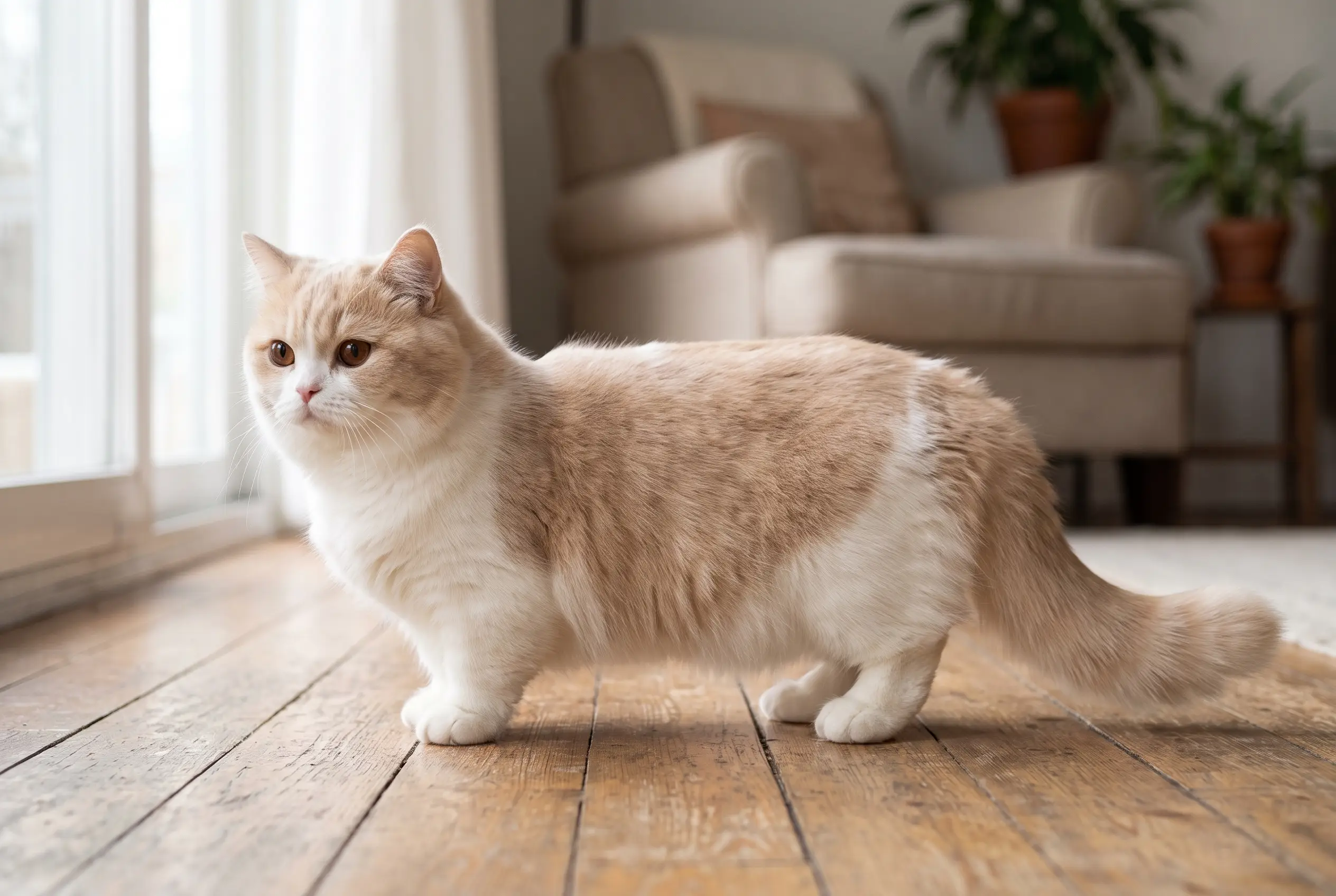
Minuet
Munchkin legs, Persian face, two names — Napoleon started it, Minuet is what TICA calls it now.
Vital stats
| Size | Small–medium · short-legged (dwarf) or standard-legged |
| Weight | 3.2–3.6 kg · short-legged type — breed literature, not a standard figure |
| Life expectancy | 12–15 years — breed literature, not survey data |
| Energy | Moderate — plays in bursts, naps hard between them |
| Shedding | Moderate to heavy — double coat, worse at the seasonal blow-out |
| Coat | Short, plush and dense, or semi-long and silky with britches |
| Group | Shorthair |
| Origin | United States |
Breed traits
Friendliness
Care
Mind
The Minuet by the numbers
The Minuet facts owners search for most — price, lifespan, weight, shedding and colours, in one place.
Less common, so expect a waitlist and some travel to a reputable breeder — which pushes the price up. Ongoing costs stay modest — it eats little and routine vet care sits at the lower end. Its coat also needs a professional groom every few weeks — a real line in the budget.
We don't quote a single figure: the real price swings with breeder, region, bloodline and health testing — and a rescue costs a fraction of a breeder's litter. Adopting is almost always the cheapest route.
Temperament
Minuets land somewhere between their two parent breeds, and where exactly depends on the litter. Most lean people-oriented rather than aloof: they follow a favourite person from room to room, ask to be picked up, and settle into a long lap session once the initial burst of energy burns off. The Munchkin habit of squirrelling away small objects — hair ties, bottle caps, anything that fits in a mouth — turns up in a good share of them, so check under the sofa before you assume something's lost. They get onto chairs and beds without trouble; a full leap to the top of a wardrobe is the one thing the short legs genuinely rule out. Sociable with other cats, generally fine with a calm dog, and rarely aggressive.
Habits & quirks
Sits up on its haunches
Short front legs make an upright, meerkat-style sit a natural way to see over furniture, and Minuets do it often — it's a Munchkin trait that came along for the ride.
Runs low and fast
The gait is a scurry rather than a stride, closer to a ferret than a cat, and it covers ground faster than the short legs suggest.
Hoards small objects
Hair ties, bottle caps, coins off a nightstand. A private stash somewhere low is common, and it's the same magpie habit the Munchkin side is known for.
Flops flat instead of curling up
Short-legged cats often sprawl belly-down rather than tucking into a ball, since the legs don't fold under the body the way a standard cat's do.
Care
| Grooming | The short-coated type needs a comb once or twice a week; the long-coated type needs closer to what a Persian gets, with more attention to the britches and the ruff. Neither mats as badly as a full Persian coat, but both need the same regular check for tangles behind the legs and under the tail. |
| The legs | The Munchkin mutation behind the short legs is autosomal dominant and lethal when a kitten inherits two copies, so short-legged Minuets are never bred to other short-legged Minuets or Munchkins — always to a standard-legged Minuet, Munchkin, or Persian-group cat. Ask the breeder how they manage this pairing, and have a vet check the spine and chest for lordosis or pectus excavatum, which turn up more often in short-legged lines. |
| Kidneys and heart | The Persian side carries polycystic kidney disease (PKD1). Ask for a DNA certificate showing both parents PKD1-negative, and for an echocardiogram screening the line for hypertrophic cardiomyopathy — neither test is optional just because the cat looks healthy. |
| The face | The TICA standard calls for a round face with a short, broad muzzle and an obvious stop, and it disqualifies a broken nose or an undershot or overshot jaw — it is written against the extreme flat face, not for it. Ask to see the parents breathe at rest with their mouths closed, and avoid a breeder chasing a flatter face than the standard asks for. |
Life expectancy
This breed has a typical life expectancy of 12–15 years — breed literature, not survey data.
Similar breeds
Breeds with a similar build and background — worth a look if this one isn't quite the fit.
Common questions
What's the difference between a Munchkin and a Minuet?
The Munchkin is the original short-legged breed and can carry almost any coat or head type, including a plain, non-flattened face. The Minuet is a specific cross of the Munchkin onto the Persian group, bred for that group's round, doll-like face and plush or silky coat, whether the individual cat has short legs or the standard-legged Minuet Tall build. Every Minuet has Munchkin ancestry, but plenty of Munchkins have none of the round Persian-group face the Minuet standard asks for.
Is the Minuet the same cat as the Napoleon?
Yes. Joe Smith bred and named it Napoleon in 1996; TICA renamed the breed Minuet in 2015 when it moved toward full recognition. Both names describe the same cat, and plenty of breeders and older paperwork still use Napoleon.
Are Bambinos, Dwelfs and Genettas the same kind of cat?
No. Those are other Munchkin crosses — with the Sphynx, with the Sphynx and Devon Rex, and with a Bengal-type spotted cat — and none of them are recognized breeds with a registry standard behind them. The Minuet and the Munchkin (including its own standard-legged variety) are the only short-legged cats TICA actually recognizes.
Does the Minuet shed a lot?
Yes — the Minuet is a heavy shedder, dropping hair year-round or in big seasonal moults. Brush it several times a week and expect regular vacuuming; it isn't the coat for you if loose fur is a dealbreaker.
Are Minuet cats hypoallergenic?
No cat breed is truly hypoallergenic, and the Minuet isn't one of the easier ones. The trigger is Fel d 1, a protein in a cat's saliva and skin that ends up on the coat during grooming and then spreads on loose hair and dander — and this breed sheds enough to move plenty of it around. If someone at home is allergic to cats, this is a hard breed to live with; spend real time around one first.
Are Minuet cats good with children?
Usually yes. The Minuet is a sociable cat that tends to tolerate the noise and handling of family life better than most, which is why it comes up so often for homes with kids. It still needs somewhere high and quiet to retreat to, and children need teaching that a cat walking away is allowed to.
How much grooming does a Minuet need?
A lot, by cat standards. The Minuet's coat needs combing several times a week — daily in a moult — or it mats, and a matted coat has to be clipped out rather than brushed out. Start while it's a kitten so being handled is normal, and check the armpits and behind the ears, where mats form first.