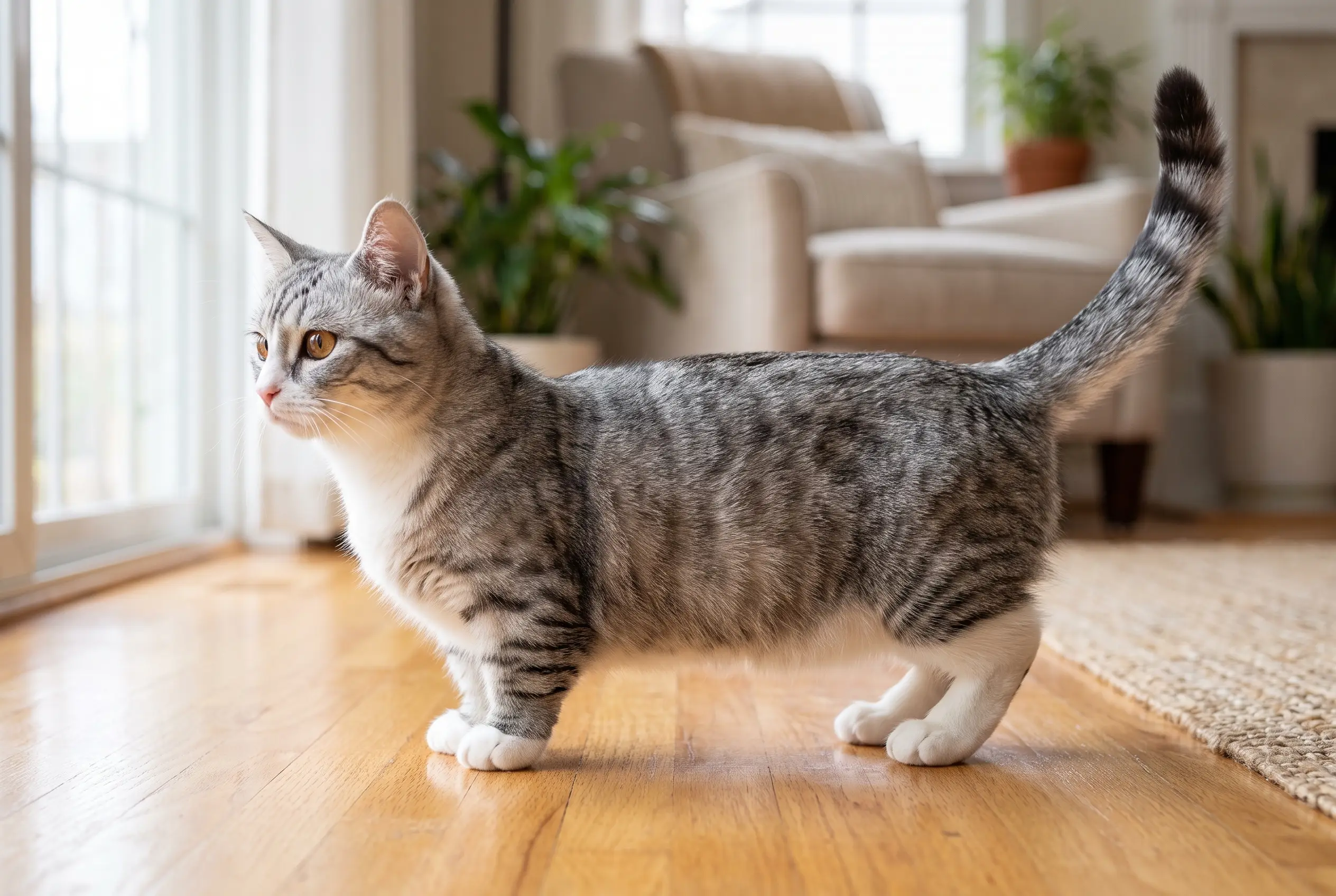
Munchkin
A dachshund's proportions on a cat's body, from one gene that two registries won't sanction.
Vital stats
| Size | Small to medium · short legs, long body |
| Weight | 2–4 kg · males heavier |
| Life expectancy | 12–15 years — breed literature, not survey data |
| Energy | High — runs and plays at a normal cat's pace |
| Shedding | Moderate — ordinary shorthair coat |
| Coat | Short or long (Munchkin Longhair); any colour or pattern |
| Group | Shorthair |
| Origin | United States |
Breed traits
Friendliness
Care
Mind
The Munchkin by the numbers
The Munchkin facts owners search for most — price, lifespan, weight, shedding and colours, in one place.
Widely bred, so you can usually find a litter from a registered breeder without a long wait. Ongoing costs stay modest — it eats little and routine vet care sits at the lower end.
We don't quote a single figure: the real price swings with breeder, region, bloodline and health testing — and a rescue costs a fraction of a breeder's litter. Adopting is almost always the cheapest route.
Temperament
Munchkins aren't shy about anything. They meet strangers at the door, follow whoever's cooking, and treat a lap as a destination rather than an occasional stop. The legs don't slow the personality down: they run at full speed, chase, fetch, and get into cupboards at the same rate any shorthair does. What changes is the vertical route: a Munchkin usually reaches a countertop in stages, chair to shelf to counter, rather than clearing it in one jump, and most top out lower than a standard-legged cat attempting the same leap. That's a difference in technique, not confidence. A Munchkin that can't make a jump finds another way up rather than giving up on the destination. A step stool by a favourite perch is a convenience, the way a step stool in anyone's kitchen is, not an accommodation for a disability.
Habits & quirks
Climbs in stages
A Munchkin maps a route to height the way a person without a stepladder would: chair, then shelf, then counter. It gets there; it just takes a beat longer than a standard-legged cat's single leap.
Sits up like a prairie dog
Balancing upright on the haunches to look over furniture or across a room is a breed-typical pose, common enough that owners call it 'the Munchkin stand'.
Shadows whoever's home
Munchkins tend to attach to the household rather than to a favourite piece of furniture, and will change rooms when you do rather than wait to be found.
Begs harder than the legs suggest
A low body doesn't come with a small appetite. Sitting by the fridge, working a cupboard latch: food-motivated behaviour is common enough to be a real weight risk, not just a personality note.
Care
| The gene — and the mating to refuse | The short legs come from a single dominant mutation in UGDH, identified in a 2020 peer-reviewed study and now available as a direct DNA test that confirms whether a cat carries one copy or, in theory, two. Two copies don't survive gestation, so a short-legged Munchkin bred to another short-legged Munchkin loses roughly a quarter of the pregnancy before birth and produces no kitten that's 'more Munchkin' for the risk. Responsible breeding is always short-legged × standard-legged, and every honest litter contains standard-legged kittens alongside short-legged ones. Ask for the DNA result, and ask for a kitten radiograph of the spine and chest around eight to twelve weeks. Severe pectus excavatum is fixable surgically in that window and harder to treat after. A breeder pairing two short-legged parents, or promising a litter of extra-short 'teacups', is the one to walk away from. |
| Weight and joints | UGDH affects cartilage through the whole skeleton, not only the long bones, and Munchkins carry a documented higher rate of osteoarthritis than long-legged cats. Extra weight loads a short-limbed frame harder than a standard one, so keep a Munchkin lean, feed measured meals, and don't mistake the low body for a reason to skip play. |
| Grooming | Coat care follows ordinary shorthair rules: a weekly brush covers most Munchkins, more during the spring and autumn moults. The Munchkin Longhair, TICA's separate long-coated division of the same breed, needs the comb two or three times a week to keep the plumed tail and britches from matting. |
| Furniture and access | A ramp to the bed, a step by a tall windowsill, a litter box with a side low enough to step over rather than jump: these are the same convenience anyone builds into a kitchen they can't quite reach the top shelf of, not an accommodation for a disability. What to skip is the single long drop from a high shelf. A Munchkin's landing gear works like any cat's, just closer to the ground, and repeated hard landings add up on joints already carrying more load than a longer-legged cat's. |
Life expectancy
This breed has a typical life expectancy of 12–15 years — breed literature, not survey data.
Similar breeds
Breeds with a similar build and background — worth a look if this one isn't quite the fit.
Common questions
Is breeding Munchkins cruel?
That's the real question, and it deserves a straight answer rather than a smoothed one. GCCF and FIFe refuse to recognize the breed at all, on the grounds that a breed built around a structural mutation shouldn't be bred for; TICA and WCF recognize it and require standard-legged outcrosses specifically to keep the gene pool sound. The medical question underneath (whether the mutation itself raises the rate of lordosis and pectus excavatum, or whether those conditions turn up at similar rates in any cat and simply get reported more in a breed everyone is already watching) hasn't been settled by controlled research either way, and this page won't pretend it has. What is settled: two short-legged parents should never be bred together, and a breeder who does that, or who selects for legs shorter than the standard calls for, is doing the thing every serious objection to the breed is actually about.
Can Munchkins jump and use stairs normally?
Yes, with a real difference in technique. They run at full speed and take stairs at a normal pace, but a jump onto a counter or wardrobe usually happens in stages (chair to shelf to counter) rather than one leap, and most Munchkins top out lower than a standard-legged cat attempting the same jump. That's a matter of leg length, not reluctance; give one a step stool or a lower perch near a favourite spot and it'll use it constantly.
Is a Minuet, Bambino, or 'teacup cat' the same as a Munchkin?
No, and the names get used loosely. The Minuet (originally called the Napoleon) is a Munchkin crossed onto Persian-type cats, recognized by TICA as its own breed since 2016. The Bambino, Genetta, Dwelf, Skookum and several other short-legged crosses all combine the Munchkin's leg-length gene with another breed's coat or ear trait, and none of them carry recognition from any major registry. 'Teacup' isn't a breed or a registry term at all — it's a marketing word for an undersized or extra-short-legged kitten, and a seller using it is describing a look, not a standard.
Does the Munchkin shed a lot?
Moderately. The Munchkin sheds a fair amount, steadily through the year with heavier seasonal patches. A weekly brush keeps most of the loose hair off your floors and clothes.
Are Munchkin cats hypoallergenic?
No cat breed is truly hypoallergenic, and the Munchkin isn't one of the easier ones. The trigger is Fel d 1, a protein in a cat's saliva and skin that ends up on the coat during grooming and then spreads on loose hair and dander — and this breed sheds enough to move plenty of it around. If someone at home is allergic to cats, this is a hard breed to live with; spend real time around one first.
Are Munchkin cats good with children?
Usually yes. The Munchkin is a sociable cat that tends to tolerate the noise and handling of family life better than most, which is why it comes up so often for homes with kids. It still needs somewhere high and quiet to retreat to, and children need teaching that a cat walking away is allowed to.
How much grooming does a Munchkin need?
A weekly comb is usually enough for the Munchkin, with a second pass during a seasonal moult. That keeps loose hair off your furniture and cuts down on hairballs, since everything the cat doesn't shed onto the sofa it swallows while washing.