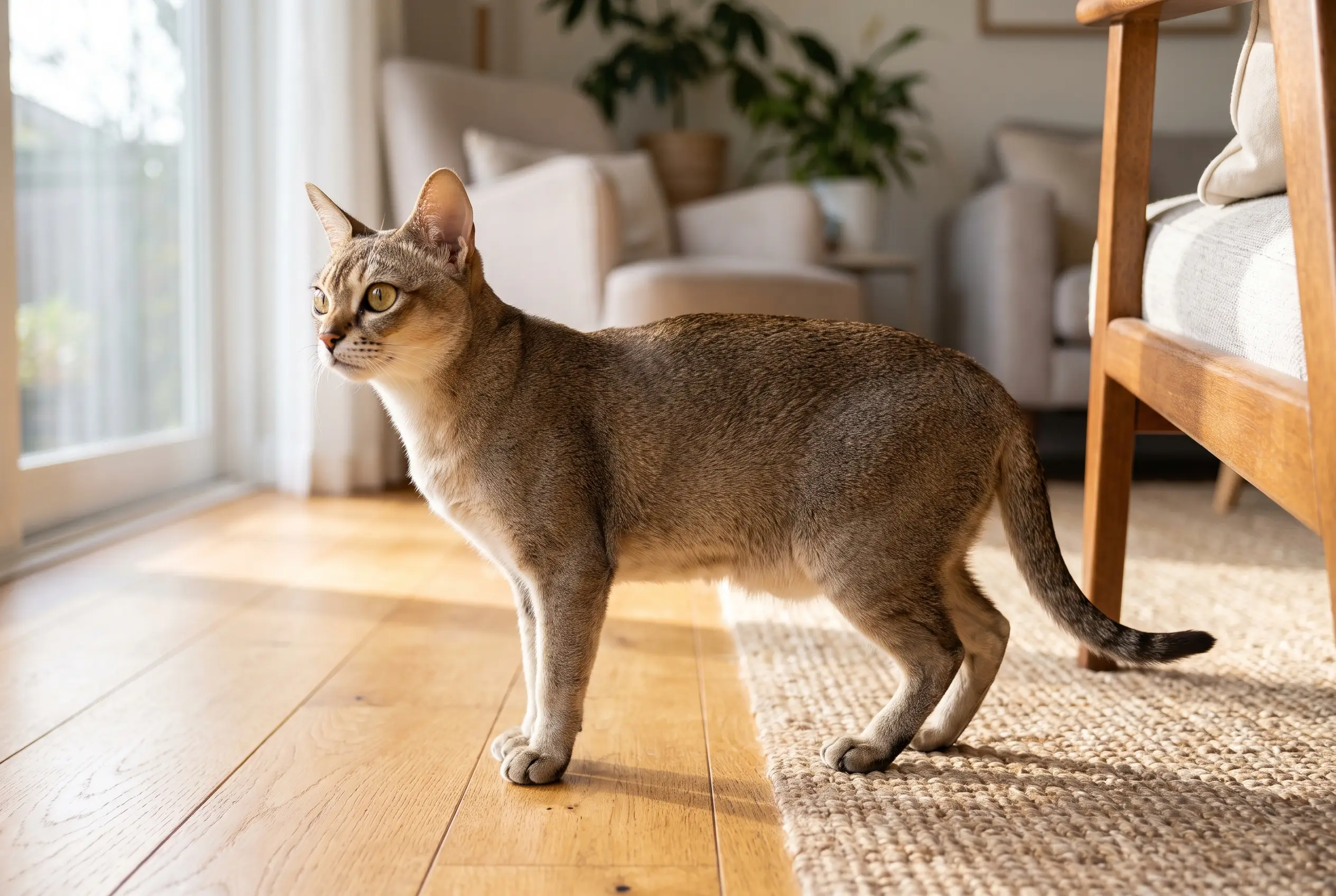
Singapura
Marketed for decades as a Singapore street cat; the paper trail says otherwise, and the breed kept its name anyway.
Vital stats
| Size | Small · fine-boned, close to the ground |
| Weight | 1.8–3.2 kg · males heavier, one of the lightest breeds by standard |
| Life expectancy | 11–15 years — breed literature, not survey data |
| Energy | Moderate to high — playful, not frantic |
| Shedding | Very low — short, close single coat |
| Coat | Short, fine, satin; sepia agouti ticking only |
| Group | Shorthair |
| Origin | Singapore |
Breed traits
Friendliness
Care
Mind
The Singapura by the numbers
The Singapura facts owners search for most — price, lifespan, weight, shedding and colours, in one place.
Less common, so expect a waitlist and some travel to a reputable breeder — which pushes the price up. Ongoing costs stay modest — it eats little and routine vet care sits at the lower end.
We don't quote a single figure: the real price swings with breeder, region, bloodline and health testing — and a rescue costs a fraction of a breeder's litter. Adopting is almost always the cheapest route.
Temperament
Singapuras are attentive rather than demanding: they track what you're doing from nearby, want to be picked up and carried, and settle fast once they're on you. The energy is real but measured, more curious investigator than the wall-climbing intensity of an Abyssinian. They talk in a soft chirp, rarely a full meow, so a Singapura in the next room is easy to miss until it's sitting on the keyboard. Cold and solitude both bother them; they look for the warmest lap or the tightest fold of blanket and dig in, and a Singapura left alone all day for years tends to get clingy rather than destructive. Good with cat-savvy dogs, gentle with children who don't chase, and generally easy around visitors once the first minute of assessment is over.
Habits & quirks
Chirps instead of meowing
The voice is a soft, birdlike trill rather than a yowl. Owners often notice a Singapura is unhappy about something well after the cat has already said so, quietly.
Watches before it joins in
New people, new rooms, new objects on the floor all get a pause and a look from a step back before the cat commits. It isn't shy, exactly — it's checking first.
Digs into the warmest fold
A blanket corner, the crook of an elbow, a lap that's just sat down. The small body and thin coat mean a Singapura hunts out heat with real persistence.
Rides at shoulder height
Being picked up and carried is a request, not a tolerance — many settle into a shoulder perch and stay there through a room change or two.
Care
| Grooming | About as easy as coats get. Short, fine and close-lying with almost no undercoat — a weekly rub with a damp hand or rubber brush lifts what little comes loose, and there's nothing dense enough to mat. |
| Health screening | Ask for a DNA test for pyruvate kinase deficiency, the same PKLR mutation documented in Abyssinian and Somali lines and carried into the Singapura through that shared ancestry; it causes episodic haemolytic anaemia and has no cure, only management. Given how small the founding population was, a breeder who can talk about inbreeding coefficients, not just parentage, is worth more than one who can't. |
| Breeding & queening | Uterine inertia — labour that stalls because the muscle contractions are too weak to finish it — turns up in the breed more than most, and often ends in a caesarean. Anyone breeding Singapuras plans for a vet to be reachable at kittening, not optional. |
| Company | This is not a cat that thrives solo. Singapuras want to be within reach of a person for most of the day; a scratching post, a warm windowsill and regular handling generally cover the breed's needs better than a lot of floor space. |
Life expectancy
This breed has a typical life expectancy of 11–15 years — breed literature, not survey data.
Similar breeds
Breeds with a similar build and background — worth a look if this one isn't quite the fit.
Common questions
Is the Singapura actually from Singapore?
The founding story says so — three street cats brought to the US in 1975 — but import papers uncovered in 1987 showed the opposite: the three foundation cats had been taken from the US into Singapore in 1974, bred from Abyssinian and Burmese stock. CFA investigated in 1990 and didn't strip the breed's status, and Singapore's tourism board still uses the cat as a mascot, but the original street-cat claim doesn't hold up on the paper trail.
Is the Singapura really the smallest cat breed?
It's genuinely one of the smallest — the standard puts females as light as 1.8 kg — but "smallest of all" is a marketing line more than a measured claim, since a few other breeds run just as small or smaller depending on the individual cat. Treat it as very small, not as a record.
How is it different from an Abyssinian or a Burmese?
Closer than the standards suggest: a 2007 DNA study placed the Singapura's genetics nearest to the Burmese, which lines up with the disputed founding story of Abyssinian- and Burmese-descended cats rather than a wild Singapore population. On paper the differences are size (the Singapura runs much smaller than either), coat colour (sepia agouti ticking only, versus the Abyssinian's several ticked colours and the Burmese's solid ones), and voice (a soft chirp, not the Burmese's constant low mutter).
Does the Singapura shed a lot?
Not much. The Singapura is a low-shedding breed, so loose hair around the home stays minimal. It still needs regular grooming, but you won't be fighting drifts of fur.
Are Singapura cats hypoallergenic?
No cat breed is truly hypoallergenic. The trigger is Fel d 1, a protein in a cat's saliva and skin that transfers to the coat during grooming and then travels on loose hair and dander — so a cat that sheds less, like the Singapura, spreads less of it around the house, but still produces it. If someone at home reacts to cats, spend real time with this breed before deciding, and no breeder should promise you an allergy-free cat.
Are Singapura cats good with children?
Usually yes. The Singapura is a sociable cat that tends to tolerate the noise and handling of family life better than most, which is why it comes up so often for homes with kids. It still needs somewhere high and quiet to retreat to, and children need teaching that a cat walking away is allowed to.
How much grooming does a Singapura need?
Very little. The Singapura handles its own coat and a comb once a week or so is plenty — mostly to catch loose hair before the cat swallows it. Claws, teeth and ears still want the usual checks, which is the part people skip on an easy-coated cat.