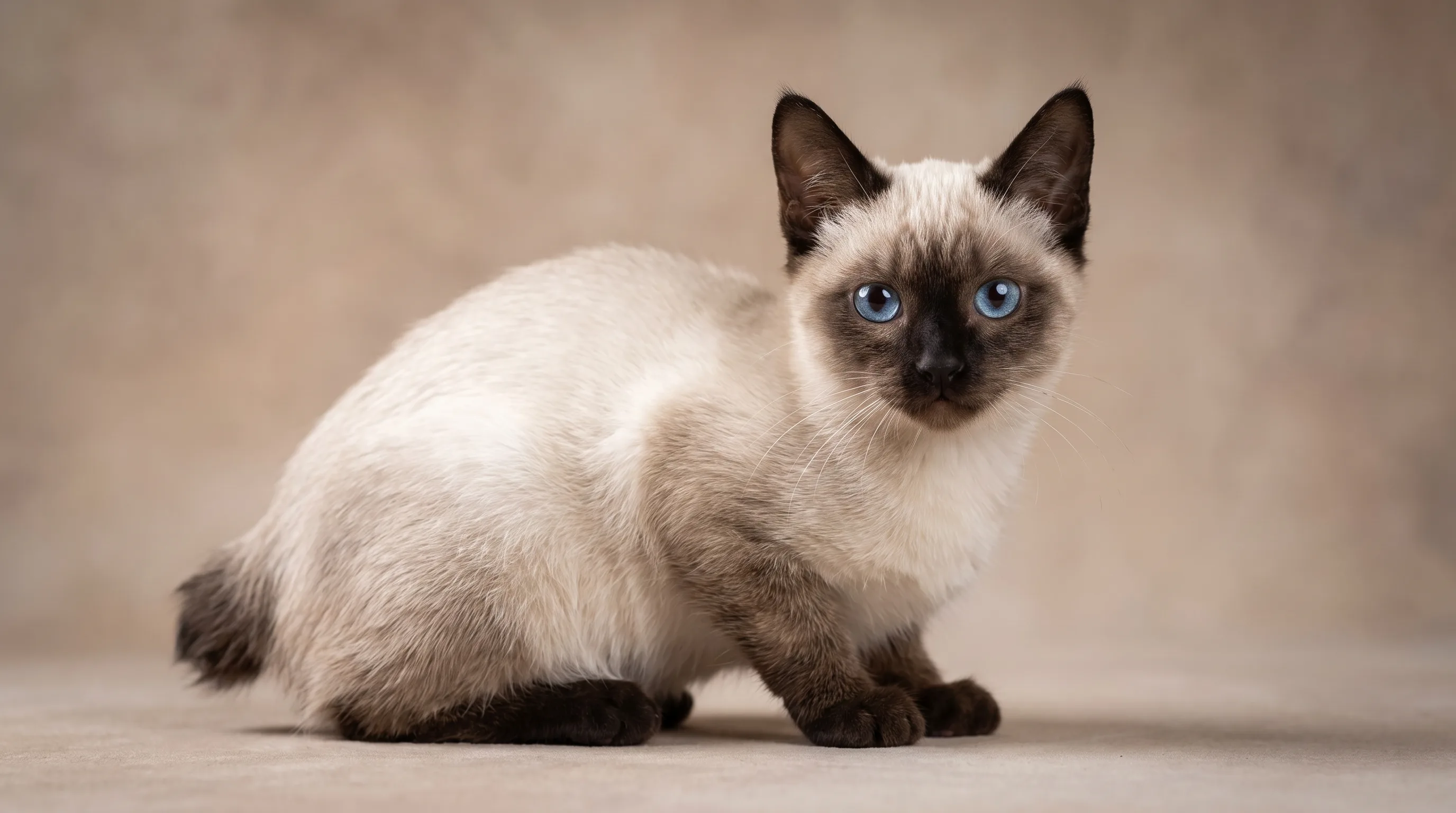
Toybob
One of the smallest cats in the world — a pocket-sized, bob-tailed cat that stays kitten-shaped for life.
Vital stats
| Size | Very small · one of the smallest cat breeds |
| Weight | 1.5–2.5 kg |
| Life expectancy | 14–15 years |
| Energy | Low to moderate — playful but calm |
| Shedding | Low — weekly brushing |
| Coat | Short or semi-long; often colourpoint. Short kinked bobtail |
| Group | Shorthair |
| Origin | Russia |
Breed traits
Friendliness
Care
Mind
The Toybob by the numbers
The Toybob facts owners search for most — price, lifespan, weight, shedding and colours, in one place.
Less common, so expect a waitlist and some travel to a reputable breeder — which pushes the price up. Ongoing costs stay modest — it eats little and routine vet care sits at the lower end.
We don't quote a single figure: the real price swings with breeder, region, bloodline and health testing — and a rescue costs a fraction of a breeder's litter. Adopting is almost always the cheapest route.
Temperament
Toybobs are gentle, even-tempered and deeply attached to their people — small lap cats with none of the nervousness the size might suggest. They are confident and unbothered by bigger animals, happy to share a home with dogs and other cats, and they'd rather be near you than off doing their own thing. Playful and curious without being hyperactive, they enjoy a game and then settle down for a cuddle. Their loyalty is often called dog-like: a Toybob tends to pick its household and stick close. Easy, affectionate and undemanding, they suit families, quieter homes and flats alike.
Habits & quirks
Stays kitten-sized
A Toybob reaches only about a quarter of the weight of an average cat and keeps a compact, kittenish look for life. Full-grown adults are routinely mistaken for half-grown kittens.
Sticks to its person
Devoted and lap-seeking, it follows its favourite people around and settles on or beside them. This is a cat that wants company, not one that keeps to itself.
Fearless for its size
Small but confident: Toybobs share space happily with dogs and larger cats and don't spook easily. The calm nerve is part of the breed's charm.
Plays, then stops
Curious and playful in bursts, but genuinely calm between them — not the restless energy of an Oriental. A game of chase, then a long nap on your lap.
Care
| Grooming | Straightforward. The short coat needs a weekly brush; the semi-long version a little more often to keep it tidy, plus the usual nails, ears and teeth. Neither coat mats badly. |
| The tail | The short, kinked bobtail is normal for the breed and shouldn't be pulled, straightened or handled roughly. Unlike some tailless breeds it isn't linked to spinal disease, but it is a sensitive part of the cat — treat it gently and leave it alone. |
| Watch the weight | On such a tiny frame, a little extra food goes a long way. Measure meals rather than free-feeding, since even a few excess grams show quickly on a 2 kg cat, and keep an eye on body condition. |
| Company | Affectionate and people-focused, Toybobs don't do well ignored all day. They're content in a busy family or alongside another pet; a long, empty house suits them less than most cats. |
Life expectancy
This breed has a typical life expectancy of 14–15 years.
Similar breeds
Breeds with a similar build and background — worth a look if this one isn't quite the fit.
Common questions
How big does a Toybob get?
Very small — it's one of the smallest cat breeds in the world. Adults commonly weigh around 1.5–2.5 kg, roughly a quarter of an average cat and about the size of a large kitten, and they keep that compact, kittenish build for life. They're sturdy and well-proportioned, just miniature.
Is the Toybob's short tail a health problem like the Manx?
No, and it's an important distinction. The Manx's taillessness comes from a gene that can cause serious spinal and nerve defects. The Toybob's short, kinked bobtail is a different, stable mutation that hasn't been linked to those problems, which is part of why the breed is considered generally healthy. The tail should still be handled gently and never pulled.
Are Toybobs good pets for families or flats?
Yes to both. They're gentle, calm and affectionate, confident around children and other animals, and small and quiet enough to be comfortable in a flat. The main thing they need is company — they're devoted lap cats that bond closely with their people and don't like being left alone all day.
Does the Toybob shed a lot?
Not much. The Toybob is a low-shedding breed, so loose hair around the home stays minimal. It still needs regular grooming, but you won't be fighting drifts of fur.
Are Toybob cats hypoallergenic?
No cat breed is truly hypoallergenic. The trigger is Fel d 1, a protein in a cat's saliva and skin that transfers to the coat during grooming and then travels on loose hair and dander — so a cat that sheds less, like the Toybob, spreads less of it around the house, but still produces it. If someone at home reacts to cats, spend real time with this breed before deciding, and no breeder should promise you an allergy-free cat.
How much grooming does a Toybob need?
Very little. The Toybob handles its own coat and a comb once a week or so is plenty — mostly to catch loose hair before the cat swallows it. Claws, teeth and ears still want the usual checks, which is the part people skip on an easy-coated cat.