Dobermann
Sleek, brilliant and devoted — the elegant thinking-dog's guardian.
On these lists: Guard dogs · Protection dogs
Vital stats
| Size | Large · 63–72 cm |
| Weight | 32–45 kg |
| Life expectancy | 10–12 years |
| Energy | High — 1–2 hours/day |
| Shedding | Moderate, year-round |
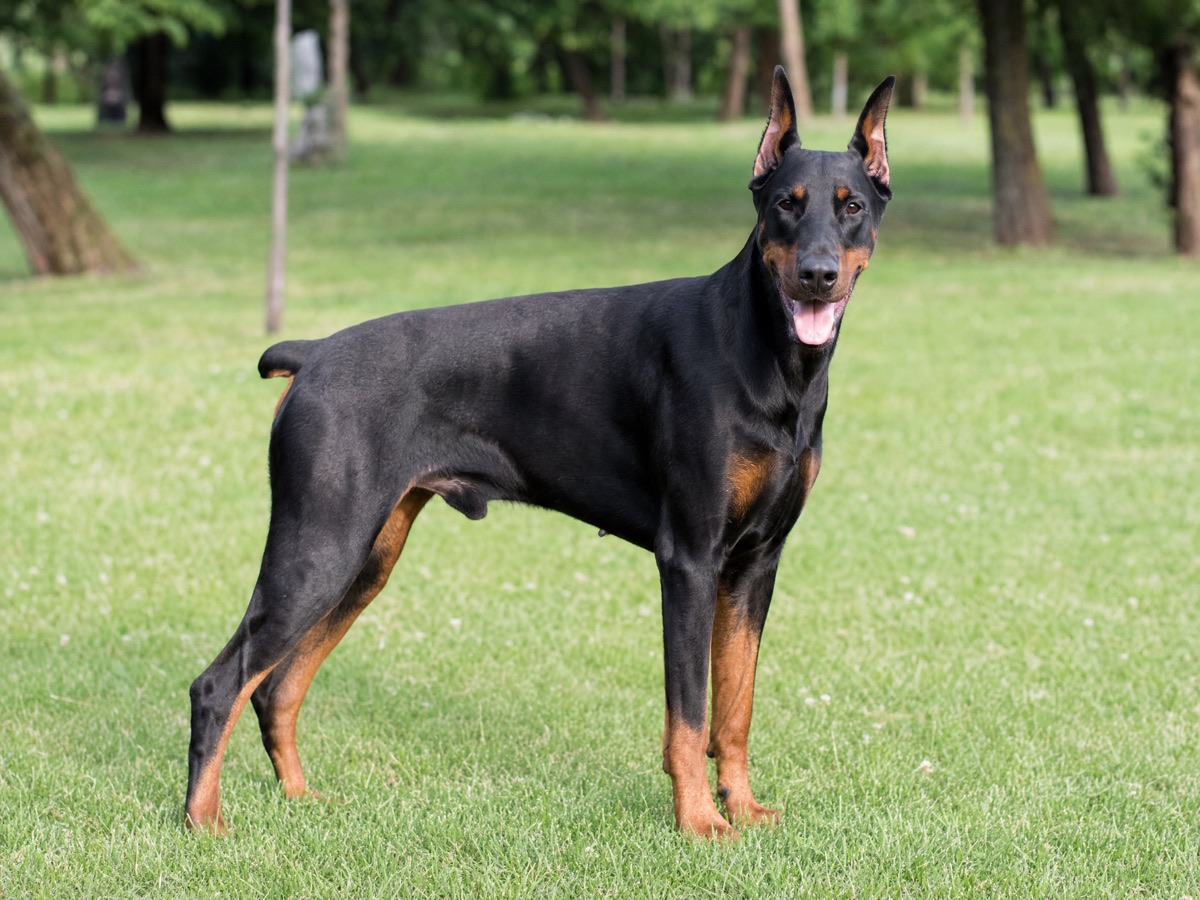
| Coat | Short and sleek · black or brown with rust |
| Group | Working · FCI №143 / AKC |
| Origin | Apolda, Germany |
| FCI group | 2 — Pinscher and Schnauzer, Molossoid and Swiss Mountain Dogs · FCI 143 |
Breed traits
Friendliness
Care
Mind
The Dobermann by the numbers
The Dobermann facts owners search for most — price, lifespan, weight, shedding and colours, in one place.
Less common, so expect a waitlist and some travel to a reputable breeder — which pushes the price up. Ongoing costs run high — more food, bigger doses at the vet, and pricier insurance.
We don't quote a single figure: the real price swings with breeder, region, bloodline and health testing — and a rescue costs a fraction of a breeder's litter. Adopting is almost always the cheapest route.
Temperament
Assembled in the 1880s to guard a tax collector on his rounds, the Dobermann is a protection dog with a scholar's brain and a velcro heart. It wants work for its mind, an athlete's exercise, and constant closeness to its people — aloof watchfulness on the street, unabashed cuddling on the sofa.
Habits & quirks
The velcro shadow
Wherever you are, a Dobermann is against your leg — or planning to be.
Blanket burrower
A thin coat plus a love of comfort equals a dog under your duvet, not on it.
Post at the door
It settles where every entrance is visible — off duty is still on call.
The lean
Full-body contact is the breed's love language; brace yourself.
Health
The Dobermann is an athletic, generally healthy dog with one serious shadow over the breed: dilated cardiomyopathy (DCM), a heart-muscle disease it is unusually prone to. This is the single most important reason to buy from a breeder who heart-tests their lines, and to keep up regular cardiac screening through your dog's life so anything is caught early. Beyond the heart, keep your Dobermann lean and fit; a well-bred, well-exercised Dobermann is a robust dog.
Nutrition
| Exercise | An hour or two of real work daily — running, training games, scent work — or the brain sours. |
| Health | Dilated cardiomyopathy is the breed's shadow; choose heart-tested lines and screen regularly. |
| Companionship | This is a velcro breed — it cannot live in a garden or be left for long hours. |
| Warmth | A thin single-layer coat means a winter jacket and a bed away from draughts. |
Feed a Dobermann to stay lean and muscular — this is an athlete, and a fit working weight suits it far better than a heavy one. Weigh the meals rather than free-feeding, count treats in the daily total, and keep the ribs easy to feel. Puppies should grow steadily on a large-breed food rather than being pushed to bulk up fast, and every adult should hold the trim, hard condition the breed is built for.
Puppy guide
A Dobermann puppy is clever, fast-growing and intensely attached, and the work you put in early shapes the adult. Start socialisation and gentle basic training the day it arrives — this is a big, powerful guardian that has to grow up steady around people and dogs. Grow it slowly on a large-breed food, keep exercise easy on developing joints, and never leave it isolated: a Dobermann raised apart from its family becomes anxious, while one kept close grows up confident.
Training
The Dobermann is one of the most trainable of all breeds — quick, eager and happiest with a job for its mind. Use calm, consistent, reward-based methods, start in puppyhood, and give it real work: training games, scent work, obedience, something to think about every day. A Dobermann with structure and a job is stable and devoted; one left bored and under-exercised turns anxious and destructive, so the training is not optional, it's the whole point.
Known health issues
No breed is problem-free. These are the conditions most worth knowing about for this breed — with what a good breeder screens for and what an owner watches. General guidance, not a substitute for your vet.
Heart muscle disease (DCM)
A weakening of the heart muscle that enlarges the heart, seen in several large and giant breeds. Good breeders screen: Heart-screened parents (echo/Holter where advised). Watch for: Tiring, coughing, fainting, or a swollen belly.
Bleeding disorder (von Willebrand)
A missing clotting protein that makes bleeding hard to stop, the most common inherited bleeding disorder in dogs and especially common in the Doberman. Good breeders screen: A DNA or blood clotting test on breeding stock. Watch for: Bleeding that won't stop from a small cut, nosebleeds, or bleeding gums — tell your vet before any surgery.
Hip dysplasia
A poorly fitting hip joint that wears early and can cause pain and arthritis, most common in larger breeds. Good breeders screen: Hip-scored parents (BVA/OFA/FCI). Watch for: Stiffness, a bunny-hop run, or reluctance on stairs.
Life expectancy
Dobermanns live 10–12 years. Dobermanns are shorter-lived than many dogs their size, largely because of the breed's heart disease, so this is where good breeding matters most: buy from lines that heart-test, screen your own dog regularly, and keep it lean and fit. The heart is the thing you most want on your side, and early detection is what buys time.
Popular Dobermann mixes
Doodleman
A tall, clever, lower-shedding cross that wants both a job and constant company — bright enough to learn fast and needy enough to hate being left alone.
Similar breeds
Breeds with a similar build and background — worth a look if this one isn't quite the fit.
Breeds that look like this
Common questions
Are Dobermanns good family dogs?
Yes for active, involved families — they're loyal, gentle with their own children and famously 'velcro'. Early socialisation and training are essential.
Do Dobermanns need a lot of exercise?
Yes — a good hour or two daily of physical and mental work. A bored, under-exercised Dobermann becomes anxious and destructive.
Are Dobermanns aggressive?
Well-bred, well-socialised Dobermanns are stable, affectionate and discerning rather than aggressive — modern lines are much softer than the film-villain image. As with any guardian breed, problems start with poor breeding or isolation.
Does the Dobermann shed a lot?
Moderately. The Dobermann sheds a fair amount, steadily through the year with heavier seasonal patches. A weekly brush keeps most of the loose hair off your floors and clothes.
Is the Dobermann hypoallergenic?
Not really. No dog is truly hypoallergenic, and the Dobermann's shedding coat releases plenty of the dander that sets off allergies. If someone at home is allergic, this isn't the easiest breed to live with — spend time around one first.
Is the Dobermann easy to train?
Yes. The Dobermann is one of the more trainable breeds — quick to learn and keen to work with you, which makes reward-based training straightforward. Start early, keep it positive, and it picks things up fast.