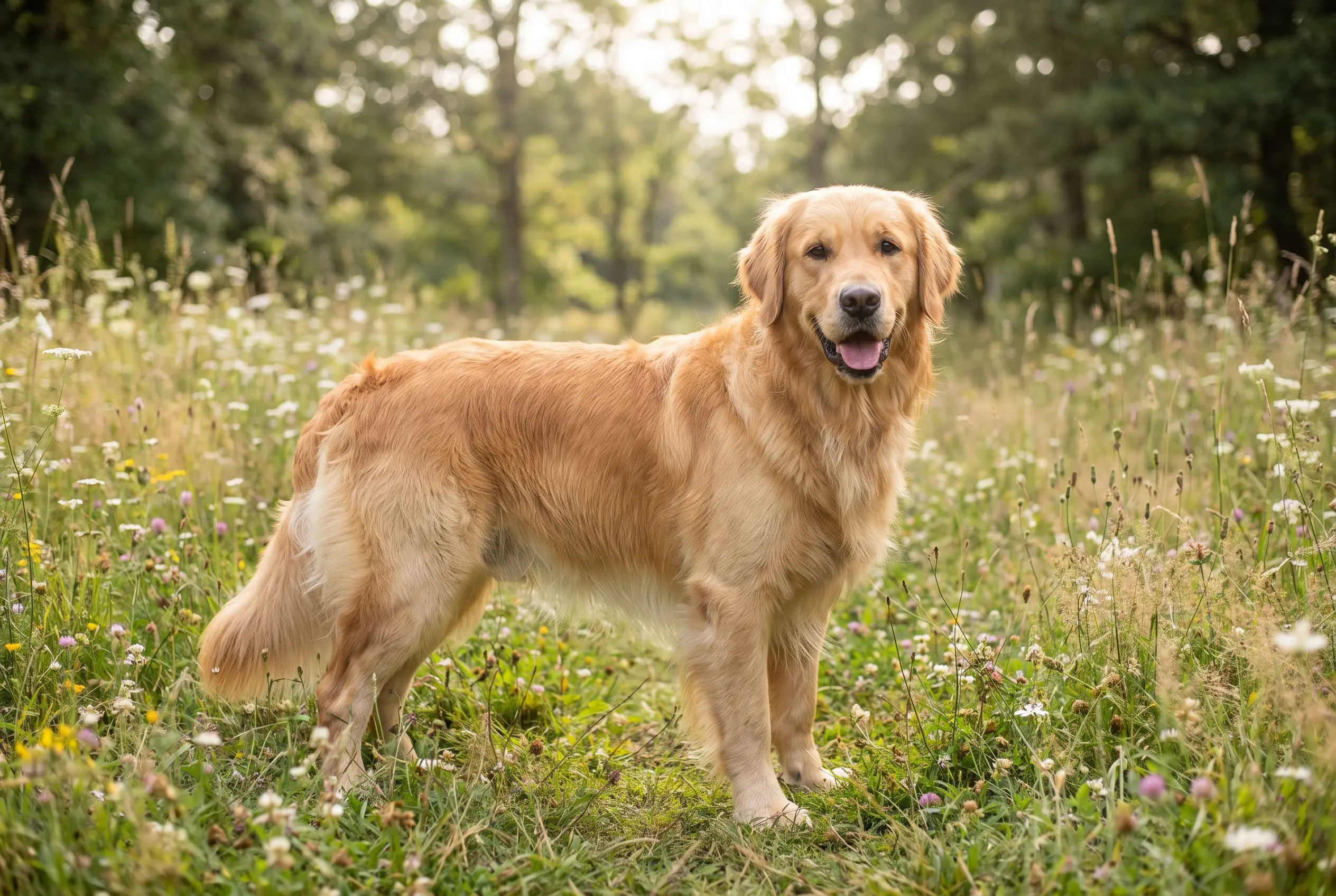
Golden Retriever
Gentle, patient, forever a puppy at heart.
On these lists: Dogs for first-time owners · Family dogs · Truffle-hunting dogs · Therapy dogs · Service dogs
Vital stats
| Size | Medium-large · 51–61 cm |
| Weight | 25–34 kg |
| Life expectancy | 10–12 years |
| Energy | High — 60–90 min/day |
| Shedding | Heavy, year-round |
| Coat | Lustrous double coat · light to dark golden |
| Group | Sporting · AKC / FCI №111 |
| Origin | Scotland |
| FCI group | 8 — Retrievers, Flushing Dogs and Water Dogs · FCI 111 |
Breed traits
Friendliness
Care
Mind
The Golden Retriever by the numbers
The Golden Retriever facts owners search for most — price, lifespan, weight, shedding and colours, in one place.
Widely bred, so you can usually find a litter from a registered breeder without a long wait. Ongoing costs run high — more food, bigger doses at the vet, and pricier insurance. Its coat also needs a professional groom every few weeks — a real line in the budget.
We don't quote a single figure: the real price swings with breeder, region, bloodline and health testing — and a rescue costs a fraction of a breeder's litter. Adopting is almost always the cheapest route.
Temperament
Bred to retrieve game gently to hand, the Golden is soft-mouthed in temperament too — patient, gentle and endlessly willing. It's a leading choice for guide, therapy and assistance work, and it stays playful and puppyish well into adulthood.
Habits & quirks
Soft mouth
Will carry your shoes, the post, and the occasional houseplant — gently.
Velcro dog
Follows you room to room; struggles with being left alone.
Serious shedder
That golden coat comes off year-round and blows out seasonally.
Water-lover
Never met a lake, pond or sprinkler it didn't like.
Health
Goldens are generally robust, but two things shape their health: joints and cancer. Hips and elbows can develop dysplasia, so a good breeder hip- and elbow-scores their dogs. The breed also carries a higher-than-average cancer risk with age, and some lines are prone to hypothyroidism. Keep your Golden lean, screen the parents, and stay on top of yearly vet checks as the dog gets older.
Nutrition
| Exercise | 60–90 min/day — retrieving, swimming and sniff walks |
| Grooming | Brush 2–3× weekly to manage the heavy coat and prevent mats |
| Health | Screen breeders for hips, elbows, eyes and heart; watch cancer risk with age |
| Company | Craves companionship — not a dog to leave alone for long days |
A Golden loves its food and puts on weight quietly, so measure meals and count treats into the day's total — ribs you can feel but not see. For the first year, feed a large-breed puppy formula so the dog grows slowly and the joints have time to form.
Puppy guide
A Golden puppy is soft, sociable and growing fast. Keep exercise gentle while the joints are still forming — a rough guide is five minutes of walk per month of age — and go easy on stairs and long runs. Socialise early and often; a well-met Golden stays trusting for life. And watch the weight from the start.
Training
Goldens are among the easiest breeds to train — bright, biddable and eager to please, which is why they fill the guide-dog and therapy ranks. They're softer than a Labrador, so keep it kind and reward-based; harsh handling backfires. Give a young Golden a job and something to carry, and drill recall early.
Known health issues
No breed is problem-free. These are the conditions most worth knowing about for this breed — with what a good breeder screens for and what an owner watches. General guidance, not a substitute for your vet.
Hip dysplasia
A poorly fitting hip joint that wears early and can cause pain and arthritis, most common in larger breeds. Good breeders screen: Hip-scored parents (BVA/OFA/FCI). Watch for: Stiffness, a bunny-hop run, or reluctance on stairs.
Elbow dysplasia
A developmental fault in the elbow that leads to lameness and arthritis, seen in fast-growing large breeds. Good breeders screen: Elbow-scored parents. Watch for: Front-leg limping that worsens after exercise.
Inherited eye disease
Progressive retinal atrophy and cataracts run in several breeds and can dim or take sight over time. Good breeders screen: Eye-tested parents and, where available, a DNA test for PRA. Watch for: Night-time bumping, cloudy eyes, or hesitation in dim light.
Underactive thyroid
A slowed thyroid that saps energy and coat, common in mid-size and large breeds and easily treated. Good breeders screen: Ask about thyroid testing in the line. Watch for: Weight gain, low energy, and thinning coat — a simple blood test confirms it.
Life expectancy
Golden Retrievers live 10–12 years. Weight and cancer screening are the two levers that matter most. Keep your Golden lean — lean dogs live longer — buy from health-tested lines, and catch lumps early with regular vet checks as the dog ages.
Popular Golden mixes
Goldendoodle
The classic doodle, bred for a lower-shedding coat and a friendly, trainable temperament. Coat type varies a lot from pup to pup.
Goldador
Two easy family dogs in one — gentle, people-focused and very trainable. Expect the shedding of both parents.
Golden Mountain Dog
A big, calm, affectionate family dog. Sturdy and gentle, but it shares both parents' joint and cancer risks, so health-test the lines.
Goberian
A striking, energetic cross with a Golden's friendliness and a Husky's drive. Needs plenty of exercise, and can be talkative and escape-prone.
Golden Cocker Retriever
A smaller, softer retriever type — sweet, biddable and people-loving, with a feathered coat that needs regular brushing.
Similar breeds
Breeds with a similar build and background — worth a look if this one isn't quite the fit.
Compare this breed
Breeds that look like this
Common questions
Are Golden Retrievers good family dogs?
Exceptionally — gentle, patient and trainable, they're a benchmark family and therapy breed.
Do Golden Retrievers shed a lot?
Yes — heavily and year-round, with seasonal peaks. Regular brushing is a must.
How much exercise does a Golden need?
60–90 minutes of real activity daily; they love retrieving and swimming above all.
Is the Golden Retriever hypoallergenic?
Not really. No dog is truly hypoallergenic, and the Golden Retriever's shedding coat releases plenty of the dander that sets off allergies. If someone at home is allergic, this isn't the easiest breed to live with — spend time around one first.
Is the Golden Retriever easy to train?
Yes. The Golden Retriever is one of the more trainable breeds — quick to learn and keen to work with you, which makes reward-based training straightforward. Start early, keep it positive, and it picks things up fast.