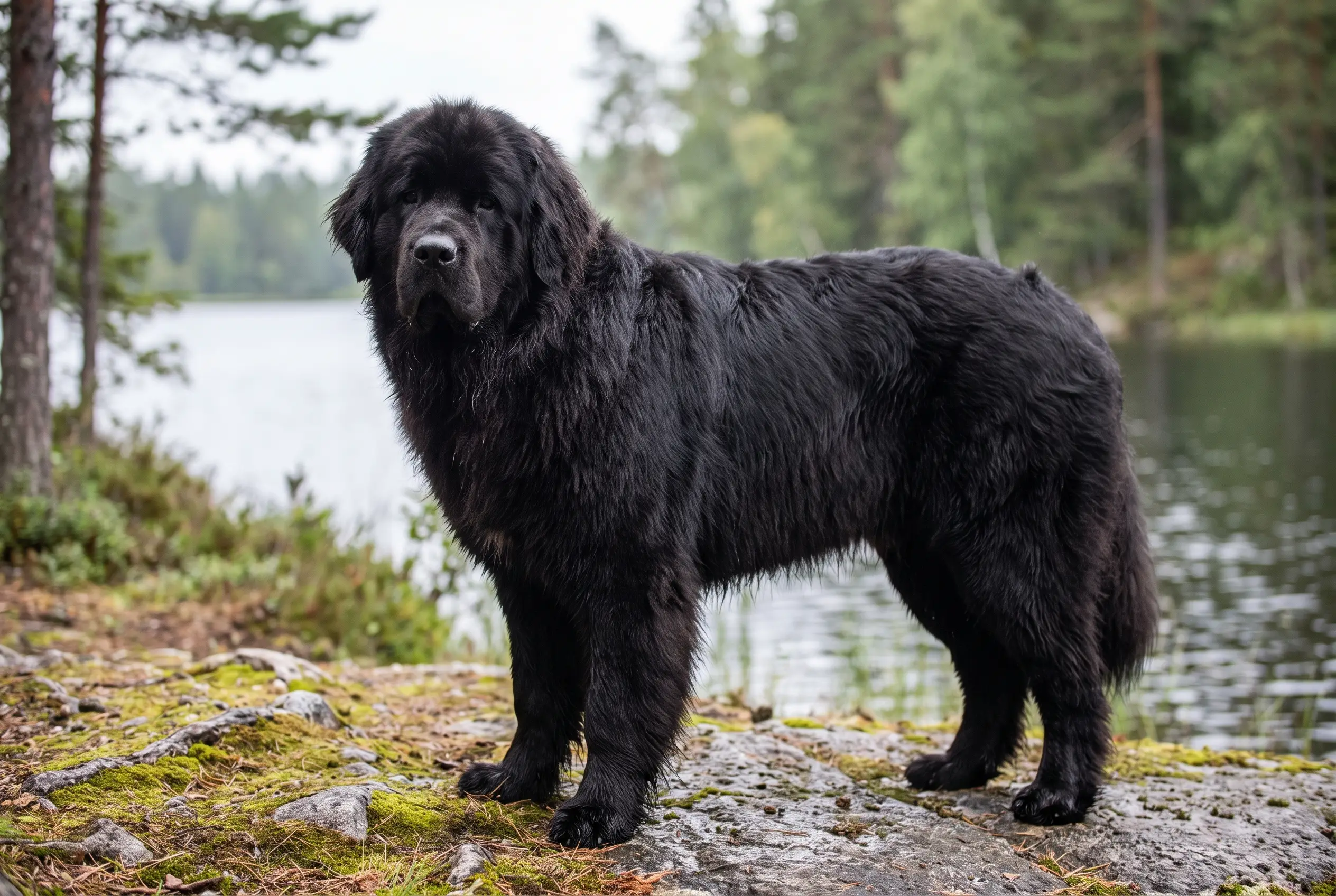
Newfoundland
A lifeguard in a bear suit — the gentlest giant the sea ever made.
On these lists: Family dogs · Dogs for cold climates
Vital stats
| Size | Giant · 66–71 cm |
| Weight | 50–68 kg |
| Life expectancy | 8–10 years |
| Energy | Moderate — 30–60 min/day |
| Shedding | Heavy, with seasonal blows |
| Coat | Thick double coat · black, brown, grey, white-and-black |
| Group | Working · FCI №50 / AKC |
| Origin | Newfoundland, Canada |
| FCI group | 2 — Pinscher and Schnauzer, Molossoid and Swiss Mountain Dogs · FCI 50 |
Breed traits
Friendliness
Care
Mind
The Newfoundland by the numbers
The Newfoundland facts owners search for most — price, lifespan, weight, shedding and colours, in one place.
Widely bred, so you can usually find a litter from a registered breeder without a long wait. Ongoing costs run high — more food, bigger doses at the vet, and pricier insurance. Its coat also needs a professional groom every few weeks — a real line in the budget.
We don't quote a single figure: the real price swings with breeder, region, bloodline and health testing — and a rescue costs a fraction of a breeder's litter. Adopting is almost always the cheapest route.
Temperament
Bred to haul nets, cart fish, and pull drowning sailors from the North Atlantic, the Newfoundland pairs enormous strength with a temperament its standard simply calls 'sweetness'. It is patient with children, gentle with smaller animals, and quietly determined to keep every member of its family within sight — especially near water.
Habits & quirks
Water radar
Ponds, puddles and paddling pools are located, entered, and thoroughly enjoyed.
The soggy lean
Affection arrives as fifty wet kilograms settling against your legs.
Lifeguard rounds
Swimming family members are monitored closely — and sometimes 'rescued' whether they need it or not.
The drool flick
One shake of that great head, and the ceiling has new artwork.
Health
The Newfoundland is a giant, and its size sets the health priorities. The hips and elbows can develop dysplasia, and the heart can carry a defect called SAS (subaortic stenosis), so buy from a breeder who screens hips, elbows and hearts. Keep the dog lean to spare those joints, and feed a giant puppy to grow slowly. That thick Atlantic coat also overheats fast, so mind warm weather as much as any illness.
Nutrition
| Grooming | Brush the dense double coat two to three times weekly — daily during the big seasonal moults. |
| Exercise | Daily unhurried walks plus swimming whenever possible; protect growing joints from stairs and jumping. |
| Health | Keep it lean and choose parents screened for hips, elbows and the heart condition SAS. |
| Heat | That Atlantic coat overheats fast in warm weather — walk early, provide shade, never push in summer. |
A Newfoundland carries huge weight on its joints, so keep it lean and measure the meals rather than free-feeding — ribs you can feel under that dense coat. Through the long puppy growth, feed a large-breed diet so the dog comes up slowly, because rushed growth is hard on joints that are still forming under all that size. Count treats into the day's total and keep the adult weight honest.
Puppy guide
A Newfoundland puppy grows into a giant, and its joints need protecting the whole way. Keep exercise gentle and unhurried — daily walks and swimming rather than stairs, jumping or hard running — and grow it slowly on a large-breed diet. Start brushing and grooming early so it learns to enjoy being handled, and mind the heat from the start: this is a cold-water breed, happiest in the cool.
Training
Newfoundlands are sweet-natured, patient and keen to please, and they take beautifully to calm, kind, reward-based training. Start early and socialise often while the puppy is still liftable, because a well-mannered giant is far easier to live with than an unschooled one — and this breed gets very large. Keep sessions gentle; harsh handling is wasted on a dog this soft and does more harm than good.
Known health issues
No breed is problem-free. These are the conditions most worth knowing about for this breed — with what a good breeder screens for and what an owner watches. General guidance, not a substitute for your vet.
Hip dysplasia
A poorly fitting hip joint that wears early and can cause pain and arthritis, most common in larger breeds. Good breeders screen: Hip-scored parents (BVA/OFA/FCI). Watch for: Stiffness, a bunny-hop run, or reluctance on stairs.
Narrowed aortic valve (SAS)
A congenital narrowing just below the aortic valve that makes the heart work harder to pump, seen in several large breeds including the Newfoundland. Good breeders screen: A cardiologist's exam or echo on puppies and breeding stock. Watch for: Fainting, tiring quickly on walks, or a murmur picked up at a routine check.
Bloat (GDV)
A sudden, life-threatening twisting of the stomach, mostly in deep-chested breeds — a true emergency. Good breeders screen: Ask about family history; discuss preventive gastropexy for high-risk lines. Watch for: A swollen belly, unproductive retching, restlessness — go to a vet at once.
Life expectancy
Newfoundlands live 8–10 years. Like most giant breeds, the Newfoundland is short-lived, but good breeding and steady care push toward the better end. Buy from lines that screen hips, elbows and hearts, keep the dog lean and grown slowly, and don't let it overheat. Regular vet checks and an honest weight are the levers you actually control.
Popular Newfoundland mixes
Newfypoo
A big, gentle, often lower-shedding cross bred for a friendly family temperament. Coat varies a lot from pup to pup, and it shares the Newfoundland's joint and heart risks, so health-test the lines.
Newfador
A large, friendly, water-loving family mix — more active than a purebred Newfoundland and very trainable. Watch the growing joints and the appetite, and keep it lean.
Similar breeds
Breeds with a similar build and background — worth a look if this one isn't quite the fit.
Breeds that look like this
Common questions
Are Newfoundlands good with children?
Famously so — patience with children is written into the breed standard, and it inspired Nana in Peter Pan. Supervise anyway; a friendly lean can flatten a toddler.
How much do Newfoundlands shed and drool?
A lot of both. Expect hair on everything, heavy spring and autumn moults, and drool that increases with heat, food, and enthusiasm.
Can a Newfoundland live in a warm climate?
It can, with care: air conditioning, shade, early-morning exercise and constant water. But this is a cold-water breed at heart, and cool climates suit it far better.
Is the Newfoundland hypoallergenic?
Not really. No dog is truly hypoallergenic, and the Newfoundland's shedding coat releases plenty of the dander that sets off allergies. If someone at home is allergic, this isn't the easiest breed to live with — spend time around one first.
Is the Newfoundland easy to train?
Reasonably. The Newfoundland is trainable with consistency and rewards, though it isn't the quickest study. Keep sessions short and positive, and be patient with the basics like recall.