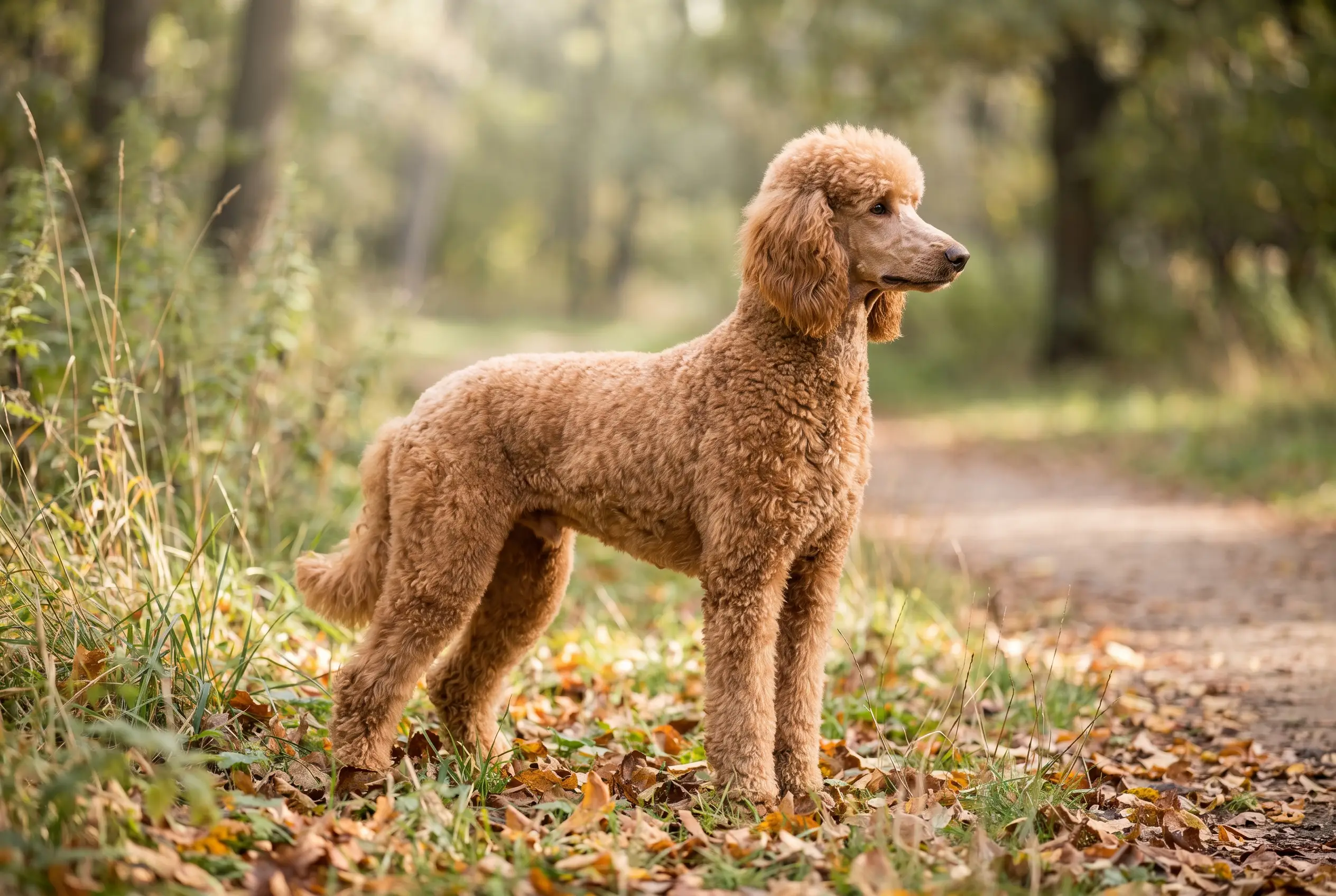
Standard Poodle
Brilliant, low-shedding, quietly the smartest dog in the room.
On these lists: Dogs for first-time owners · Low-shedding dogs · Truffle-hunting dogs · Therapy dogs · Service dogs · Dogs for allergies
Vital stats
| Size | Large · 45–60 cm (Standard) |
| Weight | 20–32 kg |
| Life expectancy | 12–15 years |
| Energy | High — 60 min+/day |
| Shedding | Very low (curly, continuously growing coat) |
| Coat | Dense curly single coat · many solid colours |
| Group | Non-Sporting · AKC / FCI №172 |
| Origin | Germany / France |
| FCI group | 9 — Companion and Toy Dogs · FCI 172 |
Breed traits
Friendliness
Care
Mind
The Standard Poodle by the numbers
The Standard Poodle facts owners search for most — price, lifespan, weight, shedding and colours, in one place.
Widely bred, so you can usually find a litter from a registered breeder without a long wait. Ongoing costs run high — more food, bigger doses at the vet, and pricier insurance. Its coat also needs a professional groom every few weeks — a real line in the budget.
We don't quote a single figure: the real price swings with breeder, region, bloodline and health testing — and a rescue costs a fraction of a breeder's litter. Adopting is almost always the cheapest route.
Temperament
Behind the show-ring clip is a serious water retriever and one of the most trainable dogs alive. The Poodle is sensitive, quick and a touch reserved with strangers — it thrives on mental work and can grow anxious or inventive when bored.
Habits & quirks
Endlessly clever
Learns fast, including things you'd rather it didn't — needs mental jobs.
Low-shed, high-maintenance
Barely sheds, but the coat must be brushed and clipped every few weeks.
Sensitive soul
Reads mood keenly; harsh handling backfires — reward-based training only.
Secret athlete
Under the fancy coat is a tireless swimmer and retriever.
Health
Standard Poodles are generally healthy and long-lived, but a few things are worth screening. Hips can develop dysplasia, the eyes are prone to PRA, and as a deep-chested breed the Poodle carries a real risk of bloat (gastric torsion). Some lines also carry Addison's disease. Buy from a breeder who health-tests, and learn the signs of bloat.
Nutrition
| Grooming | The real commitment — brush several times weekly, professional clip every 4–6 weeks |
| Exercise | 60+ min/day of body and brain work — agility, scent and retrieve games |
| Health | Screen for hips, eyes and Addison's; generally a long-lived breed |
| Enrichment | Give it problems to solve — a bored Poodle invents its own |
A Standard Poodle is athletic and does well on a good-quality diet matched to its activity. As a deep-chested breed it's prone to bloat, so feed measured meals rather than one big one, and avoid hard exercise right after eating. Keep it lean to protect the joints.
Puppy guide
A Standard Poodle puppy is clever and quick to learn — start training and grooming habits early, because that curly coat is a lifelong commitment and the dog needs to accept handling. Keep jumping and hard exercise moderate while the joints form, and give the busy brain plenty to do from the start.
Training
Poodles are one of the smartest breeds and a joy to train — quick, willing and happy to work. The flip side is that a bored Poodle invents its own jobs, so pair obedience with problems to solve: scent work, tricks, agility. Keep it reward-based and varied and they thrive.
Known health issues
No breed is problem-free. These are the conditions most worth knowing about for this breed — with what a good breeder screens for and what an owner watches. General guidance, not a substitute for your vet.
Hip dysplasia
A poorly fitting hip joint that wears early and can cause pain and arthritis, most common in larger breeds. Good breeders screen: Hip-scored parents (BVA/OFA/FCI). Watch for: Stiffness, a bunny-hop run, or reluctance on stairs.
Inherited eye disease
Progressive retinal atrophy and cataracts run in several breeds and can dim or take sight over time. Good breeders screen: Eye-tested parents and, where available, a DNA test for PRA. Watch for: Night-time bumping, cloudy eyes, or hesitation in dim light.
Bloat (GDV)
A sudden, life-threatening twisting of the stomach, mostly in deep-chested breeds — a true emergency. Good breeders screen: Ask about family history; discuss preventive gastropexy for high-risk lines. Watch for: A swollen belly, unproductive retching, restlessness — go to a vet at once.
Life expectancy
Standard Poodles live 12–15 years. Poodles are among the longer-lived big dogs. Health-tested parents, a lean weight and awareness of bloat are what keep a Standard Poodle going to the top of that range.
Popular Standard mixes
Labradoodle
The original doodle, bred for a lower-shedding coat. Coat and temperament vary a lot from pup to pup, even in one litter.
Goldendoodle
A friendly, trainable family cross with a wavy, often low-shedding coat. Popular for its gentle temperament; coat type varies.
Bernedoodle
A big, calm, affectionate cross that's often lower-shedding than a Bernese. Gentle and loyal; needs regular grooming.
Sheepadoodle
A large, fluffy, people-loving cross with plenty of energy and a coat that needs real upkeep. Bright and playful.
Cockapoo
One of the oldest doodle crosses — small, sweet and sociable, with a soft wavy coat. A good fit for families wanting a smaller Poodle mix.
Similar breeds
Breeds with a similar build and background — worth a look if this one isn't quite the fit.
Breeds that look like this
Common questions
Are Poodles hypoallergenic?
No dog is truly hypoallergenic, but the Poodle's low-shedding curly coat makes it one of the best choices for allergy sufferers.
Are Poodles high maintenance?
In grooming, yes — regular brushing and a clip every 4–6 weeks. In trainability, they're among the easiest.
Are Standard Poodles good family dogs?
Very — smart, playful and gentle, they suit active families who can meet their exercise and grooming needs.
Does the Standard Poodle shed a lot?
Not much. The Standard Poodle is a low-shedding breed, so loose hair around the home stays minimal. It still needs regular grooming, but you won't be fighting drifts of fur.
Is the Standard Poodle easy to train?
Yes. The Standard Poodle is one of the more trainable breeds — quick to learn and keen to work with you, which makes reward-based training straightforward. Start early, keep it positive, and it picks things up fast.
Stories featuring this breed
All stories →
Is a Cockapoo a breed? What designer crosses really are
A Cockapoo is a hugely popular dog — but not a breed any major registry recognises. Why a cross isn't a breed, what F1 and F1b actually mean, and why it matters.
PAW Patrol breeds: every pup's real dog, from Chase to Tracker
Chase is a German Shepherd, Zuma is a Chocolate Labrador, and Skye's Cockapoo isn't a registered breed at all. The honest, canon breed behind every PAW Patrol pup.
Low-shedding dog breeds, ranked from our own data
We scored every breed for shedding, 1 to 5. Here are the ones that scored lowest — the curly coats worth the grooming bill, the genuinely low-maintenance short-hairs, and why none of them are hypoallergenic.