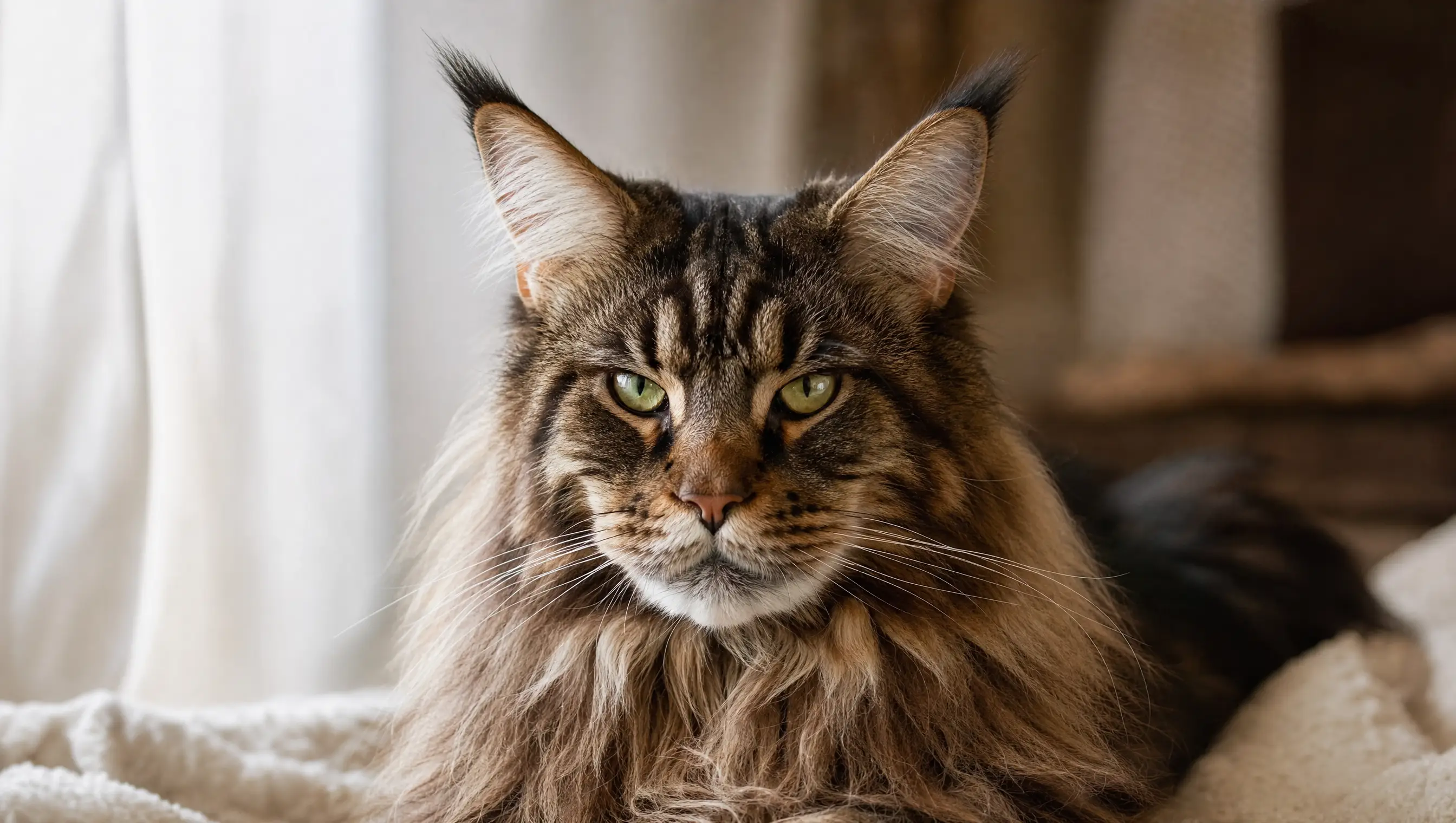
Maine Coon
The dog of the cat world — huge, shaggy, and far too friendly to sulk.
On these lists: Family cats · Cats for first-time owners
Vital stats
| Size | Large · body 25–41 cm tall |
| Weight | 4–8 kg · toms often heavier |
| Life expectancy | 12–15 years |
| Energy | Moderate — playful, not frantic |
| Shedding | Moderate to heavy, seasonal |
| Coat | Long, shaggy, water-resistant |
| Group | Longhair |
| Origin | United States |
Breed traits
Friendliness
Care
Mind
The Maine Coon by the numbers
The Maine Coon facts owners search for most — price, lifespan, weight, shedding and colours, in one place.
Widely bred, so you can usually find a litter from a registered breeder without a long wait. Ongoing costs stay modest — it eats little and routine vet care sits at the lower end. Its coat also needs a professional groom every few weeks — a real line in the budget.
We don't quote a single figure: the real price swings with breeder, region, bloodline and health testing — and a rescue costs a fraction of a breeder's litter. Adopting is almost always the cheapest route.
Temperament
Maine Coons act less like aloof cats and more like a dog that happens to purr. They pick a person, follow them from room to room, and want in on whatever you're doing — usually narrating it in chirps and trills rather than meows. They stay playful for years (kittenhood runs to about four), take to harness walks and fetch, and are patient enough for children and confident enough to share a house with dogs. Big, yes, but soft: this is a lap cat that no longer quite fits the lap.
Habits & quirks
Water paws
Many will dunk toys, paw at running taps, or drink from a moving stream — a leftover of that weatherproof coat.
The trill
Instead of meowing they chirp and trill, keeping up a running commentary as they trail you around the house.
Slow grower
Won't reach full size until three or four — expect a gangly 'teenager' stage that lasts a while.
Fetch and walks
Bright and biddable enough for clicker tricks, harness walks and a genuine game of fetch.
Health
Most Maine Coons are hardy, long-lived cats, but two inherited conditions run in the breed and are worth taking seriously. Hypertrophic cardiomyopathy (HCM) thickens the heart muscle, and hip dysplasia turns up more often in a cat this big and heavy. A responsible breeder scans the parents' hearts and screens their hips, so ask to see the results before you commit. Beyond the genetics, the everyday risks are the ordinary ones — keep the teeth clean and the weight in check, because a frame this size hides a few extra kilos well.
Nutrition
| Grooming | Comb the coat two or three times a week — more in spring shed — paying attention to the britches and the ruff, where mats form. |
| Health | A responsible breeder screens for HCM (a heart condition) and hip dysplasia, both seen in the breed; ask to see the results. |
| Play & space | Big cat, big furniture: a sturdy tall tree, room to run, and daily play keep the weight off and the mischief down. |
| Feeding | Large frame and slow growth mean steady, measured meals; watch portions once they hit adulthood to avoid piling on weight. |
Cats are obligate carnivores, so build the bowl around meat-based food with real protein rather than a filler-heavy kibble. A Maine Coon grows slowly and finishes big, so measure meals rather than leaving an open bowl down — the breed puts on weight easily once it stops growing, and the extra load falls on those same hips. Wet food, or a mix of wet and dry, keeps water going in, which matters for a cat that often doesn't drink enough on its own. Weigh portions, count treats in the daily total, and aim for ribs you can feel under the coat.
Kitten guide
A Maine Coon kitten grows for years rather than months, so don't rush it — steady food and gentle play beat big leaps while the joints are still forming. Handle it early and often, get it used to being combed, to the carrier and to the sounds of the house, and it stays the easy, sociable cat the breed is known for. Kitten-proof the space before it arrives: secure high shelves, tuck away cords, and give it a sturdy scratching post and somewhere to climb safely. Book the first vet visit early for vaccinations, a microchip and a plan for neutering, and let it settle into one quiet room before opening up the rest of the house.
Training
Maine Coons are bright and biddable, which makes the everyday training easy. Start with a big litter tray in a quiet spot — a large cat wants room to turn around — and keep it scrupulously clean. Put a tall, sturdy scratching post next to the furniture you want to protect and reward the cat for using it. Because they stay playful for years, they take happily to clicker tricks, fetch and even harness walks, so channel that energy into daily play and puzzle feeders rather than leaving them to invent their own games. Make the carrier a normal, unthreatening part of the room, so vet trips don't turn into a battle.
Life expectancy
Maine Coons live 12–15 years. The biggest levers on that number are the heart and the waistline. A cat kept lean, fed well and screened for HCM through its breeder has the best shot at the upper end of that range, while excess weight strains both the heart and those already-vulnerable hips. Regular vet checks catch changes in the heart early, when there's still the most that can be done.
Similar breeds
Breeds with a similar build and background — worth a look if this one isn't quite the fit.
Compare this breed
Common questions
Are Maine Coons good with children and dogs?
Unusually so. They're sturdy, patient and social, which is why they're a common pick for busy family homes with kids and dogs — supervise early introductions as you would with any pet.
How big do Maine Coons actually get?
Females run 4–6 kg, males often 6–8 kg or more, with a long body and tail that make them look bigger still. The record-holders you see online are outliers, not the norm.
Do Maine Coons need a lot of grooming?
Less than you'd think for the coat length — it's silkier and less prone to matting than a Persian's. A thorough comb a couple of times a week keeps it healthy.
Why do some Maine Coons have extra toes?
Polydactyly — a dominant mutation that adds toes, usually on the front feet, giving a mitten-like or thumbed paw. It was common in the breed's working ancestors along the New England coast, where the wide feet were thought to help on snow and on boat decks, and roughly two in five early Maine Coons were polydactyl. Most registries wrote it out of the standard, so show cats have the usual number of toes; TICA has since accepted a polydactyl division. It causes no health problem in itself, though the extra claws grow unopposed and need clipping. It's a trait, not a breed — cats sold as 'American Polydactyls' are polydactyl cats of no fixed breed, and no major registry recognises that as one.
Does the Maine Coon shed a lot?
Yes — the Maine Coon is a heavy shedder, dropping hair year-round or in big seasonal moults. Brush it several times a week and expect regular vacuuming; it isn't the coat for you if loose fur is a dealbreaker.
Are Maine Coon cats hypoallergenic?
No cat breed is truly hypoallergenic, and the Maine Coon isn't one of the easier ones. The trigger is Fel d 1, a protein in a cat's saliva and skin that ends up on the coat during grooming and then spreads on loose hair and dander — and this breed sheds enough to move plenty of it around. If someone at home is allergic to cats, this is a hard breed to live with; spend real time around one first.
Stories featuring this breed
All stories →
Why does my cat follow me everywhere, even the bathroom?
The supposedly aloof animal trailing you from room to room is behaving exactly as the attachment science predicts. Why cats shadow their person, the bathroom mystery, and the one change that needs a vet.
Why is my cat pooping outside the litter box? Causes and fixes
Poop on the floor has a different list of suspects than pee on the wall — urgency, pain, an unreachable tray, or (rarely) an actual message. Here's the order to check them in.
How cats choose their favourite person
It isn't whoever fills the bowl. The Swiss living-room study found one habit that predicts a cat's favourite better than food ever did — and the person who ignores cats has it by accident.