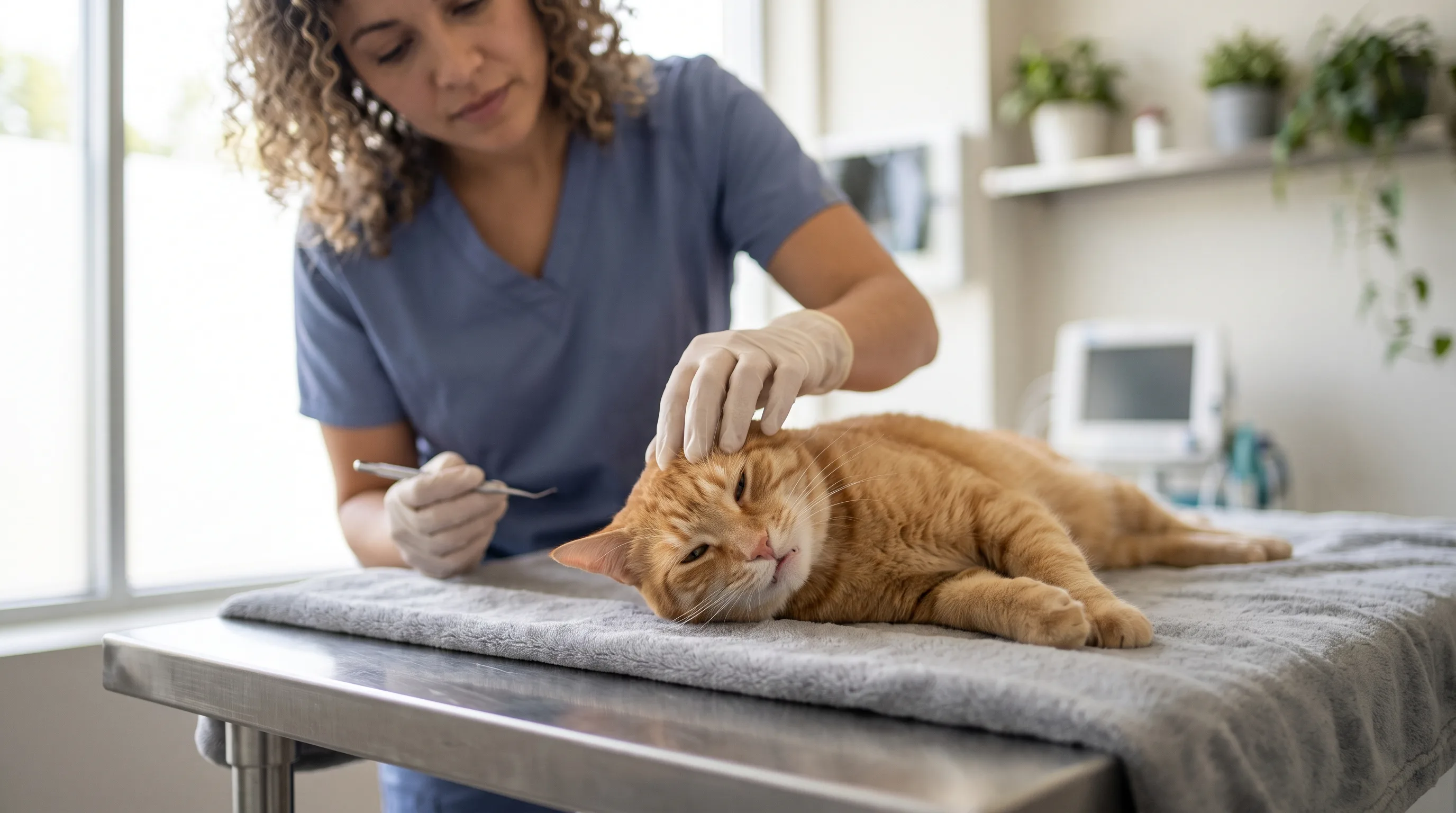
Tooth resorption in cats: the painful disease hiding below the gumline
Tooth resorption is one of the most common diseases cats have and one of the least known to their owners: the cat's own cells begin dissolving a tooth, usually starting below the gumline, and it hurts long before anything is visible. Roughly a third of adult cats are affected — more with age — and almost all of them keep eating as if nothing were wrong. Here is what resorption is, how it's actually found, and why the treatment is more reassuring than it sounds.
A tooth being dismantled from the inside
Resorption is not decay. Cavities — bacterial holes in the enamel — are practically nonexistent in cats. In resorption, cells called odontoclasts, whose legitimate job is dissolving the roots of baby teeth, switch on against a permanent tooth and begin breaking down its structure: root, dentine, eventually crown. Why they do it is genuinely unknown — decades of research have looked at diet, viruses, vitamin D and inflammation without a conclusive answer — so there is, honestly, no known prevention.
What is known is the scale: studies put meaningful resorption in roughly 30 to 50% of adult cats, climbing with age, and a cat that has one resorbing tooth is likely to develop others. Any breed, any lifestyle, immaculate home care included. This is a feline fact of life, which is exactly why it belongs on an owner's radar.
Why you won't be the one to spot it
The disease usually starts at or below the gumline, where no owner can see, and it pairs with the feline talent for hiding pain. A cat with a resorbing tooth — a process that exposes the nerve-rich dentine — typically keeps eating. It may swallow kibble whole instead of chewing, shift food to one side, drop pieces, or flinch and chatter its jaw if the spot is touched, but most show nothing at all. The myth that "she's eating, so her mouth is fine" is precisely backwards in cats: appetite survives severe oral pain.
The visible signs, when they come, are worth knowing: a spot where red gum seems to grow up over the tooth (the body's attempt to cover the defect), drooling, blood flecks in saliva or the water bowl, a sudden preference for soft food, a decline in grooming, or grumpiness about having the face handled. Several of those overlap with other mouth problems, which is fine — they all end at the same place, a dental exam. A cat that stops eating altogether has moved past subtle; why is my cat not eating treats that as the urgent sign it is.
Finding it takes X-rays, not a glance
An awake look in the mouth — yours or a vet's — catches only the late, visible lesions. Most resorption lives below the gumline, so the real exam happens under anaesthesia with dental X-rays, where the dissolving roots show plainly. This is the standard of care, and it's the reason a proper feline dental is more than a scrape-and-polish: the X-rays are where the diagnosis lives. Modern anaesthesia protocols make this routine for healthy cats, seniors included, with pre-anaesthetic bloodwork doing the risk-screening.
It's also the reason to be clear-eyed about "anaesthesia-free dental cleaning": it polishes the crowns a spectator can see, misses everything below the gumline — which is where this disease is — and gives a painful mouth a clean bill of health. For a species whose most common dental disease is invisible from above, that's worse than nothing, because it buys false reassurance.
Treatment: extraction, and why that's good news
A resorbing tooth cannot be saved — no filling or crown stops the process, and attempts to patch lesions have failed consistently. The treatment is extraction of the affected tooth, which ends the pain permanently. In one specific pattern (where the roots are already being replaced by bone, and only on X-ray evidence), the vet may instead amputate the crown and let the body finish the job it started; that call belongs to the vet and the X-ray, not preference.
Owners hear "extraction" as loss; cats experience it as relief. Cats manage superbly with fewer teeth — many eat dry food comfortably with none at all — and the almost universal report after a dental with extractions is a cat that seems years younger: playing, grooming, eating with obvious enjoyment. That's the pain leaving. If the choice is a tooth or a comfortable cat, it isn't a choice.
Living with a resorption-prone cat
One resorbing tooth makes others more likely, so the plan after a diagnosis is surveillance: a dental check at least yearly (your vet may say more), with follow-up X-rays on their advice. Home care can't prevent resorption, but it still matters — gum disease, the other common feline mouth problem, is very preventable, and a mouth you handle regularly is a mouth where changes get noticed. The brushing routine and its realistic fallbacks are in pet dental care; in older cats, where both dental disease and grooming decline arrive together, senior cat grooming carries the weekly check that catches trouble early.
The honest summary: you can't stop resorption and you probably won't see it, but you can make sure it gets found — and a found lesion is a solvable problem. The cats who suffer are the ones whose mouths nobody looks into for years, eating through pain the whole time because eating is what cats do.
Common questions
What is tooth resorption in cats?
A disease in which the cat's own cells (odontoclasts) progressively dissolve a tooth, usually starting at or below the gumline. It is not decay — cavities are practically nonexistent in cats — and its cause is unknown. Roughly 30 to 50% of adult cats are affected, more with age.
Is tooth resorption painful for cats?
Yes, often severely — the process exposes the sensitive dentine. Cats hide it well and almost always keep eating, so appetite is no reassurance. Chattering of the jaw when the spot is touched, one-sided chewing, dropped food and reduced grooming are the subtle tells.
How is tooth resorption diagnosed?
With dental X-rays under anaesthesia. Most lesions sit below the gumline where no awake exam can see them, which is also why anaesthesia-free 'cleanings' miss the disease entirely. X-rays are the standard of care for a feline dental.
Can tooth resorption be treated or reversed?
It can't be reversed or patched — fillings fail. The treatment is extracting the affected tooth, which ends the pain for good. In specific X-ray-confirmed cases the vet may amputate the crown and let the body resorb the remaining root.
Can cats eat normally after tooth extractions?
Remarkably well. Cats manage comfortably with fewer teeth, and many eat dry food with none at all. The typical report after extractions is a cat that plays, grooms and eats more happily than before — the difference is the pain being gone.
Can I prevent tooth resorption?
No known prevention exists, because the cause is unknown. What you can do is make sure it gets found: yearly dental checks, X-rays when your vet advises them, and home attention to the mouth — brushing still prevents gum disease and keeps you familiar with what normal looks like.
More in Cats
Cystitis in cats: why it's usually not an infection
Most feline cystitis isn't bacterial — it's a stress disease of the bladder, which is why antibiotics often aren't the answer. The signs, the one true emergency, and what actually prevents the next flare.
Why is my cat pooping outside the litter box? Causes and fixes
Poop on the floor has a different list of suspects than pee on the wall — urgency, pain, an unreachable tray, or (rarely) an actual message. Here's the order to check them in.
A litter box routine that actually works
Daily, weekly and monthly, plus the placement and the n+1 rule. How to keep a box a cat will keep using, and get rid of the smell without scented litter.

Autumn dangers for dogs: acorns, conkers and mushrooms
Autumn puts three scavenging hazards on the ground — acorns, conkers and wild mushrooms — plus rat bait and fermenting fruit. What's toxic, what the warning signs are, and when to call the vet.

Winter pet dangers: antifreeze, road salt and chocolate season
Antifreeze is the winter emergency — sweet, deadly and quick. Plus gritted-salt paws, the festive-food gauntlet and cats sheltering in warm car engines. What to watch and when it's urgent.
The pet danger calendar: what to watch, month by month
Most pet hazards are seasonal and many are regional. Here's the year mapped out — when heatstroke, grass seeds, processionary caterpillars, antifreeze and the rest actually peak, and which ones your area even has.