Leash reactivity: why your dog lunges on the lead, and the fix
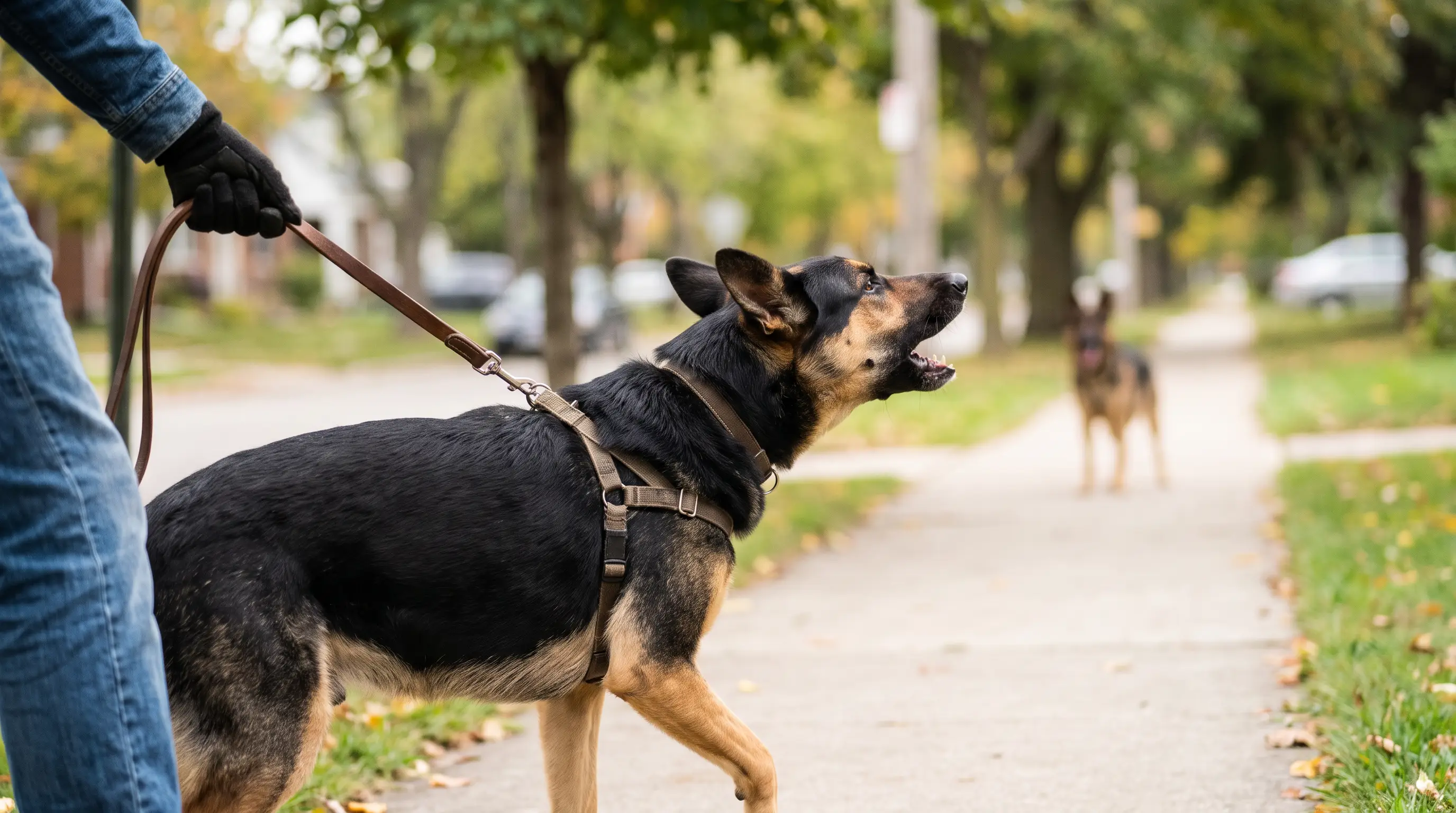
The dog that plays beautifully at daycare and turns into a barking, lunging spectacle on the lead isn't two dogs — it's one dog whose options have been taken away. Off the lead, a dog meets others in polite curves, or simply leaves. The lead deletes both moves, and what fills the vacuum is the display owners find so mortifying. Leash reactivity is common, it's not dominance, and it's very trainable — provided you treat the emotion driving it rather than the noise it makes.
What leash reactivity is (and what's underneath it)
Reactivity is an oversized response to an ordinary trigger — most often other dogs, sometimes people, bikes or joggers — that happens on the lead and often nowhere else. Underneath, there are two different engines that produce the same fireworks. The frustrated greeter is a friendly, often adolescent dog that desperately wants to say hello; the lead blocks the approach, frustration boils, and boiling looks ferocious — this is the barrier effect covered in why is my dog aggressive. The worried dog wants the opposite — more distance — and, with flight deleted by the lead, deploys the display to make the scary thing go away. It works every time, because the other dog always does eventually leave. Telling the two apart matters because the fixes differ, and the tell is everything before the explosion: loose wiggly excitement versus stiff, low, weight-back dread — the vocabulary in dog body language.
Why the lead itself makes everything worse
The lead doesn't just remove options — it actively feeds the problem. A tightening lead telegraphs your tension straight down to the collar, so the dog learns that other dogs make you nervous too. Pavements force head-on approaches, which are plain rude in dog language, where polite strangers meet in arcs. And every rehearsal strengthens the routine: each explosive episode wires the sequence in a little deeper, which is why "he'll grow out of it" fails — reactivity practised is reactivity improved. Add trigger stacking, the effect where stressors pile up faster than the dog's system resets (the bin lorry, then the cat, then the skateboard — and the spaniel that would have been manageable alone detonates the meter), and you get the days where your dog reacts to things it handled fine yesterday. None of this is the dog being difficult; it's arousal arithmetic, and the training below is how you change the sums.
Find the threshold, and stay under it
Every reactive dog has a distance at which it notices a trigger but can still think, eat and respond to its name — and a closer distance where thinking ends and the show begins. That line is the threshold, and it is the single most useful thing to learn about your own dog, because all effective training happens on the calm side of it. Under threshold, a dog can learn; over it, nothing goes in and the rehearsal counter ticks up. Your early-warning system is the pre-explosion sequence — the locked stare, the closed mouth, the stiffening, the slow-motion stalk — and your job in the moment is unglamorous: see the trigger first, add distance before the stare locks, and treat every explosion not as disobedience but as information that you were too close. Owners who master nothing but this — distance management and trigger-spotting — usually see the walks improve before formal training even starts.
The training that changes the emotion
The gold-standard method is counter-conditioning, and it's disarmingly simple: the trigger's appearance switches on something wonderful, and its disappearance switches it off. Dog appears at a workable distance → chicken rains, one piece after another; dog leaves → chicken stops. Repeated under threshold, this rewires the forecast from "dog = frustration/threat" to "dog = jackpot incoming", at which point your dog starts noticing triggers and looking at you — the moment the whole problem starts dissolving. Teach a smooth U-turn as everyday first aid, keep the lead itself loose (the mechanics from lead pulling help — a dog that walks on a slack lead has one less pressure feeding the pot), and be ruthless about equipment: a front-clip harness is fine, but prong and shock collars pour petrol on this specific fire, because adding pain to the sight of other dogs teaches precisely the association you're trying to erase. Prevention, for the puppy owners reading early: quality exposure beats quantity, per socialising a puppy.
Surviving the meantime, and when to get help
While the training cooks, engineer the walks. Go out at quiet hours, pick wide-sightline routes where nothing ambushes you at a corner, use parked cars and hedges as visual barriers, and let the dog decompress on sniffy, low-traffic walks rather than gauntlet-running the park at peak hour — a reactive dog doesn't need more exposure, it needs better exposure. Tell approaching owners plainly that your dog needs space; the ones with sense will arc. If there's any bite risk, condition a basket muzzle until it's just clothing. And calibrate the goal honestly: success for most reactive dogs is calm, happy walks past other dogs at a sensible distance — not becoming the life of the dog park, which some dogs simply never want. Escalate to a qualified behaviourist (via your vet, who can also rule out the pain that quietly fuels many cases) if the reactions are worsening, contact has ever ended in teeth, or three months of honest under-threshold work has moved nothing — that last one usually means the plan needs professional eyes, not that the dog is broken.
Common questions
Why does my dog bark and lunge at other dogs on walks?
Because the lead has removed its normal options. A friendly dog blocked from greeting boils over with frustration; a worried dog denied the ability to move away uses the display to make the other dog leave — and it always works eventually, which reinforces it. Head-on pavement approaches and a tightening lead both add fuel. It's an emotional response, not disobedience or dominance.
How do I stop my dog being reactive on the lead?
Work under threshold — the distance where your dog notices triggers but can still think and eat — and counter-condition: trigger appears, treats rain; trigger leaves, treats stop. Add a practised U-turn for surprises, manage routes and times meanwhile, and avoid punishment and aversive collars, which worsen the underlying emotion. Bites, worsening reactions or stalled progress mean a behaviourist via your vet.
Why is my dog reactive on the lead but fine off it?
Off the lead, your dog controls the encounter: it can approach in a polite curve, sniff and disengage, or simply leave. The lead deletes all of that — no escape for the worried dog, no greeting for the frustrated one — and forces rude head-on approaches on top. Same dog, different maths; that's why the reactivity lives almost entirely on the lead.
Will my dog grow out of leash reactivity?
No — it usually grows in. Every rehearsed explosion strengthens the pattern, so waiting tends to produce a more practised reactive dog, not a calmer one. The good news is the same in reverse: consistent under-threshold counter-conditioning reliably improves it at any age, and adolescent frustrated greeters often improve fastest once training replaces rehearsal.
Should I punish my dog for lunging?
No. The lunge is driven by frustration or fear, and punishment adds more of both — worse, it pairs pain or intimidation with the sight of other dogs, deepening exactly the association you're trying to fix. Prong and shock collars fall under the same rule. Add distance, then change the emotion with counter-conditioning; punish the display and you'll eventually meet it without the warning.
What is trigger stacking in dogs?
Stress piling up faster than the dog's system can reset. Each stressor — a delivery van, a cat, a close pass — raises arousal, and the effects add up over hours, so a trigger your dog handled at breakfast can detonate it in the afternoon. It's why reactive dogs have 'good days and bad days', and why rest days and quiet routes after a hard walk are training, not indulgence.
More in Dogs

Dog separation anxiety: signs, causes and the fix that works
The chewed door frame isn't revenge — it's panic. How to tell true separation anxiety from boredom, what actually rewires it, and the popular fixes that make it worse.

Why is my dog aggressive? Causes and what actually helps
Aggression is communication with the volume turned up — and almost never dominance. The real causes, the warning ladder your dog is climbing, and the fixes that don't remove the warnings.
Why does my dog eat poop? The science and the fix
Coprophagia is common, mostly harmless, and almost never a nutrient cry for help. What the research actually found, when it is a medical flag, and what stops it — spoiler: not pineapple.

Why does my dog chew everything? Causes and the fix
Chewing is a need with nowhere legal to go — not a vice to stamp out. Why the sofa keeps losing, what the destruction is telling you, and the redirect that saves your shoes.

Dog body language: what your dog is really telling you
A wag is not always happy, and hackles are not always aggression. How to read the whole dog — tail, ears, eyes, mouth and posture — and spot stress before it becomes a bite.

Do dogs love their owners? What the science measured
Yes — and unusually for a question about feelings, we have the receipts: oxytocin loops, attachment tests and brain scans. What dog love is made of, and what it looks like from the sofa.