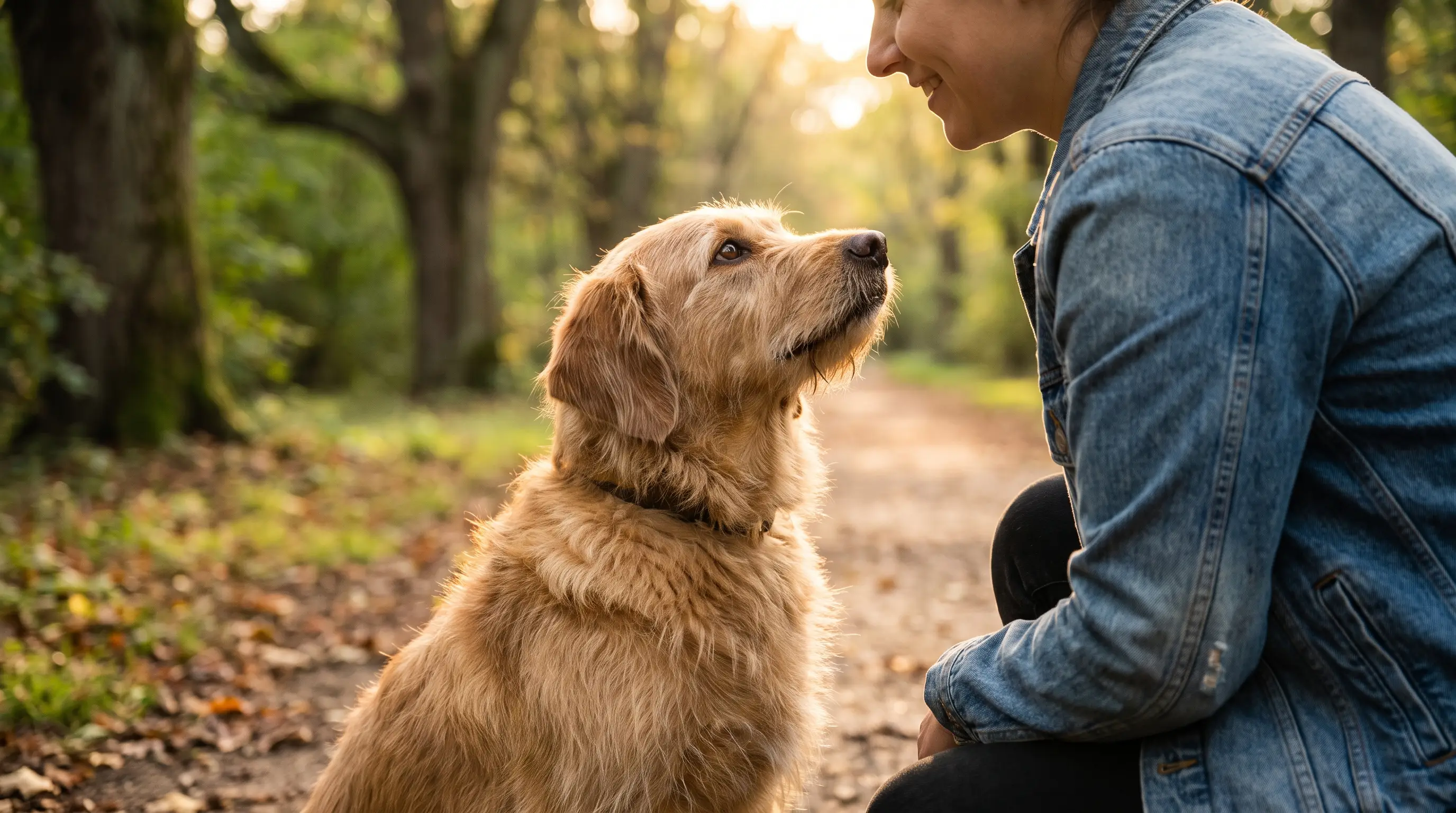
Do dogs love their owners? What the science measured
Whether dogs love us is one of the few questions about animal feelings that science has answered with instruments rather than opinions. Hormone assays, attachment tests borrowed from infant psychology, and dogs trained to lie still in brain scanners all point the same way: the bond is real, it is measurable, and it runs on the same chemistry as the bond between human parents and children. Here's what the evidence actually shows — and how to read it in the animal currently watching you from across the room.
The gaze loop: affection you can assay
The landmark result came from Takefumi Kikusui's lab in Japan, published in Science in 2015: when dogs and their owners simply looked into each other's eyes, oxytocin — the hormone that underwrites parent-infant bonding — rose in both of them, and the longer the mutual gazing, the bigger the rise. It's a feedback loop: the dog's gaze lifts your oxytocin, which makes you pet and talk to the dog, which lifts the dog's oxytocin, which produces more gazing. That is, chemically, the same circuit a human baby uses to bond with a parent — hijacked, over thousands of years of domestication, by another species. The control group is the telling part: hand-raised wolves, comfortable with their humans, didn't show the loop. Dogs didn't inherit this from wolves; they evolved it living with us.
The attachment test dogs keep passing
Developmental psychology has a standard instrument for measuring whether a child is attached to a caregiver: the strange-situation test, a scripted sequence of separations and reunions in an unfamiliar room. Run it on dogs — as researchers in Budapest first did systematically in the late 1990s — and dogs behave like securely attached toddlers: they explore a strange room more confidently when their owner is present, settle less for a friendly stranger, and greet the owner's return with unmistakable, directed enthusiasm. That's the technical meaning behind the phrase "secure base": the owner isn't just the food source, but the platform that makes the rest of the world approachable. Cats, for the record, pass a version of the same test — the evidence lives in do cats love their owners — but dogs do it with the volume turned all the way up.
Inside the scanner
Gregory Berns' group at Emory University spent years training dogs to lie motionless, unrestrained and awake, in an fMRI scanner — which made it possible to watch a dog's brain respond to its own life. Presented with five scents, the reward centre in the dogs' brains answered most strongly to one: the smell of their familiar human, outranking the scent of familiar dogs and even their own. In a later experiment the team pitted praise against food, and in most of the dogs the reward response to their owner's voice saying "good dog" was as strong as — in some dogs stronger than — the response to a piece of hot dog. That result deserves its own sentence, because it retires the oldest cynicism about dogs: for a large share of them, you are not merely the can opener. You are the reward.
What love looks like from the outside
Translated out of the lab, the bond shows up in behaviours most owners could list from memory. The greeting ceremony — and its intensity genuinely scales with how long you've been gone, which researchers have measured too. The lean against your leg, the flop that ends with contact, the sigh. The shadowing from room to room, which has its own logic covered in why dogs follow you, and the licking, which mixes grooming, greeting and taste — see why dogs lick you. Even the wag carries signal: dogs wag with a rightward bias at people and things they feel good about, part of the instrument panel explained in what a dog's tail is for. And the check-in — the glance back at you when something unexpected happens — is the secure base from the lab, running live in your kitchen.
Not unconditional — and better for it
The honest footnote is that "unconditional love" undersells what dogs actually do. The bond is attachment, and attachment is built: from predictability, from good things flowing through your hands, from play, from the thousands of small transactions in which you turned out to be safe. That's not a lesser kind of love — it's the same kind children build, and it means you can strengthen it deliberately (consistency, play, letting the dog make choices) and damage it the same way (fear and punishment teach a dog to monitor you, which photographs like devotion but runs on the wrong hormone entirely). Dogs also hold up their side of the relationship: they read our tone and faces, catch our stress, and in studies of comfort-offering they push through barriers faster to reach an owner who is crying than one who is humming. The animal watching you across the room is not running a food-acquisition script. It's checking on you.
Common questions
Do dogs actually love their owners?
By every measure science can bring to the question, yes. Mutual gazing raises oxytocin — the human bonding hormone — in both dog and owner; dogs treat their owners as a secure base in attachment tests designed for infants; and in brain scanners, a dog's reward centre responds to its owner's scent above all others, and to praise about as strongly as to food.
How do dogs show love?
Through the greeting ritual (whose intensity scales with your absence), leaning and contact-seeking, following you between rooms, soft eye contact, licking, the check-in glance when something startles them, and choosing to settle near you. Individually each has other explanations; together, aimed consistently at one person, they're attachment in plain sight.
Do dogs think of us as parents?
Functionally, something close. In the strange-situation test dogs behave the way securely attached toddlers do with a parent — exploring more bravely when the owner is present and greeting their return — and the oxytocin gaze loop dogs run with owners is the same circuit human infants use to bond. Dogs know you're not a dog; they've simply filed you as their safe person.
Does my dog know I love him?
It receives the message through the channels it reads best: a calm voice, soft eye contact, predictable handling, play and touch. The gaze loop works in both directions — your affection raises the dog's oxytocin just as its gaze raises yours — so the love is not just known, it's chemically shared. Yelling and unpredictability, by contrast, garble the signal faster than any missed walk.
Do dogs have a favourite person?
Often, yes. The favourite is usually whoever pairs positive experiences with predictability — play, training, calm handling — during the dog's socialisation window or daily life, and it isn't automatically the person who fills the bowl. Favouritism is also revisable: relationships with dogs are built from interactions, so the person who starts doing the walks and the play tends to climb the table.
Do dogs miss their owners?
The evidence says yes. Dogs greet owners more intensely after longer absences — measured, not just anecdotal — which requires registering that you were gone and caring that you're back. For most dogs this is healthy attachment; when missing you tips into panic, with howling and destruction at the exits, that's separation anxiety, which is a treatable problem rather than proof of extra love.
More in Dogs
Why do dogs eat grass? The myth, the data, the real risks
It's rarely self-medication and almost never a missing nutrient — the biggest survey ever run on grass-eating dogs retired both stories. What's actually going on, and when to pay attention.
Dog zoomies: why dogs suddenly sprint like maniacs
The tucked tail, the mad loops, the gleeful eyes — zoomies have a scientific name, a set of reliable triggers, and exactly one thing you shouldn't do about them.
Why do dogs howl? Sirens, solitude and the wolf inside
The howl is long-distance radio inherited from wolves — and no, the siren isn't hurting your dog's ears. What each howl broadcasts, and the one kind that's a message for you.
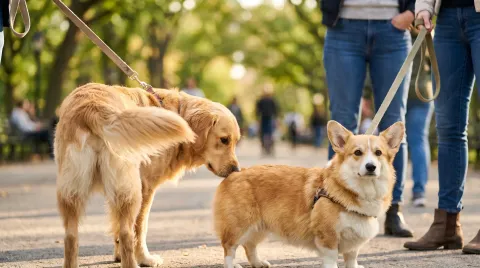
Why do dogs sniff each other's butts? The chemical handshake
It's not rude — it's the most information-dense greeting in the animal kingdom. What's actually in the message, the equipment that reads it, and the etiquette your dog is following.
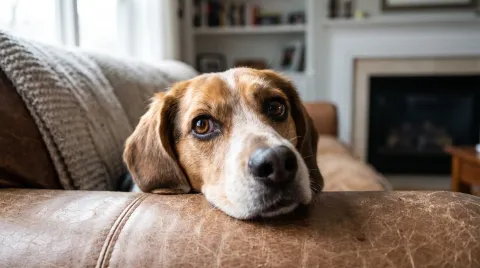
Why does my dog stare at me? Every stare, decoded
Affection, forecasting, negotiation, security detail — a dog's stare is never empty. What each one means, including the famous bathroom vigil, and the one stare to take seriously.
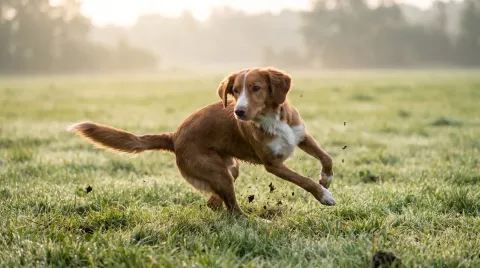
Dog body language: what your dog is really telling you
A wag is not always happy, and hackles are not always aggression. How to read the whole dog — tail, ears, eyes, mouth and posture — and spot stress before it becomes a bite.