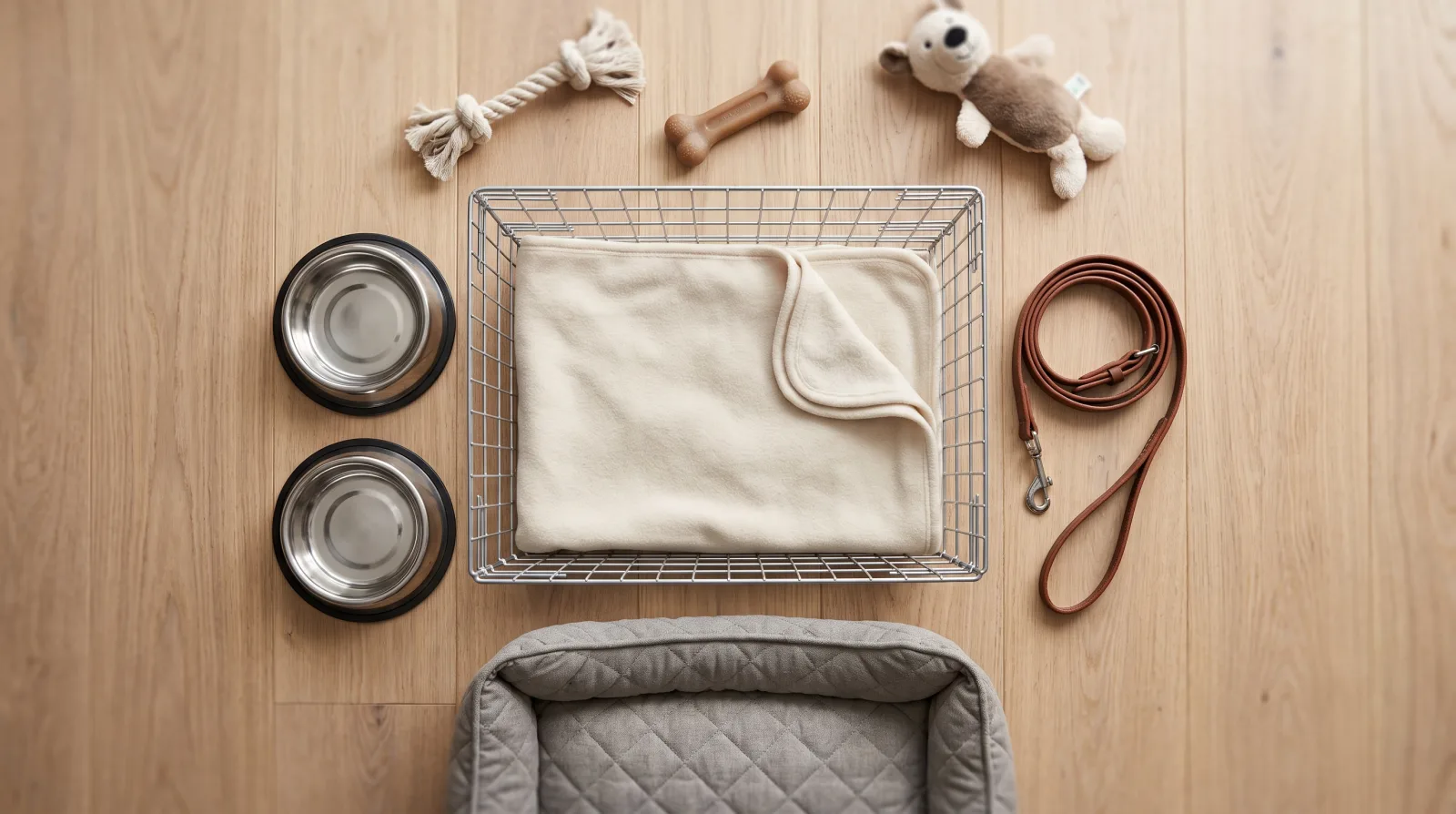
Leash training a puppy, from first steps to real walks
A puppy's first experience of a collar and lead sets the tone for years of walks, so the whole point is to make the gear boring before it is ever tested outside. Introduce the collar or harness alone first, then a dragging lead, then gentle guidance, and only then the front door — each step small enough that nothing about it feels like a fight. Rush straight to a busy pavement and you get a puppy that freezes, fights the lead, or learns to pull from day one. Here is the slower route that actually holds.
Start with the collar or harness alone, days before any lead
Before a lead ever gets involved, let your puppy simply get used to wearing a flat collar or, better for a growing puppy's neck, a well-fitted harness. Put it on for a few minutes at a time indoors, paired with treats, a meal, or a favourite game, and take it off again while things are still going well. A puppy that learns the gear itself predicts good things skips the classic freeze-and-scratch reaction that shows up when a collar arrives out of nowhere on walk day.
Check the fit properly: two fingers should slide under a collar or harness strap, no more and no less, and recheck it every couple of weeks as a growing puppy changes shape fast. A harness that clips at the chest rather than the throat is the gentler default for a young dog that has not yet learned to walk politely.
Attach the lead indoors first, and let it drag
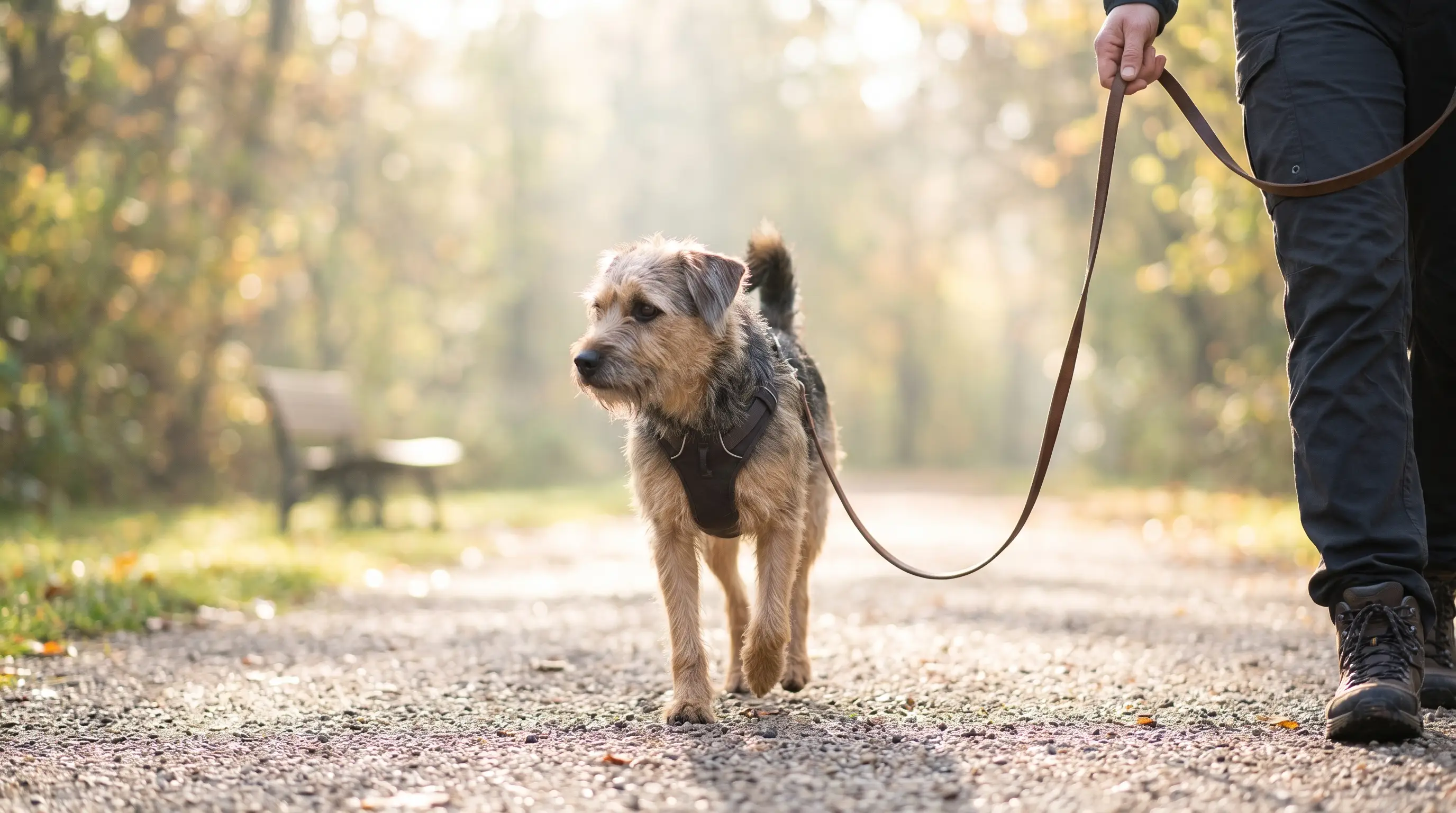
Once the gear itself is old news, clip on a light lead during a calm moment at home and simply let it trail on the floor. Do not pick it up yet. Let your puppy get used to the odd sensation of something following it around, and reward calmly for ignoring it rather than fixating on it or chewing it. A few short sessions like this, spread over a couple of days, is usually enough.
Only once the puppy is unbothered by the dragging lead should you pick up the other end. Keep the first few times you hold it completely undemanding — no pulling, no steering — just holding it while your puppy potters around a familiar room.
Teach "with me": reward position, not distance
With the lead in hand, take a couple of steps and reward your puppy for being near your leg, using a treat to guide it into position if that helps. You are teaching a spot to be in, not asking for distance or duration yet, so keep sessions to a couple of minutes at a time, first indoors, then in the garden or a quiet hallway. Mark and pay generously every time your puppy chooses to stay close, so being near you starts to feel like the best deal in the room.
Build up gradually — a few steps, then a lap of the garden, then a short loop — always ending on a success rather than pushing until your puppy loses interest or gets frustrated. Short and easy, repeated often, beats one long session every time at this age.
Take it outside — short, boring, low-distraction first
Pick a quiet street or a calm time of day for the first real outdoor walk, and expect it to be mostly sniffing and slow, meandering progress rather than a brisk stroll — that is completely normal and not bad walking. Stop and reward every time your puppy checks in with you or falls back into step. If your puppy plants its feet and refuses to move because something has spooked it, do not drag it forward; pause, wait, and let it choose to continue in its own time, rewarding the moment it does.
Keep early outdoor sessions short, five to ten minutes is plenty, and build duration and busier locations slowly over the following weeks as confidence grows. A puppy that has a calm, unhurried introduction to the outside world on a lead tends to become a far easier walking companion than one rushed straight into a crowded high street.
If your puppy already pulls, or comes from a line bred for it
Some breeds make loose-lead walking a harder project from day one, and it helps to know that going in. Sled breeds like the Siberian Husky and the Alaskan Malamute are bred to lean their whole body weight into a harness and pull, so pulling can appear early and with real strength — a front-clip harness and the loose-lead method from the very first walk pays off far more than waiting to see if it fixes itself. Scent hounds such as the Beagle or the Basset Hound get pulled off course by their own nose constantly, so shorter, lower-distraction routes and extra patience work better than expecting focus on a scent-rich pavement.
If pulling is already an established habit in an older puppy or adult dog rather than something you are preventing early, our full guide to loose-lead walking covers the stop-and-reward method in depth.
Common questions
What age can you start leash training a puppy?
You can start introducing a collar or harness indoors from the day a puppy comes home, around 8 weeks, well before any real walk. Keep the earliest sessions to wearing the gear and a dragging lead indoors, moving outside only once your puppy is relaxed with both.
Should I use a collar or a harness for leash training?
A well-fitted harness that clips at the chest is generally the gentler choice for a young, growing puppy, since it spreads pressure across the body rather than the neck. A flat collar works too for identification, but many trainers prefer the harness for the lead itself.
My puppy won't walk on a leash and just sits down — what do I do?
Don't drag a puppy that has planted itself; it is usually uncertain or overwhelmed rather than being stubborn. Crouch down, encourage gently with your voice or a treat, and let it choose to move at its own pace. If it happens often, the walk may be too long, too busy, or too soon after a lead was introduced.
How long does it take to leash train a puppy?
Getting comfortable wearing a collar or harness and a dragging lead often takes just a few days of short sessions. A genuinely calm, loose walk outside typically builds over several weeks, and longer still if your puppy is a natural puller or especially nervous about new experiences.
Why does my puppy bite the leash?
Leash biting is usually play, over-excitement, or mild frustration rather than aggression, especially in young puppies still mouthing everything. Stop moving and go still and boring until the biting stops, offer a toy as an alternative, and keep early sessions short enough that your puppy is not getting overtired or overstimulated.
See also
More in Dogs

How to crate train a puppy, step by step
Done right, a crate becomes the one place a puppy feels safest — not a cage. The reward-based method, the timing, and the mistakes that make a puppy hate it.
How to stop a puppy biting and mouthing
Puppy biting is normal, not aggression — and how you respond in the first months decides whether it fades or hardens. The reward-based fixes that actually work.
How to stop a dog barking too much
Barking is communication, not defiance, and the fix depends entirely on which of four reasons is driving it. The reward-based method for each, and why shouting or a bark collar usually makes it worse.
House training a puppy: the schedule that actually works
Most house-training failures are a supervision problem, not a stubborn puppy. The realistic age-based schedule, the signals to watch for, and how to recover from a setback.
How to socialize a puppy: the critical window, done right
A puppy's sensitive period for accepting new things as normal narrows sharply by around 16 weeks. What to expose it to, why every single experience has to end well, and where more is not automatically better.
Working dog jobs: the breeds behind the badge
Which breeds do police, detection, rescue and hunting work, and the drive that makes each one right for the job.