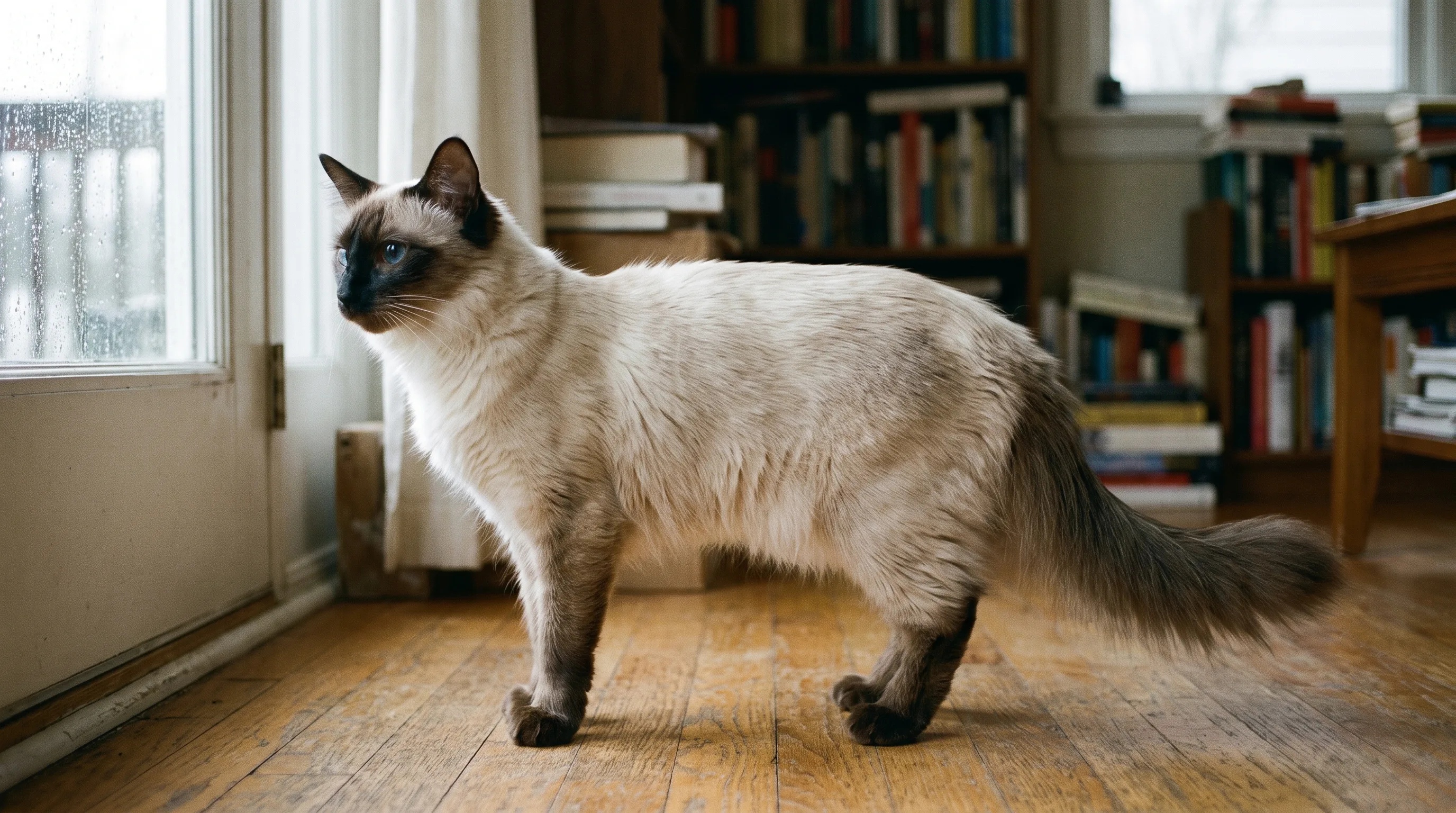
Balinese
A Siamese in a silk coat: same volume, same opinions, twice the tail.
On these lists: Hypoallergenic cats
Vital stats
| Size | Small · long-lined, fine-boned |
| Weight | 2.5–4.5 kg · males heavier |
| Life expectancy | 12–18 years |
| Energy | High — still playing at twelve |
| Shedding | Low — single coat, no undercoat |
| Coat | Long, silky, close-lying; pointed |
| Group | Longhair |
| Origin | United States |
Breed traits
Friendliness
Care
Mind
The Balinese by the numbers
The Balinese facts owners search for most — price, lifespan, weight, shedding and colours, in one place.
Less common, so expect a waitlist and some travel to a reputable breeder — which pushes the price up. Ongoing costs stay modest — it eats little and routine vet care sits at the lower end.
We don't quote a single figure: the real price swings with breeder, region, bloodline and health testing — and a rescue costs a fraction of a breeder's litter. Adopting is almost always the cheapest route.
Temperament
A Balinese has opinions and shares them, in the same loud cracked voice the Siamese is famous for. They follow you room to room, treat a closed door as a personal insult, and want to inspect whatever you have opened before they'll settle on your lap. They're clever — drawers, handles and cupboard doors are all solvable — and most learn fetch without being taught. The flip side is that they take badly to long days alone; this is a breed that does better in pairs, or in a household where someone is usually in. With children and confident cats they're easy company. With a nervous resident cat, less so: the Balinese does not know how to give anyone space.
Habits & quirks
Runs a commentary
Doors, dinner, your phone call — a Balinese narrates all of it, and gets louder if ignored. Quiet is not a feature of this breed.
Shoulder rider
Many learn to climb a leg and settle across the shoulders, which is charming until you are carrying something hot.
Brings it back
Throw a bottle cap or a crumpled receipt and it usually comes back. Fetch is close to standard equipment here.
Finds the warm spot
Radiators, laptops, the patch of sun that moves across the floor at four o'clock: a fine single coat means a Balinese feels the cold and plans around it.
Care
| Grooming | Easier than it looks. No undercoat means almost nothing to mat, so a comb once a week keeps the tail plume tidy and lifts dead hair. Shedding is light and year-round rather than seasonal. |
| Health screening | The Siamese lines behind the breed carry progressive retinal atrophy (a DNA test exists for the rdAc mutation) and systemic amyloidosis, which damages the liver. Ask a breeder for the PRA result in writing and for what the older cats in the line died of. |
| Company | Plan for it. A Balinese left alone from eight to six most days will overgroom, yell, or take an interest in your houseplants. Two cats, or a household with someone home, is the honest requirement. |
| Teeth | Oriental-type cats are prone to gingivitis and early dental disease. Start brushing while the cat is young and book a dental check into the annual vet visit rather than waiting for bad breath. |
Life expectancy
This breed has a typical life expectancy of 12–18 years.
Similar breeds
Breeds with a similar build and background — worth a look if this one isn't quite the fit.
Common questions
Is a Balinese just a long-haired Siamese?
Genetically, yes — it's the same cat carrying a recessive coat gene, and CFA judges it against a standard nearly identical to the Siamese apart from the coat. Registries differ on the rest: CFA recognises four point colours as Balinese and files the others as Javanese, while TICA counts them all as one breed.
Are Balinese hypoallergenic?
No. The claim follows them around because the coat sheds little and there's no undercoat, but reactions are to Fel d 1 in saliva and skin, and a Balinese makes it like any other cat. Some allergy sufferers do report an easier time with the breed; nobody has shown why, and it's not something to plan a purchase around.
Do they get on with dogs?
Usually well. A confident, cat-experienced dog is often the ideal flatmate for a Balinese — it supplies the constant company the breed wants, and the cat will happily boss it. Introduce slowly and give the cat high routes it can use to leave.
Does the Balinese shed a lot?
Not much. The Balinese is a low-shedding breed, so loose hair around the home stays minimal. It still needs regular grooming, but you won't be fighting drifts of fur.
Are Balinese cats good with children?
Usually yes. The Balinese is a sociable cat that tends to tolerate the noise and handling of family life better than most, which is why it comes up so often for homes with kids. It still needs somewhere high and quiet to retreat to, and children need teaching that a cat walking away is allowed to.
How much grooming does a Balinese need?
A weekly comb is usually enough for the Balinese, with a second pass during a seasonal moult. That keeps loose hair off your furniture and cuts down on hairballs, since everything the cat doesn't shed onto the sofa it swallows while washing.