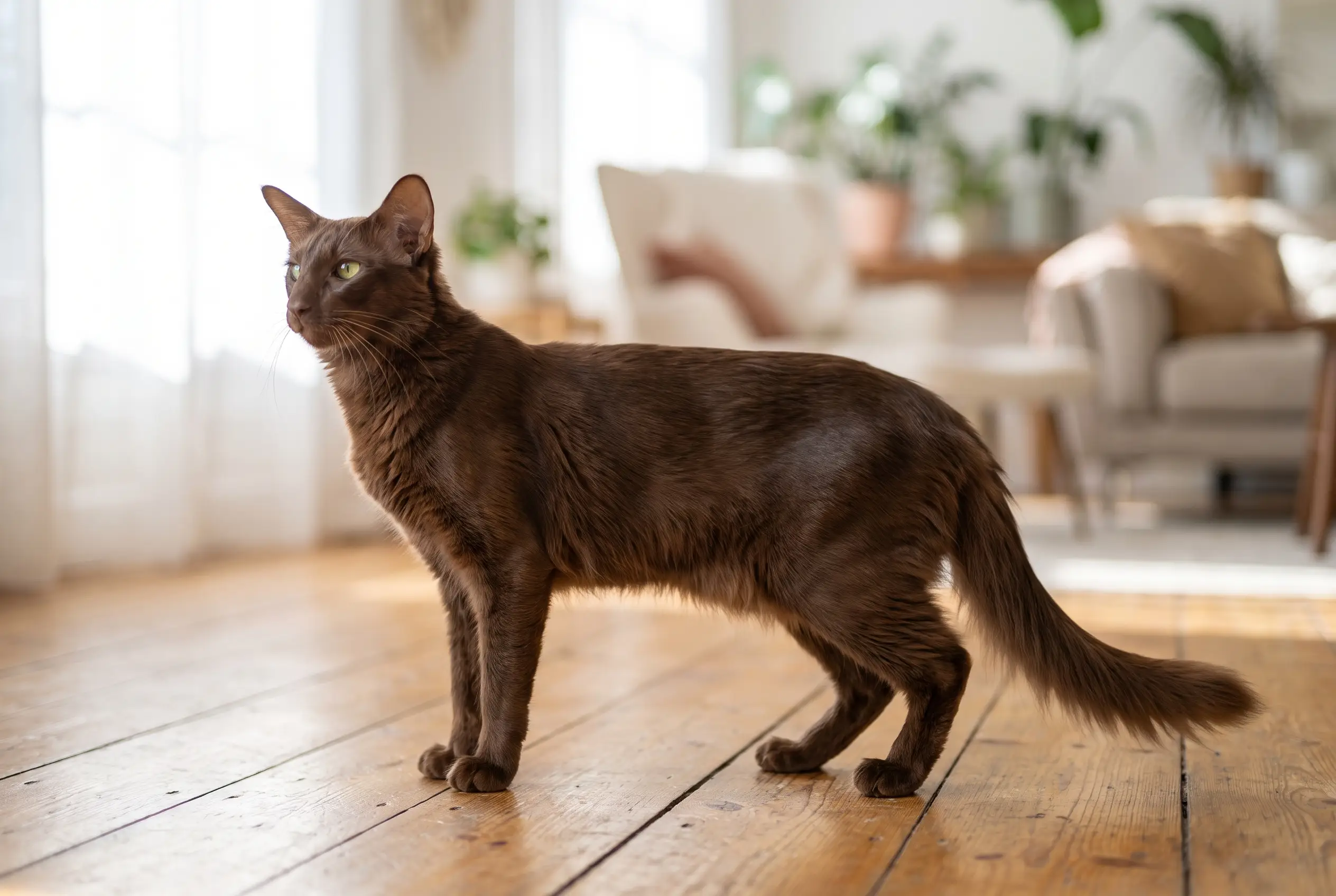
Oriental Longhair
A Siamese in a long silk coat, in almost every colour except pointed.
Vital stats
| Size | Small to medium · long, tubular, fine-boned |
| Weight | 2.5–5 kg · males heavier — breed literature, not standard |
| Life expectancy | 12–15 years — breed literature, not standard |
| Energy | Very high — climbs and talks all day |
| Shedding | Low — single coat, no undercoat |
| Coat | Medium-length, silky, single layer; 300+ colours, no points |
| Group | Longhair |
| Origin | United States / United Kingdom |
Breed traits
Friendliness
Care
Mind
The Oriental Longhair by the numbers
The Oriental Longhair facts owners search for most — price, lifespan, weight, shedding and colours, in one place.
Less common, so expect a waitlist and some travel to a reputable breeder — which pushes the price up. Ongoing costs stay modest — it eats little and routine vet care sits at the lower end.
We don't quote a single figure: the real price swings with breeder, region, bloodline and health testing — and a rescue costs a fraction of a breeder's litter. Adopting is almost always the cheapest route.
Temperament
An Oriental Longhair runs the house on its own schedule and expects you to keep up. It follows from room to room, comments on what you're doing in a hard, carrying voice, and treats a closed door as something to be argued with until it opens. Cupboard doors, drawer handles and bag zips all get investigated with a paw that works almost like a hand. They bond hard to one or two people and don't hide it — draped across a shoulder, wedged under an arm, or simply refusing to be in a different room. That devotion has a cost: left alone all day, this is one of the breeds most likely to overgroom or grow destructive, and a second cat or an attentive household matters more here than the coat length does.
Habits & quirks
Answers every question
Talk to an Oriental Longhair and it talks back, in the same hard, nasal Siamese voice, and it will keep the exchange going well past the point you meant to stop.
Opens what's closed
Cupboard doors, latch handles, zipped bags. A long fine paw and a lot of patience make most household catches temporary.
Flags its mood with the tail
The plume is more visible than the Shorthair's whip tail, so a happy cat broadcasts it — carried high and swishing, easy to read across a room.
Hunts the warm patch
A single coat with no undercoat means this cat feels the cold. Radiators, laptops and the afternoon sun get claimed on a schedule, and a closed door to a warm room is taken personally.
Care
| Grooming | Easier than the length implies. With no undercoat to mat, a comb once a week keeps the tail plume tidy and lifts loose hair; there's no seasonal blowout to plan around the way there is with a double-coated longhair. |
| Health screening | The Siamese ancestry behind this breed carries progressive retinal atrophy (the rdAc DNA test) and systemic amyloidosis, which damages the liver and has no test — ask what the older cats in the line died of, not just what the parents cleared. The wider family also runs a higher rate of feline asthma than most breeds; a cat with a chronic cough or wheeze needs it worked up, not written off as a hairball. |
| Teeth | Oriental-type cats develop gingivitis and periodontal disease young. Start brushing in kittenhood and put a dental check into every annual visit instead of waiting for bad breath to announce a problem. |
| Company | The real cost of this breed, not the coat. An Oriental Longhair left alone most of the day gets loud, then destructive, then licks itself bald along the belly and legs. Two cats, or a household where someone is usually around, is the honest baseline. |
Life expectancy
This breed has a typical life expectancy of 12–15 years — breed literature, not standard.
Similar breeds
Breeds with a similar build and background — worth a look if this one isn't quite the fit.
Common questions
Is the Oriental Longhair just a long-haired Oriental Shorthair?
Genetically, yes — same standard, same body, one recessive coat gene apart. What your paperwork calls it depends on the registry: CFA treats Oriental Longhair as a coat-length division of a single merged breed, the Oriental, so a shorthair and a longhair from the same litter are both registered as Oriental. TICA and GCCF register Oriental Longhair as its own breed name, separate from Oriental Shorthair.
What's the difference between an Oriental Longhair and a Balinese?
Points, not coat. Both carry the same medium-length, single-layer coat from the same recessive gene, and both can turn up in the same litter out of carrier parents. A Balinese is the pointed version — pale body, darker face, ears, legs and tail, blue eyes, judged as a colour-restricted Siamese. An Oriental Longhair is everything else: solid, shaded, smoke, tabby, bicolour and particolour, in green, gold or odd eyes, with no point pattern at all.
Doesn't a long coat mean a lot of brushing?
Less than it looks. The coat is a single layer with no undercoat, so it doesn't felt or mat the way a Persian's does — a weekly comb is the actual maintenance. That's the practical case for choosing this breed over a double-coated longhair: most of the look, a fraction of the work.
Does the Oriental Longhair shed a lot?
Not much. The Oriental Longhair is a low-shedding breed, so loose hair around the home stays minimal. It still needs regular grooming, but you won't be fighting drifts of fur.
Are Oriental Longhair cats hypoallergenic?
No cat breed is truly hypoallergenic. The trigger is Fel d 1, a protein in a cat's saliva and skin that transfers to the coat during grooming and then travels on loose hair and dander — so a cat that sheds less, like the Oriental Longhair, spreads less of it around the house, but still produces it. If someone at home reacts to cats, spend real time with this breed before deciding, and no breeder should promise you an allergy-free cat.
Are Oriental Longhair cats good with children?
Usually yes. The Oriental Longhair is a sociable cat that tends to tolerate the noise and handling of family life better than most, which is why it comes up so often for homes with kids. It still needs somewhere high and quiet to retreat to, and children need teaching that a cat walking away is allowed to.