Where cat breeds come from, and why there are so few
There are far fewer cat breeds than dog breeds, and most of the ones that exist were invented in the last hundred years. Registries recognise somewhere around 45 to 75 cat breeds depending on how you count; the big dog bodies list two hundred and up. The reason is not that cats are less varied by accident. It is that we spent thousands of years asking dogs to do jobs and mostly left cats to be cats. When people finally did start breeding them on purpose, they bred for looks, and they started late.
Why cats never sprouted the variety dogs did
Dogs diverged so wildly because we made them work, and cats mostly didn't have to. A collie was shaped to move sheep, a mastiff to guard, a sighthound to run down game, a sled dog to haul across ice. Each job pulled the body in a different direction over centuries, and the extremes compounded. That is how you end up with a species where a Great Dane and a Chihuahua are the same animal. The Victorian stud book then froze those differences into named types, which is a separate story worth reading in how breeds were invented, and the way the working, herding and toy divisions were drawn is its own tangle, told in how the breed groups were drawn.
Cats had exactly one job, and they did it without instruction: they killed rodents around grain. Nobody needed a specialist cat for the barn and a different one for the ship. A good mouser was a good mouser. So for most of the domestic cat's history there were no breeds at all, only regional free-living populations, the feline version of the free-breeding village dogs that are still the global default for dogs today. Selection for appearance, the thing that actually makes a breed, barely happened until cat shows arrived in the late nineteenth century.
A thin, recent layer on an ancient animal
The genetics say cat breeds are shallow and young, sitting on top of a much older domestication. The cat itself descends from the African wildcat and moved in with people in the Near East thousands of years ago, a deep-time backstory covered in its own article on the African wildcat. Everything below is about the thin recent layer of breeds laid over that ancestry, not the domestication itself.
The landmark study is Lipinski and colleagues, "The ascent of cat breeds", published in Genomics in 2008. They genotyped more than 1,100 cats across 22 breeds and 17 random-bred populations on five continents. Two findings matter here. First, most breeds derive from the local random-bred cats of the region they claim as home, which means a breed is usually just the neighbourhood cat with a standard written around it. Second, pure breeding measurably cut genetic diversity, and the loss did not track with how old a breed was said to be. That last point is the quiet killing of a lot of marketing copy: an ancient-sounding pedigree does not show up in the DNA as ancient.
The natural breeds are landraces with paperwork
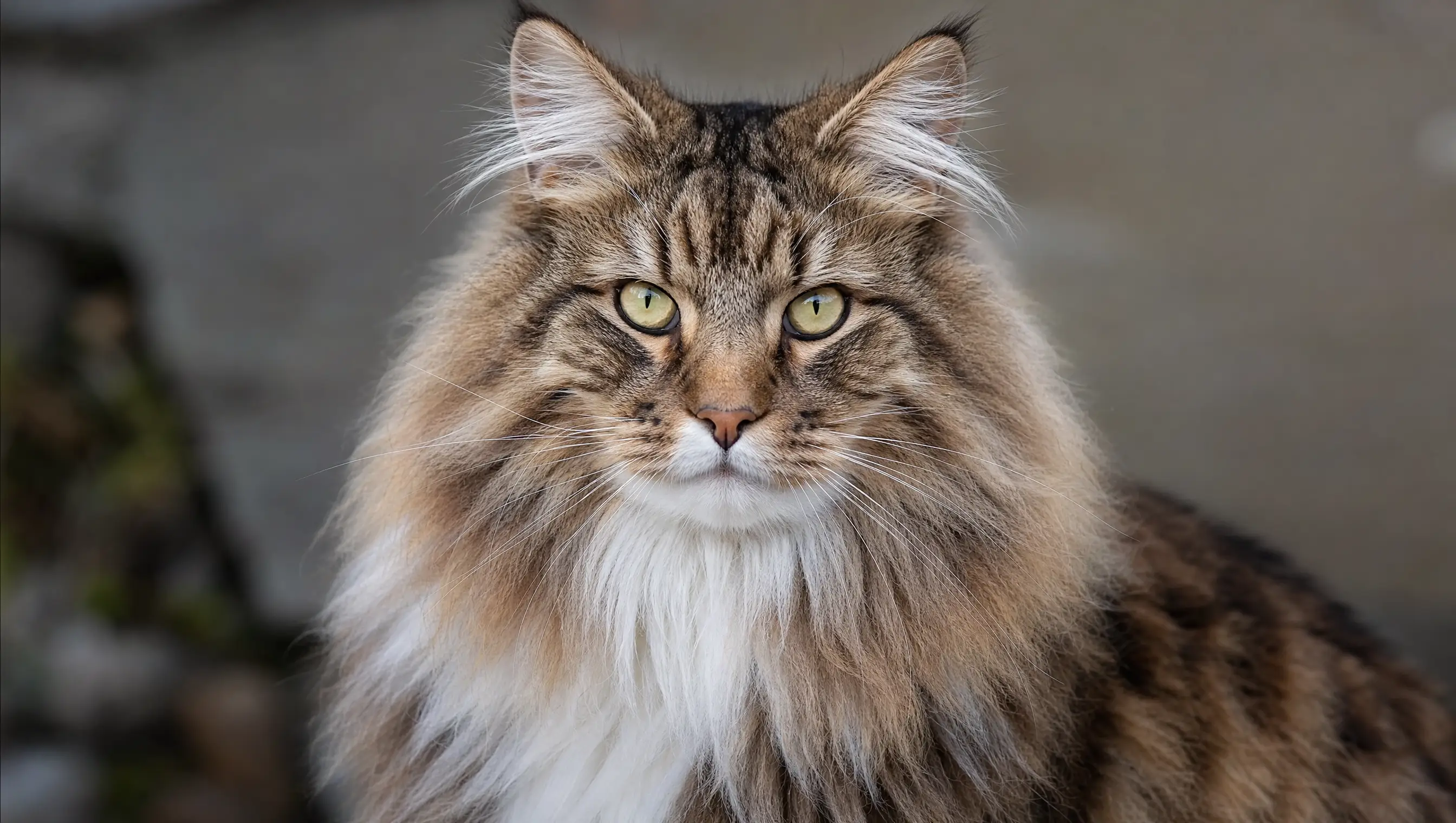
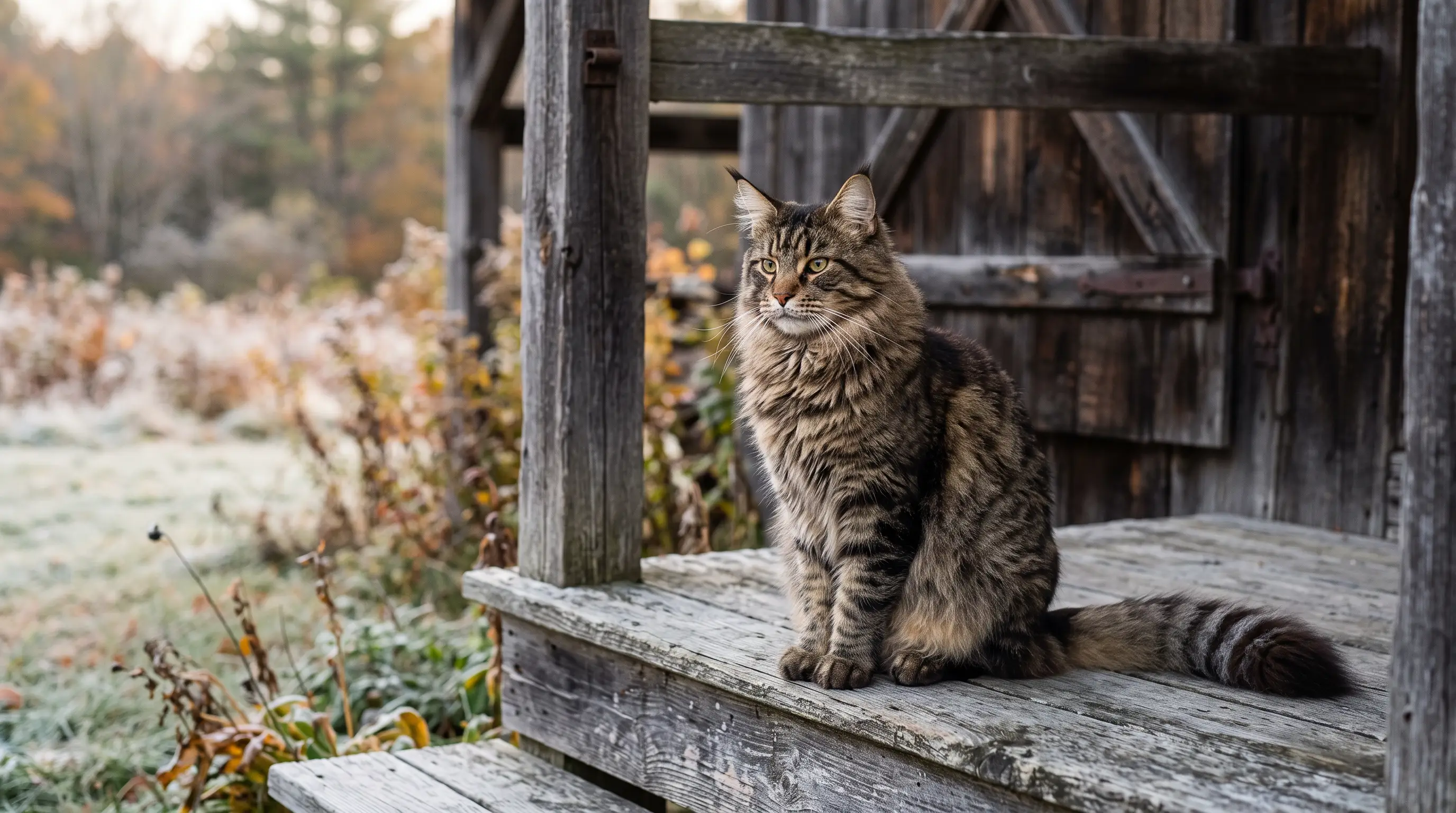
The breeds people call natural are landraces that were already there, then had a standard drawn around them. A landrace is a population shaped by climate and local life rather than by a breeder's plan, and the classic cats fit the description exactly. The Maine Coon is a North American farm cat that grew large and shaggy in a cold climate long before anyone registered it. The Norwegian Forest Cat is the same idea in Scandinavia, a cold-adapted native type that FIFe only formally recognised in the 1970s.
Turkey gives us two more. The Turkish Angora and the Turkish Van are Anatolian landraces; the modern show Angora was essentially rebuilt from a pair brought out of Ankara Zoo in 1962. The honest way to read all of these is that the cat came first and the breed came after. That is the same relationship dogs have with their landraces, and it is why the free-breeding village dogs are the closest dog parallel to how most cats lived until very recently.
The made cats: Ragdoll, Bengal, Sphynx, the Rexes
The other half of the list is cats built on purpose, mostly since the 1960s, and often from a single founder animal or a single mutation. The Ragdoll is the clearest example: Ann Baker created it in Riverside, California in the 1960s from a domestic longhair called Josephine. There is no ancient Ragdoll. It is a designed breed with a documented start date and a named person behind it.
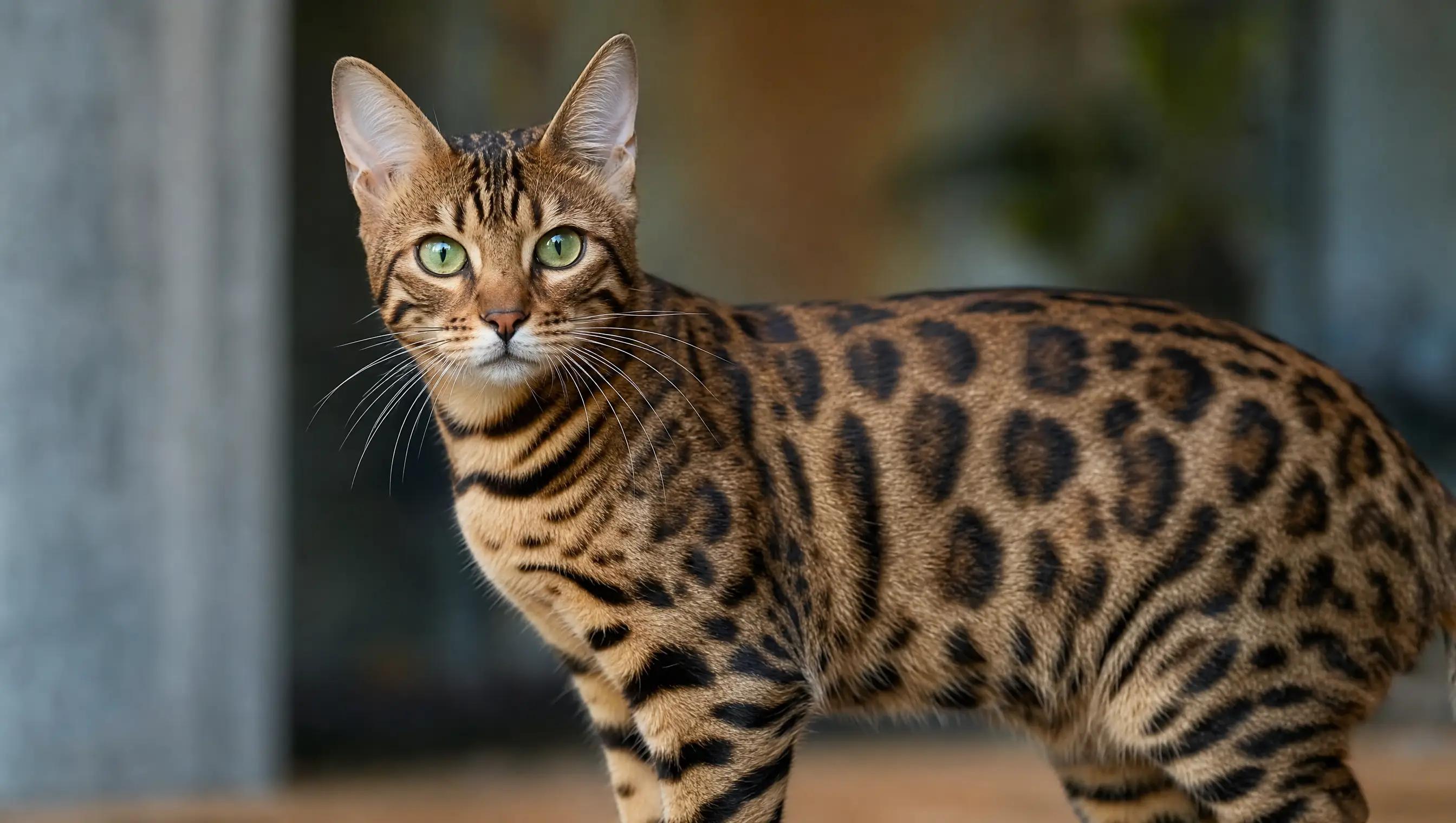
The Bengal goes a step further and reaches outside the species, crossing the domestic cat with the Asian leopard cat. The founding hybrids trace to Willard Centerwall's 1960s immunity research, and Jean Mill developed them into a breed from around 1980. That wild-hybrid route has its own complications, set out in the piece on wildcat hybridisation.
The hairless and curly cats are pure mutation stories. The Sphynx comes from spontaneous hairless kittens carrying a recessive change in the KRT71 gene, first noted in a Toronto kitten called Prune in 1966 and then rebuilt from separate 1970s mutations in Minnesota and Toronto. The Cornish Rex of the 1950s and the Devon Rex, which appeared in Buckfastleigh, Devon in 1960, are two different curly-coat mutations that look similar. Breeders proved they were different genes the hard way: crossing the Devon founder Kirlee with a Cornish Rex produced straight-coated kittens, which would not happen if the two carried the same mutation.
How many cat breeds are there, really
There is no single number, because each registry decides for itself what counts, so the honest answer is a range. As of 2026, the Cat Fanciers' Association recognises roughly 45 breeds, the UK's GCCF about 45, FIFe around 50, and TICA the most at roughly 71 to 75. Treat any exact figure as a snapshot that will drift as registries add or merge breeds. Compare that with dogs: the FCI lists somewhere around 340 to 360 breeds, the American Kennel Club about 200, and the UK Kennel Club around 210. However you slice it, cats sit at a fraction of the dog total. If you want to see how these bodies differ in what they accept, the registries page lays it out, and the full cat list lives at our cat breeds alongside the whole collection.
The oldest cat breed is a story, not a fact
The idea that any living breed is thousands of years old does not survive contact with the genetics. You will read that the Egyptian Mau is the oldest cat breed, roughly 4,000 years, on the strength of spotted cats in tomb paintings. It is a lovely claim and it belongs in the folklore drawer, not the evidence drawer. Egyptian art tells us Egyptians kept spotted cats; it does not tell us today's Mau is a continuous line from them, and the Lipinski work found breeds to be recent and shallow regardless of the age they advertise. Ancient cat imagery is real, but a breed is a modern construct.
Dogs have the same problem with the same shape, which is worth reading in which dog breeds are genuinely old: a handful of dog lineages really do sit deep in the tree, but most old-breed claims are branding. With cats the deflation is even sharper, because the whole idea of a cat breed is barely a century and a half old. The animal is ancient. The breed is not.
Common questions
Why are there fewer cat breeds than dog breeds?
Because dogs were bred for many working roles, herding, hunting, guarding and hauling, which pulled their bodies in wildly different directions, while cats were mostly kept as mousers and only bred for appearance recently. Registries list roughly 45 to 75 cat breeds against 200-plus for dogs.
How many cat breeds are there?
There is no single number; it depends on the registry. As of 2026 the CFA recognises around 45, GCCF about 45, FIFe around 50 and TICA the most at roughly 71 to 75. Treat any figure as a snapshot.
What is the oldest cat breed?
No living breed is reliably ancient. The Egyptian Mau is often called the oldest at around 4,000 years, but that rests on tomb art, not genetics, and the DNA shows cat breeds are recent and shallow. It is best read as folklore.
What is a natural cat breed?
A natural breed is a landrace, a population shaped by regional climate and life rather than a breeder's plan, that later had a standard written around it. The Maine Coon, Norwegian Forest Cat and Turkish Angora are the usual examples.
Are Ragdoll cats a natural breed or man-made?
Man-made. Ann Baker created the Ragdoll in Riverside, California in the 1960s from a domestic longhair called Josephine. It has a documented start date and no ancient lineage.
Why are Sphynx cats hairless?
Because of a spontaneous recessive mutation in the KRT71 gene, first recorded in a Toronto kitten in 1966. The modern breed was built from later hairless mutations in Minnesota and Toronto in the 1970s.
See also
More in Cats
Why is my cat spraying? What it means and how to stop it
Spraying isn't a litter-box failure — it's a message about territory, written in urine. How to tell it from peeing, what's behind it, and the fixes that hold.
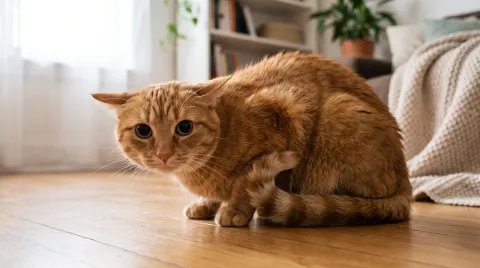
Why is my cat aggressive? Causes and how to calm it
Cat aggression isn't a personality — it's a diagnosis with about six usual suspects, and each one has a different fix. Work through them in order and the biting usually explains itself.
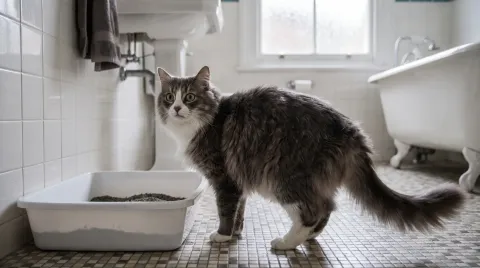
Why is my cat pooping outside the litter box? Causes and fixes
Poop on the floor has a different list of suspects than pee on the wall — urgency, pain, an unreachable tray, or (rarely) an actual message. Here's the order to check them in.
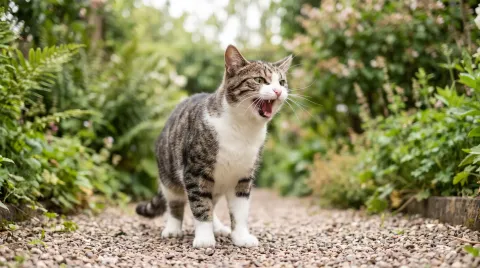
Why do cats hiss? What it means and what to do
A hiss is not an attack — it's the thing a cat does to avoid one. What the sound actually is, what triggers it, and why the polite answer is always to back off.
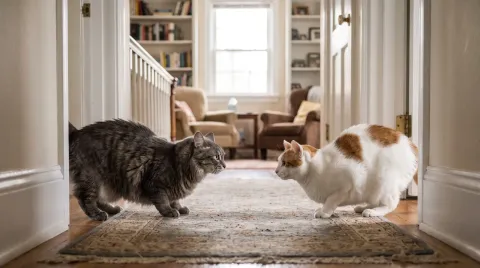
Why are my cats fighting? How to restore the peace
Two cats that shared a bed for years can turn into enemies in an afternoon. What breaks a feline relationship, why 'letting them fight it out' entrenches the war, and the reset that works.
How neutering changes cat behavior — and what it won't fix
Neutering deletes the hormone-driven behaviours — the roaming, the spraying, the 3am opera — and touches almost nothing else. What changes, what doesn't, and when.